Discovery
-
 eDiscovery, Litigators, Technology
Let The Rules Guide You In eDiscovery
No matter how long you've been practicing, sit down and read the rules on electronic discovery, comments included. -
 Labor / Employment, Litigators, On The Job
1 Weird Trick to Avoid Sanctions
Courts around the country are rapidly losing patience with boilerplate objections to written discovery requests.  Sponsored
Early Adopters Of Legal AI Gaining Competitive Edge In Marketplace
How to best leverage generative AI as an early adopter with ethical use.-
 Document Review, eDiscovery, Technology
Time To Change Your eDiscovery Mindset
New columnist Kelly Twigger dispels a few myths about ediscovery.
-
Benchslaps
Judge Peck Gets Saucy Over Lazy Filings
“Let us count the ways the defendants have violated the rules.” -
 Morning Docket
Morning Docket: 02.16.17
* Are federal authorities investigating Fox News? [Law360]
* Has Trump made law school “cool again”? No. Law school was never cool. [Quartz]
* What do you know? Looks like some firms are finally waking up to the fact that they didn’t have good years and really couldn’t afford to jack up associate salaries. [ABA Journal]
* That said, Davis Polk just had its self-described “best year ever.” Did nobody tell these people Bowie died? [Am Law Daily]
* Judges say they understand technology, but contradictory rulings about discovery and “the cloud” may say otherwise. [Law.com]
* The litigation finance industry is leery of class actions. Should they be? [The Recorder]
* Then again, maybe it won’t matter because this Congress is trying to gut class actions by making it next to impossible to find lawyers willing to take on these cases. [Forbes]
* Hofstra Law is opening a clinic to serve immigrants dealing with deportation. [Newsday]
* Nobody actually likes the Rams or Chargers. That’s why Biglaw is in deep with a gaggle of antitrust suits brought by the people of Los Angeles over having to buy NFL Sunday Ticket. [Law.com]
-
 Constitutional Law, Politics
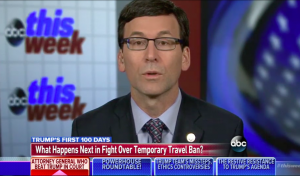
Washington AG Will Use Discovery To Delve Into The Motives Behind The Travel Ban
I'm looking forward to a Trump deposition. -
 Non-Sequiturs
Non-Sequiturs: 01.26.17
* True confessions of a Biglaw partner. [Law Practice Today]
* If you could prevent one person on Trump’s shortlist from getting on the Court, who would it be? [Slate]
* Will President Trump, or in the alternative, Congress, do anything about the bane of lawyers’ existence: discovery? [The Hill]
* Tim Kaine had some pretty cool alternate plans on inauguration day. [Huffington Post]
* The Netherlands’s safe abortion fund. [The Slot]
* Forever 21’s fighting infringement. [The Fashion Law]
* If you’ll be in Philly on Monday the 30th, please come to “Fred Korematsu Day: A Conversation,” featuring Kermit Roosevelt, author of Allegiance (affiliate link), and our very own David Lat. [Japan America Society]
-
 Federal Judges, Litigators
Federal Judges Sound Off On Discovery
Federal judges are sick and tired of having to resolve all your discovery disputes because you can't settle them on your own like grown-ups.  Sponsored
Navigating Financial Success by Avoiding Common Pitfalls and Maximizing Firm Performance
In this CLE-eligible webinar, we’ll explore the most common accounting pitfalls and how to avoid them for your firm.-
 In-House Counsel, Litigators
5 Tips For In-House Lawyers To Make Discovery Less Painful
Discovery doesn't have to suck (well, at least as much as it so often does). -
 Non-Sequiturs
Non-Sequiturs: 07.20.16
* Will Pokémon Go open up a battlefield of legal troubles for Nintendo? [Ohio State Bar Association]
* Better Call Saul’s Jimmy McGill is a great example of the trickster lawyer. [Guile is Good]
* ComicCon is coming, and most of the vendors owe a lot to the doctrine of fair use. [ReCreate Coalition]
* A soured love affair turns into sanctions for discovery violations. [Legal Profession Blog]
* Lawyers get a reputation for being slow to change, but you need to adapt to a changing landscape. [Reboot Your Law Practice]
-
 Boutique Law Firms, Litigators, Small Law Firms
Beyond Biglaw: 3 Tips For Discussions With Opposing Counsel
Columnist Gaston Kroub advises lawyers on how to make the most of the opportunity every single time they actually speak to opposing counsel. -
 Non-Sequiturs
Non-Sequiturs: 01.12.16
* Even at a conference, Judge Easterbrook can be intimidating. [Business Law Prof Blog]
* Boeing filed a patent to make air travel slight less hellish. Good luck with that. [Travel and Leisure]
* Judge plans to stick Ammon Bundy’s merry band of militia men playing terrorist out in the woods with the bill for their security… to the tune of $70,000 a day. [Raw Story]
* Josh Duggar is such a loser he is even losing discovery battles like a pro. [Radar]
* Lawyer Eric Macleish played a role in the legal battles over child abuse by Catholic priests in Boston (as recounted in the movie Spotlight). Whether he was a villain or victim in the saga is still up for debate. [Guile is Good]
* Is it possibly true that you can really discharge student loan debt in bankruptcy? [My Bank Tracker]
* If you’re goofing off by pretending to work from home, don’t give yourself away. [Daily Lawyer Tips]
-
Litigators, Technology
Everything You Need to Know About The New FRCP Amendments
Columnist Jeff Bennion offers an overview of the most significant changes and what you need to know.
Sponsored

Is The Future Of Law Distributed? Lessons From The Tech Adoption Curve

Legal AI: 3 Steps Law Firms Should Take Now
Early Adopters Of Legal AI Gaining Competitive Edge In Marketplace
Sponsored
Navigating Financial Success by Avoiding Common Pitfalls and Maximizing Firm Performance

The Business Case For AI At Your Law Firm

-
Crime
Criminally Yours: The Black Hole Of Discovery
The decision to plead guilty is often made in the dark, based on fear and a shortage of information. Why does this happen? -
Non-Sequiturs
Non-Sequiturs: 07.08.15
* Time Warner Cable owes $229,500 for incessantly calling a woman after she demanded that they stop. Hm. Maybe this isn’t the right time to launch my new “Happy Dude” scam. [Reuters]
* Tom Selleck in hot water for allegedly stealing truckloads of H2O in the midst of California’s drought. Claims he’s just the caretaker and the authorities really need to check out Robin Masters. [LA Times]
* In the wake of Judge Kopf’s comments on Sen. Ted Cruz, Professor Kerr has found actual precedent involving Second Circuit Judge Guido Calabresi discussing George W. Bush. [The Volokh Conspiracy / Washington Post]
* Law firm tax practice rankings are here! [TaxProf Blog]
* Is your website optimized to sell your firm? [Law and More]
* Have you ever invoked Rule 27 of the FRCP? Do you even know what it says? [What About Clients?]
* Studying for the bar exam in GIF form. [Thought Catalog]
* In case you missed our recent Weed Law symposium, you can now listen to the entire presentation here. [Legal Talk Network]
-
Attorney Misconduct, Biglaw, Legal Ethics
Biglaw Partner And Associate Destroyed Evidence, Suborned Perjury
What Biglaw firm is in hot water for ordering the destruction of dox? -
Morning Docket
Morning Docket 05.15.15
* Lance Armstrong is feuding, again, with former teammate Floyd Landis — this time over discovery [National Law Journal]
* Remember July 2014 when we all learned that ExamSoft — the bar examination software — totally crapped out on test takers? Yeah, they just reached a $2.1 million settlement. #NeverForgetBarghazi [Law360]
* Rejoice haters of measles and other preventable diseases! California is moving to end “personal belief exemptions” for mandatory vaccines. [NPR]
* In oral arguments for an appeal of the conviction of Jesse Litvak, a bond trader convicted of securities fraud involving government bailout funds, the Second Circuit was skeptical over the fairness of the trial. [New York Law Journal]
* The FDA finally arrives in the year 2015; plans to ease restrictions on gay blood donors. [Jurist]
* Senate Judiciary Committee recommends prosecutor Robert Capers the next U.S. Attorney for the Eastern District of New York, filling Attorney General Loretta Lynch’s vacancy. [Wall Street Journal]
* An analysis of who the winners will be under Google’s new plan to buy up patents before the trolls. [JD Supra]
-
Litigators, Technology
Your Edge In Litigation Depends On How You Organize Your Case
Cases are won primarily by two factors 1) how smart your team is, and 2) how organized it is. You can’t really do much to control factor one, but factor two is entirely in your control. -
Federal Judges, Rudeness
This Pissed-Off Judge Is Really Sick Of Discovery Disputes
The judge was so annoyed with the litigants in this case that she wrote a rather sarcastic ruling. -
Biglaw, Litigators, Technology
alt.legal: My Overreaction To Potentially Sane Discovery Policies
What will the impact of "proportional" discovery be on the legal industry?
