FOURTH AMENDMENT SECURITY — PRESS RELEASE
Two law professors have launched a website (FourthAmendmentSecurity.com) and public education project to teach the Fourth Amendment through LAWn signs. These LAWn signs are actual yard signs—and soon to be bumper stickers, magnets, and more—that teach constitutional law.
The project is the brainchild of Stephen E. Henderson, the Judge Haskell A. Holloman Professor of Law at The University of Oklahoma, and Andrew Guthrie Ferguson, a law professor at the UDC David A. Clarke School of Law in Washington D.C. The two professors have several aims, the foremost being to encourage citizens to learn about their Fourth Amendment rights.

Beyond Recall And Precision: Strategic Oversight Of AI Managed Review
AI can accelerate document review, but metrics alone aren't enough. Learn how Managing Attorney oversight turns AI-driven review into a more adaptive, strategic and defensible process.
“We would love to cover the lawns of America with statements about Fourth Amendment security,” Henderson said. “Our hope is that citizens will thereby learn, think—ideally laugh a bit—and better engage with their constitutional rights.”
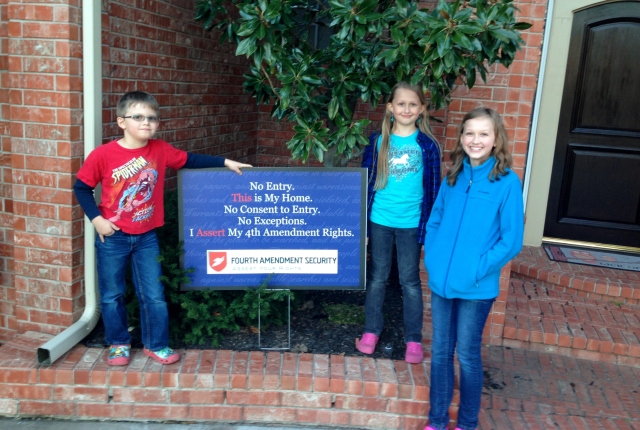
The project arose out of a forthcoming article appropriately titled LAWn Signs: A Fourth Amendment for Constitutional Curmudgeons, to be published in the Ohio State Journal of Criminal Law. “We write lots of articles,” noted Ferguson, “and articles are good in their sphere. But obviously ordinary Americans do not read law review articles, and these rights are for ordinary Americans. So, we wanted to do something more.”
According to the public website, the article arose out of a Supreme Court Case – Florida v. Jardines – that addressed whether police could walk a drug-sniffing dog to a homeowner’s front door. The Supreme Court decided in the negative, but based its holding on what they called the “implicit license” to approach homes, which required analyzing “the social customs of peddlers, pamphleteers, aluminum-siding salesmen, and girl scouts.” The obvious response to such an admittedly odd decision is to change the implicit license by explicit signs (LAWn signs). So in a serious, but not to be taken too seriously way, Professors Henderson and Ferguson came up with a practical response for ordinary people.
In its Frequently Asked Questions, one is whether LAWn Signs are a joke or a serious project, to which the professors reply, “Maybe a bit of both. We certainly expect many will purchase LAWn Signs to humor their friends and neighbors, or to antagonize their parents. But as a program of civic education, sometimes pointing out the absurdity of a situation is the best way to educate people.”

Managing Partners are Navigating the AI Inflection Point.
New executive research from Ari Kaplan explores how law firm leaders are responding to changing client expectations, evolving economics, talent transformation, and AI governance.
And the serious side of the project was highlighted this month when the Tenth Circuit Court of Appeals decided United States v. Carloss, in which the federal appellate judges debated the constitutional significance not only of the defendant’s “No Trespassing” signs, but also of hypothetical signs more like those available for purchase on the LAWn Signs website.
“In a country where people rightly love the Constitution, but too often do not understand its rights,” said Henderson, “we aim to marginally improve the situation. If our lighthearted but constitutionally-serious campaign can do that, we will be very pleased.”
More information on the campaign and its signs can be found at the Fourth Amendment Security website.
David Lat is the founder and managing editor of Above the Law and the author of Supreme Ambitions: A Novel. You can connect with David on Twitter (@DavidLat), LinkedIn, and Facebook, and you can reach him by email at [email protected].