 Ed. note: This article is part of the Introduction to Law School series, powered by Thomson Reuters.
Recently we asked you which of the myriad extracurricular options available to law students — journals, moot court, clinics, student government, and so on — are most likely to help you land a job. We had an excellent response; more than 1,200 of you weighed in, and today we share our findings.
Our survey had two components. First, we asked you to rate, on a scale of 1-10, the relative “prestige” — i.e., the value added to a student résumé in the eyes of a potential employer — of the various categories of law student extracurricular activities. Here are your ratings:
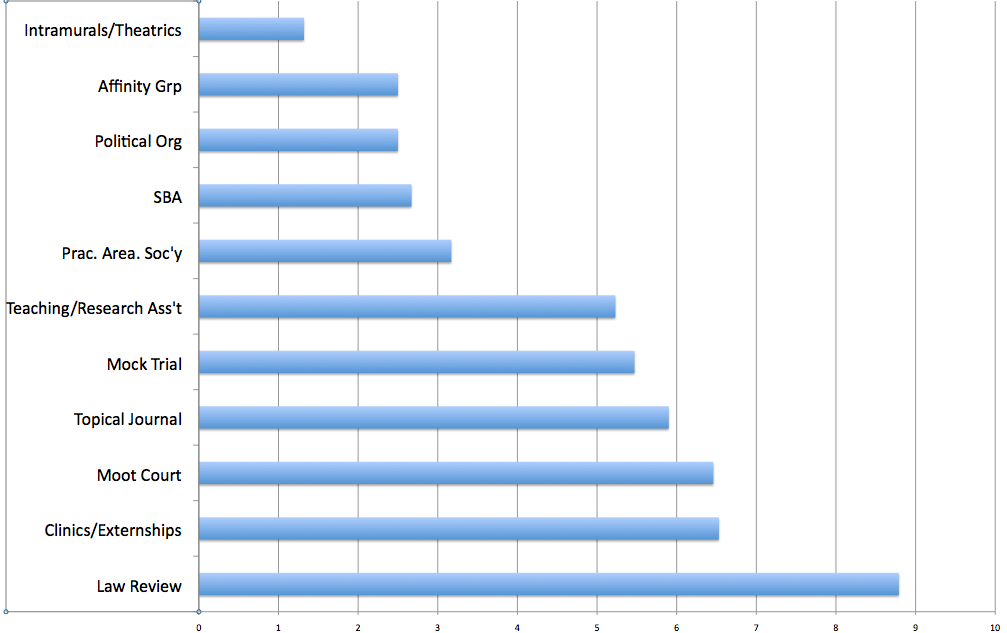
While it is certainly no surprise that law review experience is the most highly prized, the degree to which it was valued more than any other activity is something some might find striking. On our 10-point scale, law review’s mean rating was 2.5 points higher than any other, in an exclusive tier of its own. But chances are, you’re not getting on law review. So now what?
Other activities fall into two other distinct tiers. The “mid-tier” comprises clinics, moot court, secondary journals, mock trial, and research/teaching assistantships. The bottom tier is made up of practice area societies, SBA, political and affinity organizations, intramural sports, and student theatrics. A few other observations:
- Topical or secondary journals are not “runners-up” to the law review — their perceived value is clearly behind moot court and clinics/externships.
- When we separate the perceptions of attorneys from those of students, we see that practicing lawyers value clinics/externships consistently higher than moot court experience. For students, the reverse is true.
- The one other instance where lawyers and students disagreed on ordinal rankings, was political organizations (e.g., Federalist Society) versus affinity groups (e.g., BLSA). Lawyers prized affinity groups higher — and political groups lower — than current students.
The second piece of our survey asked you to place in order of relative value, a series of generic hypothetical résumé items:
1. Editor-in-chief of law review at a mid-tier school (mean = 1.30)
2. Staff of environmental law journal at a top 14 law school (2.03)
3. Housing clinic at midtier school (3.36)
4. Moot Court captain at unranked school (4.02)
5. SBA president at a tier 3 school (4.28)
(“Mean” refers to the ordinal rank assigned by respondents for each of the five items.)
For this question, there was no significant difference between lawyers and students in the relative value of the options. One way to characterize what we see here is a sort of rough hierarchy of Law review EIC wherever > T14 school whatever > other extracurricular options in the order we saw above (when the schools are indistinguishable).
Next, we’ll have a look at the considerable qualitative feedback we received from our survey.