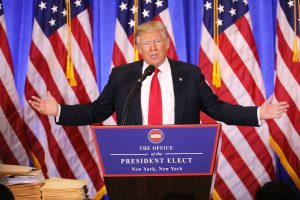
(Photo by Spencer Platt/Getty Images)
Earlier this week, President-elect Donald Trump gave a press conference detailing the plans his team had come up with to ensure his massive holdings would not present a conflict of interest problem. He even trotted out the Biglaw guns for the presser.
Also featured was a large stack of manila folders, which Trump described thusly:

So this is all — just so you understand, these papers — because I’m not sure that was explained properly. But these papers are all just a piece of the many, many companies that are being put into trust to be run by my two sons that I hope at the end of eight years, I’ll come back and say, oh, you did a good job. Otherwise, if they do a bad job, I’ll say, you’re fired.
But the internet isn’t so sure that complex legal document reside in the curiously neat folders. And after the press was denied access to the content of the folders, speculation ran wild as to what was really in there.
The pages are blank. pic.twitter.com/agLqnBTjrg
— Mikey Neumann (@mikeyface) January 12, 2017

Context Windows In Legal AI And Why Content Still Determines Quality
Legal teams ask a practical question. If large language models are so capable, why does legal AI still depend on curated content, and why does surfacing that content matter so much?
But we’ve cracked the code, and this is what’s really in those files:
