
(Getty Images)
In the United States, we’ve been talking about privacy for at least a century. In December 1890, the Harvard Law Review published The Right to Privacy, by Samuel Warren and Louis Brandeis (who later became Justice Brandeis of the U.S. Supreme Court). The pathbreaking article, rightly described as “one of the most influential essays in the history of American law,” is generally regarded as the first American publication to advocate a right to privacy, described by the authors as a “right to be let alone.”
And we are not alone, as Americans, in how we’ve been discussing, arguing about, and obsessing over privacy ever since. One theme running through the recent Global Privacy Summit, reflected in the conference’s very name, is that privacy is now a worldwide concern. As Trevor Hughes, president and CEO of the International Association of Privacy Professionals (IAPP), stated in his welcoming remarks, “We are not just a profession, but a global profession.”
This globalization of privacy creates both opportunities and challenges. Every country will take a different approach to privacy, reflecting its unique culture, history, and values. In the United States, we try to strike a balance between privacy and another major societal value, convenience. In Europe, haunted by the history of governments prying into the private lives of citizens, privacy enjoys more aggressive protection -– reflected in the GDPR, which seeks to institute a comprehensive and robust system for regulating data privacy.
The GDPR dominates headlines right now because it’s taking effect next month. But nations around the world, from Canada to Israel to Japan, are exploring novel and innovative approaches to protecting privacy. In February, Australia’s new regulatory scheme for data breach notification took effect. In late March, the CLOUD Act was signed into law in the United States.

Tim Harty
“Everywhere you look, there’s new activity,” Tim Harty, Global Head of Actionable Intelligence at Thomson Reuters, told me at the Global Privacy Summit. “Ten years ago, you might have been looking at about 35 countries with regulations governing data privacy. Today, around 120 countries have data-privacy regulations.”
For corporations with international or global operations, keeping up with all these changes can be a daunting task. How can companies track the whirlwind of new developments?
Harty — who has spent almost two decades at Thomson Reuters in a wide range of roles, working in the U.K., Asia, and the U.S. — oversees a business designed to do just that. He’s in charge of the company’s Data Privacy Advisor product, which helps companies understand — and comply with — the complexities of global rules and regulations concerning privacy and data protection.
Data Privacy Advisor, which brings in privacy-related content from over 80 countries, including U.S. and Australia state-level and Canada provincial-level materials, was two years in the making. Harty and his team brought together first-class domain expertise, content, and technology, creating a unique offering for privacy professionals at companies with cross-border, international, or global operations. The product also incorporates features powered by artificial intelligence, currently in beta, from Thomson Reuters & IBM Watson to provide a one-of-a-kind user experience.
For 18 months prior to launch, a group of design partners, including privacy practitioners from the U.S., Canada, and the U.K., helped to design and test early versions of Data Privacy Advisor. The design partners offered feedback on both content and the user experience, and the product was revised to address their needs and concerns.
After a three-month, highly controlled sales pilot, Data Privacy Advisor had its official market launch on January 29, 2018 — one day after Data Privacy Day, appropriately enough. It’s now available in the United States, Canada, and the United Kingdom, with additional geographies to follow.
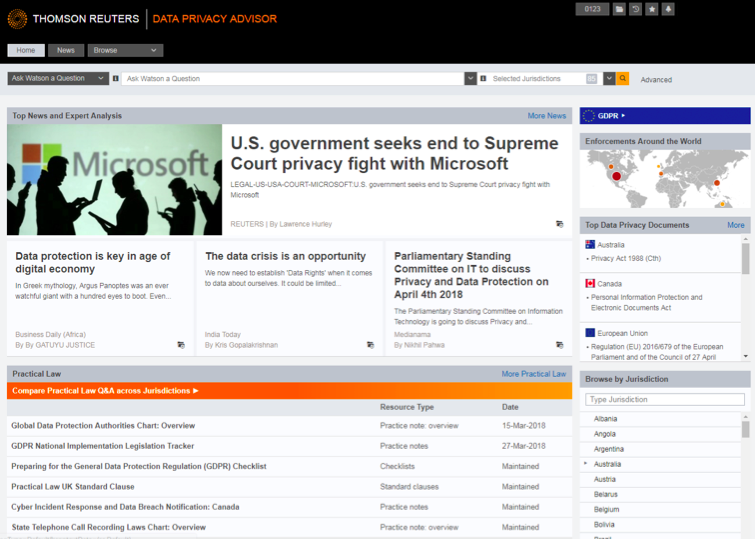
The Data Privacy Advisor homepage (click to enlarge).
As one would expect from a product that involves collaboration between the Thomson Reuters Center for Cognitive Computing and IBM Watson, Data Privacy Advisor includes a number of features powered by artificial intelligence. For example, the “Ask Watson a Question” feature allows the user to type in a plain language question, select specific jurisdictions, and have Watson pull out a sentence-level answer from the top three documents in each content type:
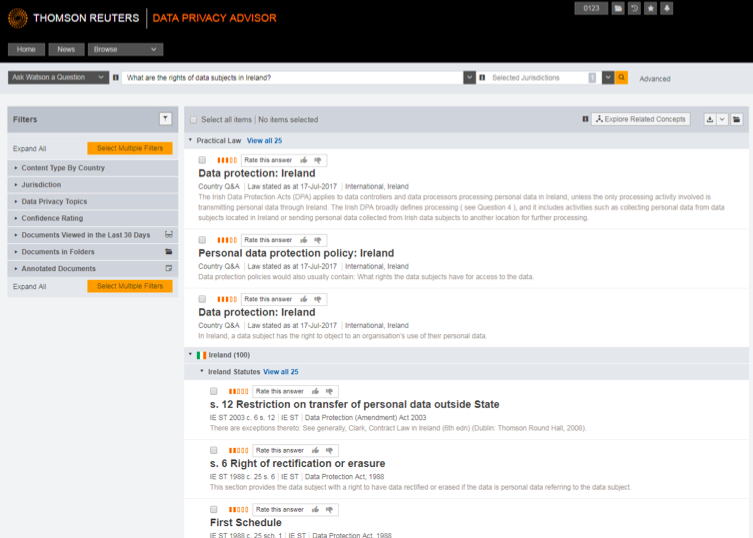
Ask Watson a Question (click to enlarge).
Users can provide active feedback on the results they receive from Ask Watson, which helps “train” the algorithms to provide even more accurate answers in the future.
Ask Watson a Question also offers a “Related Concepts” feature, which aids discovery through visually presenting topics possibly related to the question posed:

Related Concepts (click to enlarge).
Another impressive visual feature is the Enforcement Heat Map, which provides an at-a-glance view of enforcement actions across multiple jurisdictions. Clicking on a hot spot zooms in the view and lists all the enforcement actions for that specific country or jurisdiction.
The AI and visualization features are exciting, but at the end of the day, Data Privacy Advisor rests on its content — hundreds of thousands of privacy-related laws, regulations, news articles, blog posts, and more, from 80-plus countries.
“Data Privacy Advisor is driven by its content and information,” Harty said. “Without content and information, you have nothing.”
I asked Harty: what led Thomson Reuters to develop Data Privacy Advisor?
“Thomson Reuters has always spent a lot of time in market, close to its customers,” he explained. “In late 2014 and early 2015, we undertook a major study of our customers to identify their key concerns. In reviewing the results, it became evident that data privacy issues were causing our corporate customers a lot of anxiety and pain.”
Was this mounting concern driven by the years of debate leading up to the April 2016 adoption of the GDPR in Europe?
“The GDPR did contribute to the challenges and concerns of our clients,” Harty said. “But it was bigger than that. Increased globalization, digitalization, regulation, and enforcement, on a global level — bring all that together, and it created a major market opportunity.”
The market response to Data Privacy Advisor has been “fantastic,” according to Harty. “The timing is right, and the opportunity is here.”
Thomson Reuters will continue to invest in Data Privacy Advisor, in response to customer feedback and to expand it to more countries based on market developments. Because it is a cloud-based solution, enhancing and adding features and content to Data Privacy Advisor can be done quickly.
“Right now, the world is having a data privacy conversation — or conversations, in countries across the globe,” Harty said. “We offer a tool to help make sense of those conversations, and the market is responding positively””
To learn more or request a free trial, please visit Data Privacy Advisor.
 David Lat is editor at large and founding editor of Above the Law, as well as the author of Supreme Ambitions: A Novel. He previously worked as a federal prosecutor in Newark, New Jersey; a litigation associate at Wachtell, Lipton, Rosen & Katz; and a law clerk to Judge Diarmuid F. O’Scannlain of the U.S. Court of Appeals for the Ninth Circuit. You can connect with David on Twitter (@DavidLat), LinkedIn, and Facebook, and you can reach him by email at [email protected].