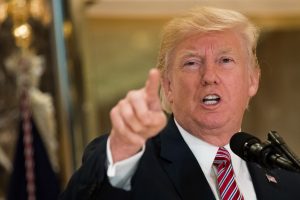
(Photo by Drew Angerer/Getty Images)
Earlier this year, in my column on 2018’s top three IP questions, I pointed to the importance of the Supreme Court’s then-upcoming decision on the constitutionality of IPRs in Oil States. I wrote: “After Oil States, which has the potential to most immediately shift patent practice overnight, I think the next most pressing IP question for 2018 centers on whether or not we will finally see express political support for IP owners coming from President Trump — or at least another high-ranking executive branch official.” Almost on cue, in the immediate aftermath of the Supreme Court’s actual decision in Oil States, we had President Trump himself come forward with a statement heralding World Intellectual Property Day. IP owners — and especially beleaguered patent owners — could not have asked for a more heartening message from the leader of the free world. “Express political support for IP owners” — delivered.
At the time of my earlier column, I made clear “any changes could take some time to develop” when it came to the USPTO, even with Director Iancu’s nomination serving at the time as a bellwether for a shift to a more patent-owner-friendly agency. I did note that President Trump held a unique position as “a president who personally derives significant wealth from his personal IP,” which could be seen as a harbinger for his administration taking a more IP-owner-friendly approach to IP issues. As has been noted in numerous places since then, Director Iancu has been prominently calling for pro-patentee reforms in the USPTO, while starting to implement some already — such as revised guidance on 101 issues.

Why Your Practice Is Burning Money And How You Can Do Better
Our expert panel explores common sources of profit leakage along with practical steps for improvement.
More importantly, I noted that a pro-IP statement from President Trump could have an “immediate impact, if only to signal that there is a recognition that perhaps the pendulum has shifted too far in the direction of weak domestic IP rights — particularly in the patent space.” President Trump’s recent message could not have been clearer in that regard. In terms of “immediate impact,” I think both IP owners and erstwhile “efficient infringers” should consider themselves on notice of the possibility of some real movement in IP owners’ favor in the coming months. In short, strategic thinking by IP stakeholders must henceforth take into account the President’s statements, just as foreign leaders must when the leader of the richest, freest, and most powerful country in the world speaks about their countries. Director Iancu’s public statements since President Trump’s proclamations are in accord.
Now that some time has passed from President Trump’s statement, it is worth taking another look at what he actually said in honor of World Intellectual Property Day. He starts with a rhetorical bang, directly tying IP rights with America’s “economic competitiveness” by “creating the framework for a competitive market that leads to higher wages and more jobs for everyone.” It is not hard to find examples of innovative companies that have used their IP to create new markets for their goods and services or elbow their way into mature markets on the strength of their innovations. The importance of IP to the nation’s economy is not really disputed, as even those companies known to fall in the “efficient infringer” camp make no bones about touting the benefits and value of their own (whether homegrown or acquired) IP in their public securities filings.
Next, President Trump launches a broadside against the “unfair and unscrupulous economic practices of some foreign actors.” Methinks he is not complaining about Tanzanian branding practices for exported coffee. While this statement can fairly be construed as a direct warning to China, however, it is most interesting when we consider how the president ties IP theft to national security issues. In effect, he is offering justification for the well-publicized bans on ZTE and Huawei products on security grounds, while also signaling that similar actions against other companies are on the table. While I assume that the administration would prefer not to have to take further action against Chinese companies, having the threat hanging out there could have a deterrent effect against the more egregious IP abuses — such as counterfeiting and trade secret theft — that have been alleged against certain foreign actors. In fact, his more recent expressions of sympathy for ZTE’s plight is a classic example of President Trump’s trying to marry tough talk with a pragmatic approach.
While tough talk against foreign encroachment always finds a receptive audience, it is what President Trump had to say about domestic IP that will be most uplifting to existing and aspiring IP owners. He promises that his “[A]dministration will also take steps to strengthen our patent system here at home” with the aim of implementing a “system that increases the reliability and enforceability of patents” so that investment will increase in “creative and innovative industries.” Some may bemoan the lack of specifics, but as a statement of intent, IP owners could nary ask for more. After nearly a decade of the IP community assaulted with negative messages about patents themselves being anti-growth, mainly due to reasonable criticism of abusive patent trolling practices, here is the President directly tying strong patent rights with “pro-growth policies.” A more resounding call to action by Director Iancu and his team at the USPTO would be hard to imagine. And they are starting to deliver.
The Trump Gold Card: A New $1 Million Pathway To A U.S. Green Card
A new proposal would let wealthy foreign nationals secure an opportunity for a U.S. green card with a $1 million 'gift' to the government, sparking legal and ethical debate.
Ultimately, each proposed change in IP practice sponsored by President Trump’s Administration must be considered carefully, and patience must be afforded their implementation. There has been a lot of talk about the PTAB’s response to the Supreme Court’s SAS decision, as well the proposed shift to a potentially narrower claim construction standard in IPRs. Where things will end up remains hazy. What is clear, however, is that after a long period in exile, IP owners are once again invited back to the discussion table, with a President who recognizes “the necessity of maintaining intellectual property rights” at its head. It may be premature to crown President Trump as the Great American IP Hero that IP owners have hoped for. But his recent statements may in the future be seen as a key step toward his accepting that mantle. For all those IP owners singing Bonnie Tyler’s “I Need a Hero,” there is surely some hope that President Trump could fit the bill.
Please feel free to send comments or questions to me at [email protected] or via Twitter: @gkroub. Any topic suggestions or thoughts are most welcome.
Gaston Kroub lives in Brooklyn and is a founding partner of Kroub, Silbersher & Kolmykov PLLC, an intellectual property litigation boutique, and Markman Advisors LLC, a leading consultancy on patent issues for the investment community. Gaston’s practice focuses on intellectual property litigation and related counseling, with a strong focus on patent matters. You can reach him at [email protected] or follow him on Twitter: @gkroub.