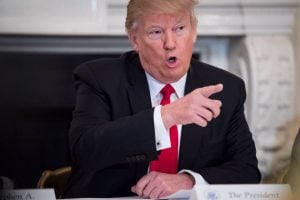
(Photo by Jabin Botsford/The Washington Post via Getty Images)
Whatever your thoughts are on the morality of political conservatism and religious orthodoxy, it is simply impossible to deny that an institutionalized censorship of these views exists within public universities in the United States. Thankfully, such blatant unconstitutional censorship has faced robust challenges in the courts, resulting in many outrageous campus speech codes being struck down. Recently, the President of the United States weighed in on this serious problem by issuing a vague executive order supporting free speech on college campus.
Given the pressing need to protect certain views on college campuses and when taken alone with no other context, the president’s order appears as a positive development for First Amendment values. After all, this sort of thing — making sure the laws are faithfully executed — is why our Constitution has an executive in the first place. However, when the president’s record on free speech issues is taken into the context of this order, the analysis changes dramatically. In fact, the only reasonable inference that could be derived from this order is that it will only function as a tool to target universities the president personally disfavors.

Humans in the Loop: The People Powering Trusted Legal AI
As the use of artificial intelligence permeates legal practice, a critical question confronts every legal professional who uses these tools: Can I trust this?
If you are one of the president’s supporters, it would be entirely fair to ask why or how I could reach this conclusion or possess so little faith in your dear leader. The only answer to MAGA folks is to remind them how this president, in the very same month this executive order was issued no less, threatened to use the immense power of the federal government to target a satirical show that made fun of him, and repeatedly demonstrates outright contempt towards First Amendment values generally. With this record of disrespect for the First Amendment, it is a little much, to say the least, to trot out this president as the great defender of the free speech. The president’s record of contempt for the First Amendment however does not end with free speech.
With his party’s Congressional support, this president has put in place unapologetic religious bigots within the highest levels of the executive branch. Bigots who openly state in public forums, including in their own confirmation hearings, that unless you subscribe to their religious views, your presence in government is characterized as — and this is worth repeatedly stressing upon — a dire threat that must be stopped. Furthermore, this president, also with his party’s approval in Congress, has placed on the Supreme Court justices who seek to overturn and restrict original First Amendment intent regarding one of our most treasured individual liberties: freedom of conscience.
Madison was clear when drafting the First Amendment that whenever the government forcibly extracts money from its citizenry in order to propagate religious speech or maintain and preserve churches, this is the very definition of an established church and a violation of free conscience liberty. It also just so happens that this type of forced extraction to maintain and preserve churches is precisely what both of the president’s Supreme Court picks, now on the Court, desperately want to impose on the American people.
Adding to the concern over the president is the fact that most members of the ideological right appear to share contempt for the First Amendment generally. Many on the right in fact are all too ready to abandon First Amendment values in favor of social control when such control aligns with their ideological point of view. For example, as pointed out by many others, a trend has developed on the right to invoke free speech principles when expressing their own opinions, yet often in the same breath, threaten defamation lawsuits against any who criticizes their opinions.

How LexisNexis State Net Uses Gen AI To Tame Gov’t Data
Its new features transform how you can track and analyze the more than 200,000 bills, regulations, and other measures set to be introduced this year.
For another example, a pluralistic society where opposing views can be freely expressed is not what the current Vice President is interested in. Instead, the Vice President has demanded that his view and his view alone should be accepted in the name of tolerance while criticism of his beliefs “should stop.” It seems absurd to have to say this, but demanding from a position of the highest authority that only your views should be accepted while your opponent’s views should not is not how a “tolerant society” functions.
To be abundantly clear, the left is no bastion of First Amendment values either as the first paragraph in this piece seeks to make clear. Moreover, I could dedicate an entire piece criticizing the previous president for his grotesque record when it comes to First Amendment liberty. The point therefore, is not to say that the left is good, it is to illustrate that this president represents the greatest threat currently to First Amendment values and norms. To me, this statement is just as obvious as saying the left is clearly more of a threat right now to Second Amendment values. Also, the distinction must be made that unlike the very real threats from the left that are thankfully being challenged and often defeated, the right’s assaults on First Amendment values, particularly on the issue of original anti-establishment liberty, is being accepted in every branch of government that has a conservative majority, including the judiciary.
The good news is that the public at large is not accepting many of the president’s attacks on First Amendment values such as targeting satirical shows for government retribution because they make fun of him. Our libel laws for example, despite the extreme views of a conservative member on the Supreme Court, have not been grossly expanded in the way that the president wants. That such tactics have not worked here is an encouraging demonstration of American exceptionalism because for all too many other places in the world, these sorts of totalitarian tactics have worked.
 Tyler Broker’s work has been published in the Gonzaga Law Review, the Albany Law Review, and is forthcoming in the University of Memphis Law Review. Feel free to email him or follow him on Twitter to discuss his column.