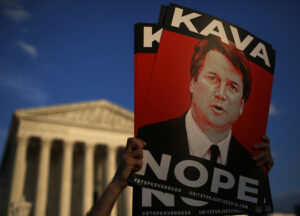
(Photo by Win McNamee /Getty Images)
Travis County, Texas Court-at-Law No. 3 Judge John Lipscombe doesn’t like Brett Kavanaugh, which, amen. He also believes that Kavanugh’s elevation to the Supreme Court is a blight on the nation’s judiciary, which, again, same. But when Lipscombe’s outrage over Justice Kavanaugh spilled over into a protest in his courtroom, he wound up in hot water with the Texas Commission on Judicial Conduct.
In October of 2018, Lipscombe closed his courtroom with a black cloth over the door as a form of protest over the confirmation of Brett Kavanaugh to the Supreme Court. Lipscombe’s protest was even covered by local news.

Context Windows In Legal AI And Why Content Still Determines Quality
Legal teams ask a practical question. If large language models are so capable, why does legal AI still depend on curated content, and why does surfacing that content matter so much?
County Court at Law 3 Judge, @JohnLipscombe, draped funeral bunting over his door and shut down his court today as a form of “silent protest.” He says he felt the need to something after Kavanaugh’s confirmation, calling it a big step backwards for the country. @kvue pic.twitter.com/96OnrtxsHI
— Jenni Lee (@JenniL_KVUE) October 8, 2018
The resulting media attention garnered Lipscombe five complaints over his protest. As reported by Texas Lawyer, even after getting called out by the Commission for his protests, Lipscombe gave the ultimate sorry, not sorry response:
“I strongly felt, and continue to feel, that the Supreme Court and our entire judiciary has been besmirched and that I had a personal obligation to show my disapproval and demonstrate my utmost respect for the judiciary and my dedication to our constitution and its principles of fairness and justice,” Lipscombe said, according to the reprimand.

Opus 2 Steps Up Its AI Game With Acquisition Of A Legal Tech Startup
With the addition of Uncover’s technology, the litigation software is delivering rapid innovation.
The Commission ultimately found Lipscombe’s behavior was a violation of judicial ethics as it was influenced by “partisan interests and public clamor” and “cast public discredit on the judiciary or the administration of justice.” The Committee issued a public admonition, which can be read below, as punishment for his actions.
[pdfjs-viewer url=”https://abovethelaw.com/wp-content/uploads/sites/4/2019/09/LIPSCOMBE.19-0148.et_.al_.Pub_.Adm_.8.8.19.pdf”]
 Kathryn Rubino is a Senior Editor at Above the Law, and host of The Jabot podcast. AtL tipsters are the best, so please connect with her. Feel free to email her with any tips, questions, or comments and follow her on Twitter (@Kathryn1).