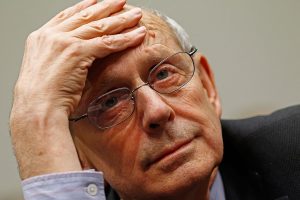
(Photo by Chip Somodevilla/Getty Images)
In the immediate aftermath of the Supreme Court finishing blowing up voting rights with a transparent rewriting of a plainly worded statute, Justice Stephen Breyer could have announced that he would step down from his position to guarantee that a successor could be confirmed. He just watched what happened to Justice Ginsburg and he’s theoretically aware that this is his only opportunity to leave before the midterm elections which, historically, disadvantage the White House party. With Republican Senators explicit that they’re willing to block 100 percent of judicial nominations if they control the chamber, Breyer should be aware that if he doesn’t resign now, he’s buying himself at least another two years on the bench… if the soon-to-be 83-year-old remains healthy that long.
So, of course, he did not step down.

The New Way Litigators Handle Depositions Applies AI Every Step Of The Way
Depositions by Filevine help with scheduling, tracking goals, and trial prep.
It’s quite the move from a justice who seems to revel in his reputation as a pragmatist. What does that mean? Well, let’s let Cass Sunstein explain in his review of Breyer’s book Active Liberty:
Its most distinctive feature is its effort to connect three seemingly disparate claims. The first is an insistence that judicial review can and should be undertaken with close reference to active liberty and to democratic goals, a point with clear links to the work of John Hart Ely.’ The second is an emphasis on the centrality of “purposes” to legal interpretation, a point rooted in the great legal process materials of Henry Hart and Albert Sacks and, in particular, their brilliant note on statutory interpretation.’ The third is a claim about the need to evaluate theories of legal interpretation with close reference to their consequences, a point whose foundations can be found in American pragmatism. In Breyer’s view, any theory of interpretation must be assessed by taking close account of its actual effects.
It’s the third point — evaluating actions with a close reference to consequences — that Breyer seems to have completely forgotten about.
What are the consequences of sticking around at this point? Breyer is great at his job… and yet, he’s not uniquely better suited to the job than any of the handful of SCOTUS papabile waiting to be called up. Meanwhile, unless Democrats hold or gain in the Senate, he’s guaranteeing that he won’t be replaced. That’s the thing — put aside “replaced by a Democrat” — the only chance his seat is filled at all is if he leaves now. Were he to stick around another year and then become unable to continue or worse, there’s a high likelihood that the Supreme Court would have a vacant seat for upwards of six years with a Republican majority just blocking everyone Biden sends over. Having lived through the eight-justice debacle a few years ago, it’s bonkers that Breyer would risk a repeat just so he could continue to prevent another jurist from having the cool job he’s held since before first-year associates were even born.

What Even Is AI ‘Competence’? It Depends.
Takeaways from a Legalweek panel on evolving malpractice risks.
Extraordinarily high risks for minuscule gain.
Maybe it was too much to ask that the justice would actually live out his professed pragmatism. At the end of the day, there’s nothing particularly pragmatic about Breyer’s brand of pragmatism. It’s just a mainstream center-liberal judicial philosophy justified with apolitical rhetoric. Now, there’s nothing wrong with a little branding. Just look at how successful the conservative justices have been at selling contemporary Republican policy initiatives as “originalist.” I’m not faulting anyone for trying to forge a PR-friendly judicial philosophy. But if you can’t consistently live out your own worldview, it loses a lot of its punch.
And the fig leaf is failing. Because no pragmatist would put the Court on this course.
 Joe Patrice is a senior editor at Above the Law and co-host of Thinking Like A Lawyer. Feel free to email any tips, questions, or comments. Follow him on Twitter if you’re interested in law, politics, and a healthy dose of college sports news. Joe also serves as a Managing Director at RPN Executive Search.