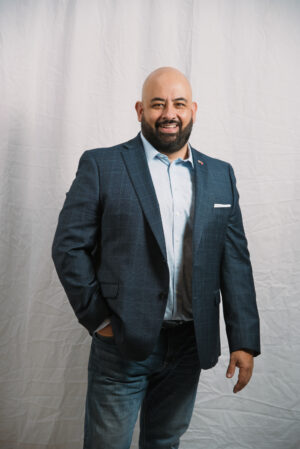
 Edgar Ocampo is General Counsel at Stan Koch & Sons Trucking, Inc.
He previously worked at Fredrikson & Byron, P.A., and came into law school through his experience consulting in the hospitality and food & beverage industries.
Here, Edgar explains his transition to an in-house counsel role and offers some advice for building business relationships. (This interview has been edited for length and clarity.)
Well, welcome, thanks for joining me today. I like your [videoconference background].
It’s called the “airport bar.”
That’s a good place to be. Where are you going?
Washington, D.C. There’s a little bit of work, and then there’s a nonpolitical veterans’ march at the steps to the Lincoln Memorial.
I deployed to Afghanistan in support of Operations Swift Freedom & Enduring Freedom way back in the day. The march is bringing together decades of veterans who served in Afghanistan in an effort to raise awareness about the recent mishandlings in Afghanistan.
Very good. I remember you being interviewed about your service previously. Well, why don’t we go back in time again to start out and talk about how you got into the law in the first place?
I took a leap of faith into the law from consulting in several industries. I wanted to get into the law to do veterans’ advocacy, with the intent of doing everything I could for the Vietnam-era veterans.
They didn’t have the same welcome home that we did, they didn’t have the same kind of system set up for them, including the V.A. Before law school, I was traveling the country managing liquor liability and security teams for music festivals, Coachella, Stagecoach, Ultra, some of the bigger ones.
I got into a conversation with one of the guys who did the staffing, he was a Vietnam vet. He had heard me talk about law school and veterans’ advocacy for several years.
One day he told me: “Hey, I’m not firing you, but I’m not asking for you back either. It’s time for you to go do what you need to do.”
Oh, that’s interesting. Sounds like you got a little push there. So what’d you do after you graduated from law school?
I was fortunate enough to get involved with Fredrikson & Byron my 1L and 2L years, and I worked there pretty much full-time throughout my 3L year.
I enjoyed the people and culture there — it was very different from what I previously thought large law firms were like.
It was one of those things I thought I’d never do. But based on the people and based on the culture, I spent a couple years at Fredrikson after law school.
What kind of law were you practicing there?
I was doing employment advice, litigation, and some transactional M&A and due diligence stuff. A little bit of everything.
In all honesty, I realized this was a great environment to just learn from as many professionals as I could. I wasn’t sure if it was going to be long-term for me or not, but I wanted to expand my knowledge and not get pigeonholed into any one area.
So, when you left Fredrikson & Byron, where’d you go, and why’d you make that transition?
I don’t know that you leave Fredrikson with the intention to make it to another law firm. I had a friend who was at Koch Trucking though, where I am at now.
She kept reaching out with all kinds of questions. One day, while we were at her parents’ house at the lake, this was a colleague from law school, she said, “Hey, I’m asking if you’re interested in coming here.”
I wasn’t reading between the lines. Then I looked into it though, I met with the ownership, I met with several of the business leaders, and it really resonated. It was, again, a great culture. And it kind of dialed back to a lot of military experiences.
It was kind of like, we all have a mission together, and we’re all going to collaborate, to get done what we need to get done.
Was there already a legal team there when you came? Small team, big team, what did that look like?
They had kind of gutted the legal department to some degree. Some left on their own, and some just weren’t a good fit anymore.
That former colleague from law school was kind of holding the fort down on her own, and I don’t know how she was doing it. When I showed up it was what I call “legal whack-a-mole.”
It wasn’t necessarily tending to what I thought were the biggest problems, it was dealing with what business leaders and ownership thought was the biggest problem at any one time. The first year was a lot of organizational efforts rather than looking at substantive legal issues.
Sure. Do you like that kind of work with the organizational framework, or do you sometimes miss dealing with the more substantive legal issues?
It’s a great balance at this point. I consulted for several years before leaping into the law, I consulted since 2008, and “no” was the answer you got there, so that’s the answer you worked around.
I was able to tap into that experience my first year. Now we’ve hired another attorney, we have stability, there’s growth, we have structure. A lot of the things we needed to have in play, we now have in play.
This year, I’m looking at trying to dig deeper into federal regulations, the DOT regulations, more substantive issues like that. I like that I can balance both aspects, the organizational aspects along with my legal knowledge and experience in the legal field.
Great. Well, one thing I do like to ask almost everyone I talk to for these pieces is whether you have any advice for law students, new lawyers, people who are looking down the road and thinking in 10 years they want to be somewhere similar to where you’re at.
Building relationships is essential.
You have to establish trust before you are going to be able to get a “yes” to do something. It’s different based on where you are — it’s a different mindset at Fredrickson than at a trucking company.
You have to learn to talk the talk. You have to learn to communicate in the context you’re in.
It’s not just the way you talk, it’s the way you dress, it’s the way you write.
I have to understand what the business leaders are looking for, so if I send them a legal memo and want it taken seriously, it can’t be full of legalese. It’s got to resonate with them.
One of the biggest things I’ve had to learn in the transition from a large law firm to in-house work in a trucking company is just that hard work matters.
Hard work in law firms may or may not be valued, you don’t know sometimes. If you take time to learn the culture of where you’re going though — the culture at big law firms is going to be very different from a place that’s family driven — that will be noticed. You will learn the communication: What is your GC looking for? What is ownership looking for? What is leadership looking for?
It’s kind of like love languages. If you don’t learn the communication nuances in your organization, there’s going to be a disconnect there. You have to move from matter to matter quickly in-house, and good communication really matters in that.
Makes total sense. Any parting thoughts?
I’ll leave it with this: For in-house roles, as opposed to private practice, you don’t need to be the best legal topic area expert necessarily — you outsource that — you need to be a good judge of character so you know who you’re sending it to is the appropriate counsel for it, and before you even get to that stage you have to have a creative but practical approach to problem solving.
Most in-house legal departments are a cost center, not a revenue center. So, if you are spending all kinds of funds on legal fees and are not getting the resolution they’re looking for, you’re going to find yourself in the hot seat with a lot of explaining to do.
Jonathan Wolf is a civil litigator and author of Your Debt-Free JD (affiliate link). He has taught legal writing, written for a wide variety of publications, and made it both his business and his pleasure to be financially and scientifically literate. Any views he expresses are probably pure gold, but are nonetheless solely his own and should not be attributed to any organization with which he is affiliated. He wouldn’t want to share the credit anyway. He can be reached at [email protected].