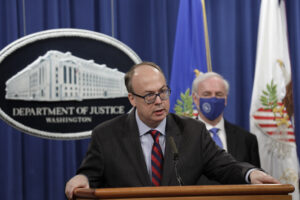
(Photo by Yuri Gripas-Pool/Getty Images)
“How about you go back to your office and we’ll call you when there’s an oil spill?” deputy Attorney General Richard Donoghue snarked at Jeff Clark in the fateful Oval Office meeting on January 3, 2021. It’s an all-time classic prosecutor burn, and a perfect takedown of the nebbishy dork who red-pilled himself with internet research and tried to conscript the DOJ in Trump’s coup plot.
As head of the environmental division, Clark schemed to get himself made acting attorney general, displacing AG Jeffrey Rosen and announcing investigations of non-existent electoral fraud in the swing states. But Donoghue, Rosen, White House Counsel Pat Cipollone, and several other highranking lawyers in the Trump administration threatened to quit en masse if Clark got the reins of the DOJ, so Trump eventually backed down.

Heading To Legalweek? Come Join Above The Law!
Meet the team in NYC at our Monday night happy hour — 3/9 at 7pm. RSVP required.
Clark went on to have his phone seized by the FBI, although no charges have been filed. He did, however, find himself on the pointy end of disciplinary process in July, when the DC Court of Appeals Board on Professional Responsibility filed a Petition Instituting Formal Disciplinary Proceedings against him. In October, he finally got around to doing something about it, and what he did was as gonzo as ever: Clark marched into the E. Barrett Prettyman Courthouse in DC and demanded to remove his bar complaint to federal court.
Clark’s lawyer Charles Burnham cooked up some interesting theories in support of the claim. He suggested that attorney disciplinary proceedings are some hybrid mix of criminal and civil process, and hence are removable under the Supremacy Clause and federal officer removal statutes, 28 U.S.C. §§ 1442 and 1445. He claimed that it violated the separation of powers to allow an organ of the DC government, which was created by Congress, to police the conduct of an executive branch employee. And finally he argued that, because DC is not a state, none of the laws and precedents allowing state bars to discipline federal attorneys apply.
To say that US District Judge Rudolph Contreras was not impressed would be something of an understatement. He made short shrift of Clark’s argument that bar complaints are some kind of civil/criminal chimera, noting that the only precedent Clark cited is a Fourth Circuit decision from 1989 which has been largely disregarded by every other court to examine the issue. And in any event, that precedent appears to have been superseded by the 1989 “McDade Amendment” to 28 U.S.C. § 530B(a), which explicitly subjects government attorneys to local process:
An attorney for the Government shall be subject to State laws and rules, and local Federal court rules, governing attorneys in each State where such attorney engages in that attorney’s duties, to the same extent and in the same manner as other attorneys in that State.

How LexisNexis State Net Uses Gen AI To Tame Gov’t Data
Its new features transform how you can track and analyze the more than 200,000 bills, regulations, and other measures set to be introduced this year.
“To accept Mr. Clark’s position would be to subscribe to the absurd proposition that Congress chose to make these officials subject to jurisdictional rules of professional conduct everywhere except where they work,” Judge Contreras wrote, adding, “That D.C. is home to, by far, the most government lawyers in the country only compounds this absurdity.”
Moreover, the legislative history makes fully clear that congress had Justice Department attorneys in DC in mind, since the amendment was a direct response to perceived excesses of Special Counsel Ken Starr in his pursuit Bill Clinton.
“The legislative history confirms beyond a whisper of doubt that Congress did not intend to exempt D.C. from section 530B,” the court goes on.
And as for Clark’s suggestion that somehow DC’s status as an independent municipality means that its state bar can’t discipline him, the court observes that “Section 1442 also contains a paragraph defining ‘State to include the District of Columbia and ‘State court’ to include ‘the Superior Court of the District of Columbia, a court of a United States territory or insular possession, and a tribal court.’”
In short, “there is no merit to these arguments,” and Clark’s attorney disciplinary proceeding will go back to the DC Court of Appeals where it belongs.
In re: Jeffrey B. Clark [Docket via Court Listener]
Liz Dye lives in Baltimore where she writes about law and politics and appears on the Opening Arguments podcast.