 Yesterday, White & Case announced that Hugh Verrier would step down as the firm’s chair in September and Heather McDevitt would take over the firm’s top job. It’s exciting news in Biglaw when one of the top 10 firms by any metric embarks on a leadership change. All the legal press covered it.
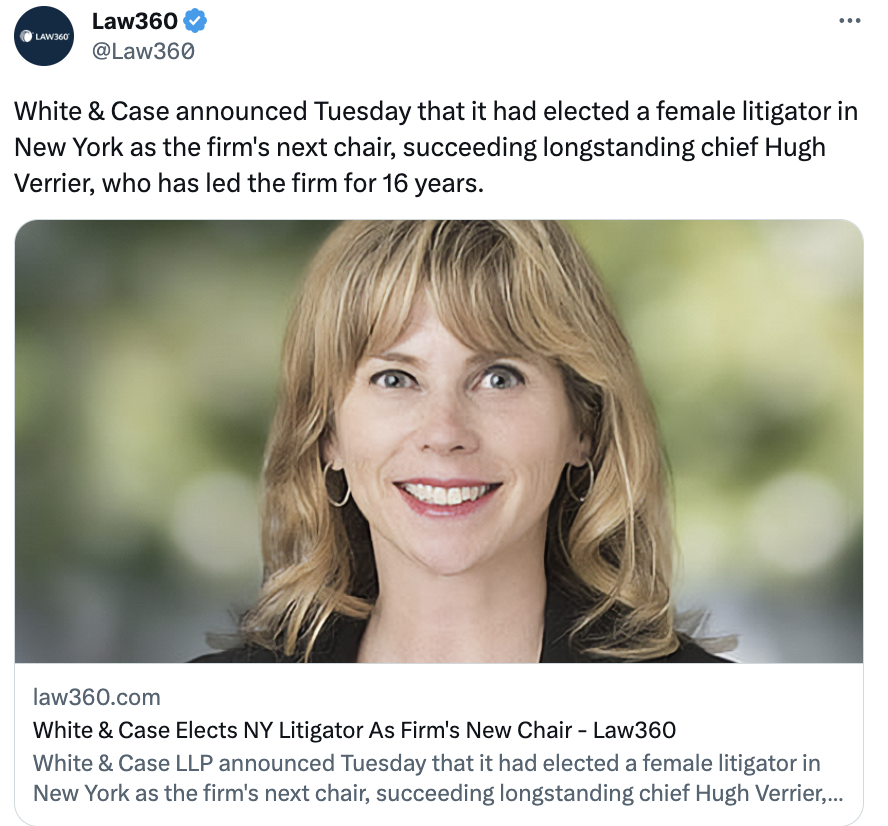
One outlet’s coverage… left a little something to be desired.

Humans in the Loop: The People Powering Trusted Legal AI
As the use of artificial intelligence permeates legal practice, a critical question confronts every legal professional who uses these tools: Can I trust this?
The replies tell the story of what happened next. Elon Musk won’t let the public see the number of replies anymore because he was tired of getting ratioed to death, but trust that they’ve accumulated for hours at this point. Here’s a slice of only the most recent…

The word is technically “litigatrix” per Black’s Law Dictionary (via Above the Law itself) — though I’ve never liked it when “litigator” is right there — but we’re pretty sure the commenter means something along the lines of “bias” or “sexism” in this instance.
Now, I suspect what happened here is that somewhere along the line, this conversation happened:

Social media author: We’ll put “White & Case elects new leader”
Supervisor: Hmm. That’s a little bland. Is there anything interesting about this new leader?
Social media author: Well, Heather McDevitt is a female litigator… that might be a first for the firm?
Supervisor: Yeah… but if we tell them who is taking over in the Tweet, they might not click.
Social media author: Right, right. We could just say Hugh Verrier is stepping down.
Supervisor: That’s better, but then we lose the “female litigator” hook. Tell you what — say Verrier is stepping down and point out that his successor is a female litigator and then people will click to find out who she is.
Social media author: Brilliant, boss!
Supervisor: I know.
Had this headline just said “female litigator” and not mentioned Verrier, it would be a little weird — are people really not going to click if they see her name in the Tweet? — but I think most folks would write it off as an effort to preserve a little mystery for the readers. It’s the contrast that made this problematic because it grants a name to one party and not the other… while simultaneously reducing the latter to a demographic.
And this might be a bit of a trend. Compare:
Baker Botts LLP has elected litigation department co-chair Danny David as the firm's 16th managing partner. https://t.co/K3Rql2cNtL
— Law360 (@Law360) June 16, 2023
And contrast:
WilmerHale said that a longtime white collar litigator and strategic adviser will become its next managing partner effective Jan. 1. https://t.co/v4WVP0pXSX pic.twitter.com/7jE782NRAU
— Law360 (@Law360) June 15, 2023
It’s not even limited to enticing readers to click to figure out about the “new” leader:
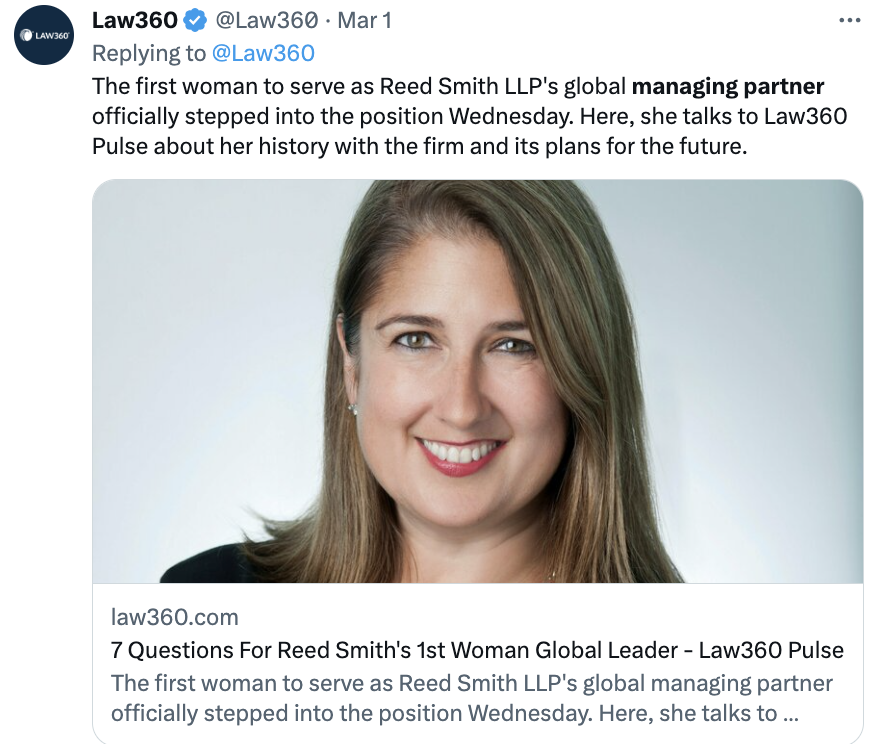
To be clear, I doubt Law360 harbored any ill-intent here. There is a fine line to walk when it comes to coaxing readers to click on a story, and highlighting that the story features a successful lawyer from outside the white male box can draw an audience. Deftly phrased, zeroing in on “Woman Global Leader” or “Female Litigator” can celebrate achievement in a profession that often flops on diversity.
But… there’s not really any reason not to also name these lawyers and there’s certainly no reason to give that benefit to the white dudes’ names and not anyone else.
To be fair, Law360 generally makes it a habit to not name the incoming leader in these headlines (the Baker Botts story, while recent, is an outlier). And that’s fine if it’s the consistent practice.
This sort of thing happens when scrambling to produce content fast for a voracious audience. Above the Law has certainly had unintentional issues like this too. And they can get complex. Recently I used a generic stock image of a white person in a story and someone pointed out that the subject of the story was non-white. But the story was negative and dealt with ethical violations… should the generic image reflect the subject’s race even though race had nothing to do with the infraction and using the image could inject racist baggage on its own? It can be tough.
That said, this is not so tough.
The problem isn’t really that it happens in the first place — though that’s not good! — it’s how you approach it once it’s brought to your attention and avoid it going forward.
I think we’ve got sufficient notice now.
 Joe Patrice is a senior editor at Above the Law and co-host of Thinking Like A Lawyer. Feel free to email any tips, questions, or comments. Follow him on Twitter if you’re interested in law, politics, and a healthy dose of college sports news. Joe also serves as a Managing Director at RPN Executive Search.