Yesterday Solicitor General John Sauer tried to convince five Supreme Court justices to let President Trump burn down the Federal Reserve. It did not go well.
Nota bene: Conservative justices can do real law when they actually have skin in the game.
The oral argument was fascinating, not least because it proved once again that the entire executive branch is brain-poisoned by social media and can’t distinguish between online and real life. There were literally eight mentions of Truth Social!

How LexisNexis State Net Uses Gen AI To Tame Gov’t Data
Its new features transform how you can track and analyze the more than 200,000 bills, regulations, and other measures set to be introduced this year.
The question was whether a social media post accusing Federal Reserve Governor Lisa Cook of mortgage fraud and calling for her resignation counted as official notice prior to termination. Under 12 USC § 242, members of the Board of Governors can only be removed “for cause,” giving Cook a due process right to contest her removal. But Sauer argued that tagging Cook and giving her a chance to clap back was process enough.
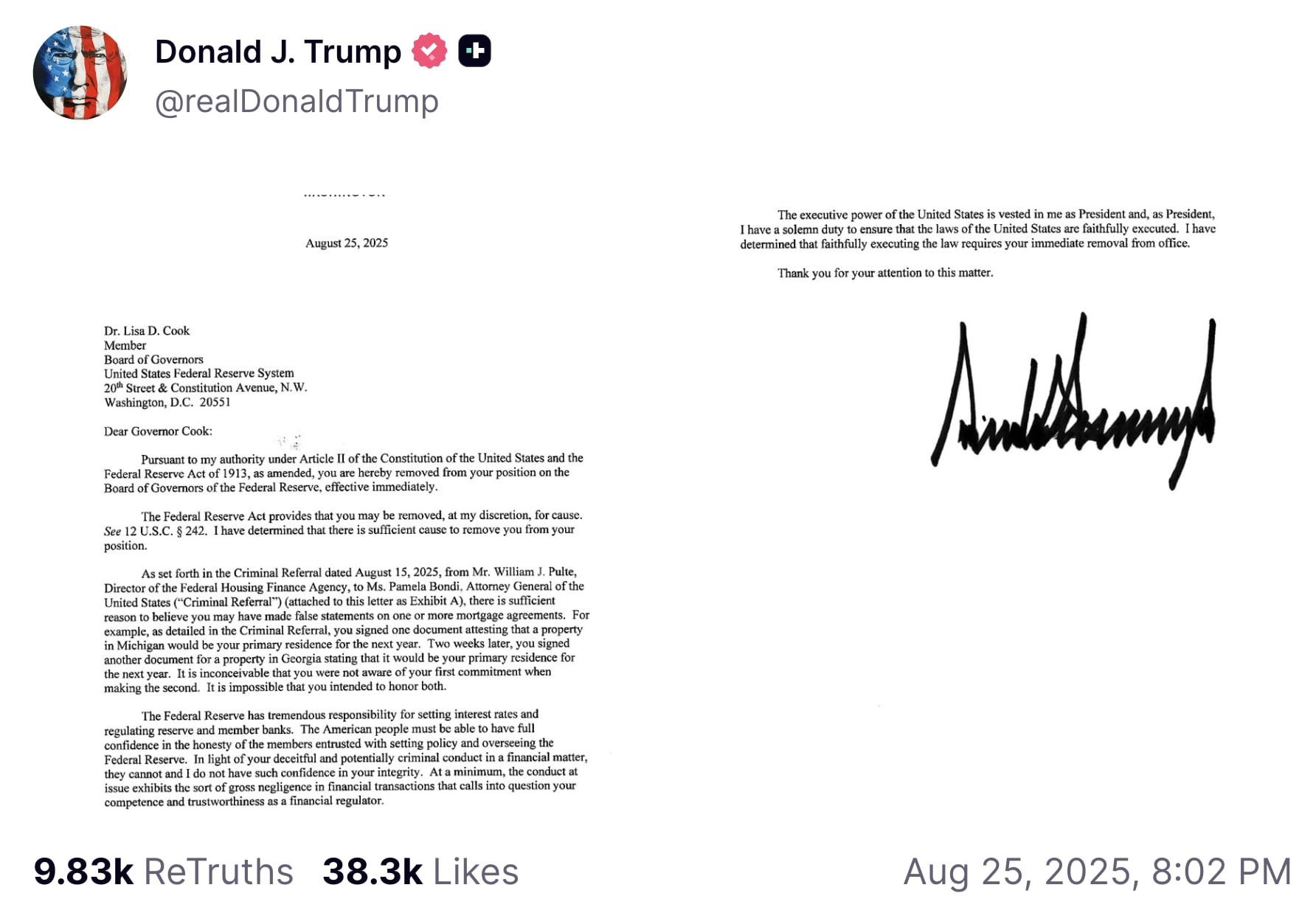
The “notice” came on August 20, when Trump posted a Bloomberg story detailing allegations by Bill Pulte, director of the Federal Housing Finance Agency, that Cook made false claims on a mortgage application to score a lower rate.
“Cook must resign, now!!!” he screeched on Truth Social.


The government says the post put the onus on Cook to come forward and clear her name. And since she failed to throw down in the comment section or slide into Trump’s DMs, he was justified in firing her five days later for “deceitful and potentially criminal conduct in a financial matter.” On Truth Social of course.
“Our contention is that there already has been a process. There was a social media post that said, look, these two documents contradict each other. And the response was defiance,” Sauer wheedled. “So there was a chance to tell … her side of the story. It just wasn’t adopted.”
Neither of these arguments persuaded Judge Jia Cobb, the trial judge, who scoffed that a social media post could not possibly constitute actual notice.
“At no point did President Trump indicate that Cook would be provided an opportunity to argue that the allegations were untrue or did not merit removal, or invite Cook to submit such evidence,” she noted.
The DC Circuit majority treated the argument as functionally abandoned, writing that “the government does not dispute that it provided Cook no meaningful notice or opportunity to respond to the allegations against her.”
But Sauer’s back, baby, and he’s hanging his hat on the claim that tagging someone on the socials totally counts as due process.
“We believe that was provided in the five-day window between the Truth Social post and the removal letter,” he told the justices yesterday, insisting that anything more would be an “intrusion on the executive branch.”
And what was the procedure for Cook to assert her objections? She was supposed to post through it!
JUSTICE JACKSON: Was Ms. Cook given the opportunity in some sort of formal proceeding to contest that evidence or explain it?
GENERAL SAUER: Not a formal proceeding. She was given an opportunity in public because she was notified —
JUSTICE JACKSON: In the world?
GENERAL SAUER: Yes.
JUSTICE JACKSON: Like, she was supposed to post about it and that was the opportunity to be heard — that you’re saying is — was afforded to her in this case?
GENERAL SAUER: Yes …
Gosh, why wouldn’t a federal official facing potential criminal liability pop off about the details of her case on a commercial website owned by the president of the United States?
As Justice Sotomayor noted, Cook did respond; but she did it through her lawyers, not online.
“If the president can go by social media and one believes that that is adequate notice under law, I’m hard pressed to think a letter from a lawyer is not notice from the adversary,” she observed tartly.
Does it even count if you don’t post it? Or, conversely, doesn’t posting substitute for literally every other thing? Sauer wasn’t even sure whether the supposed smoking gun evidence that Cook was fired “for cause” had ever been docketed anywhere but the high court of Truth Social.
“I know that the text of the social media post that screenshots the mortgage applications is in the record. But I don’t recall if the — the paperwork itself is in the record, in the district court’s record,” he said to an uncharacteristically unfriendly (to the government) Justice Alito.
Former solicitor general Paul Clement, who argued for Cook, was substantially faster on his feet than his successor. He doggedly refused to get cornered on the issue of whether social media posts could constitute notice. Instead he argued that this supposed notice was categorically defective “because it’s also indisputable evidence that the President prejudged the matter.”
Demanding someone’s resignation is different from posting “I’m going to convene a hearing at the Roosevelt Room at 4pm tomorrow, please bring all your evidence,” he insisted.
Having dodged the culture war ragebait trap, Clement was then free to parry with Justices Alito and Gorsuch about whether conduct before the official takes office is grounds for termination for cause.
It’s amazing what a decent lawyer can do if he LOGS OFF once in a while.
Subscribe to read more at Law and Chaos….
Liz Dye produces the Law and Chaos Substack and podcast. You can subscribe by clicking the logo: