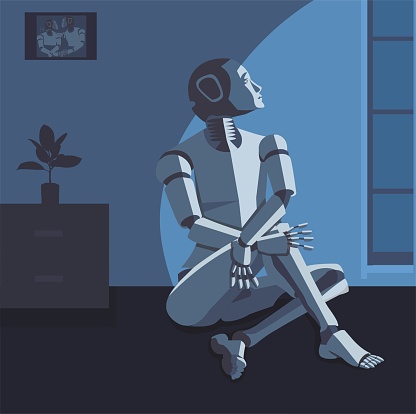
Given the recent gyrations in the markets, it’s no wonder that people are jittery about the effects (past, present, and future) of AI in our profession. True, we are not the only profession that is nervous about AI’s potential to completely reset our landscape. Jobs once stable and secure may not be any more. It’s no fun looking at something that doesn’t blink back.
Panicking about our demise is premature. Lawyers are not just lawyers; we are counselors too. How often have we sat with a client who is anxious, fearful, uncertain as to how to proceed? Sometimes clients need to vent, to feel that someone is truly listening to them, an art in itself that many lawyers do not have. Often, it’s not legal advice that is needed (sorry billable hours) but more for the client to be heard. That’s a skill that we don’t do often enough: to listen and not talk, to not interrupt, to tell the client and show that nothing is more important than the here and now, or should I say the “the hear and now.”

5 Tips For Proving Your Legal Department’s Value
Join our expert panel on March 3rd at 1pm ET to explore actionable, emerging ways you can gather and proactively share the data that demonstrates the impact of your work.
We’ve all chatted about emotional intelligence for decades, that EQ is a necessary component of lawyering, but it seems that it’s even more important now and going forward for lawyers to have emotional intelligence. That is one thing that large language models and other forms of AI just don’t have. How do you schmooze with a robot? Go out for coffee? Go out for lunch? Entertain clients? The only advantage is that the robot doesn’t have to run home to take care of the family or any personal matters; it doesn’t have to be human. The robot can and does work 24/7. Dreary, but the robot doesn’t know that, at least not yet.
One tech company that is trying to install a moral code in AI is Anthropic, which has a resident philosopher whose job is to teach Claude about morality. (And I am not making this up.) We can debate the morals of lawyers but that’s for another time. We do have rules of professional conduct. I wonder if AI ever will.
What does a resident philosopher at a tech company do? Amanda Askell’s job is to interact with Claude in an effort to learn its reasoning patterns and build its personality. What? An AI model with personality? Is that a good thing? It’s Askell’s belief that eventually the models will create “senses of self.” She is teaching Claude to learn right from wrong. Humans are taught right from wrong, at least they should have been, but sometimes that learning goes awry. That morality instruction can’t come too soon, as there have been deaths in which it is claimed that chatbots have somehow and in some manner have been responsible.
However, before delving into whether LLMs should have a soul or at least a moral compass, we still need to stop the hallucinations that seem to hover over the shoulders of some firms. Hallucinations are the epitome of laziness. And they seem to be without end.

Right now, it’s not AI that needs a soul, although perhaps that would be a step in the right direction. But first, lawyers need to have a soul or, at least a conscience, so that when they sign a pleading, they understand the consequences. Ever wondered how you benchslap AI?
Meanwhile, a report by Citrini Research is sobering, even frightening, saying that there may be a “race to the bottom” for white-collar workers, (i.e., us). The report wonders whether future predictions for AI are not bullish, but bearish. It used to be that human intelligence was a scarce commodity. Not any more. Not with AI being able to perform many tasks that we used to think only humans could do. “While machine intelligence will continue to accelerate, the premium on human intelligence will narrow.” Swell.
However, a New York Times article says “not so fast.” It points out that while some fret about displacement, others think that AI will be just a tool, and not the kiss of death for white collar workers. So, for some, reports of AI taking over the world may be greatly exaggerated, at least right now.
Lastly, remember the Magic 8 Ball? It answered questions in the affirmative, the neutral noncommittal, and the flat-out negative. Will AI replace lawyers? The Magic 8 Ball is not ready to answer that question yet.
Jill Switzer has been an active member of the State Bar of California for over 40 years. She remembers practicing law in a kinder, gentler time. She’s had a diverse legal career, including stints as a deputy district attorney, a solo practice, and several senior in-house gigs. She now mediates full-time, which gives her the opportunity to see dinosaurs, millennials, and those in-between interact — it’s not always civil. You can reach her by email at [email protected].