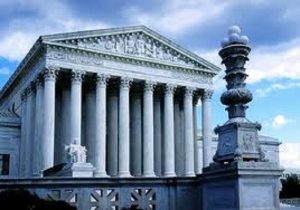
 When the deadline for intervening in the Texas abortion case came and went, and the stunningly awful SB8 — which prohibits abortions after 6 weeks and deputizes citizen to go after anyone who aids or abets someone who procures the procedure — went into effect Wednesday, we knew the Supreme Court’s shadow docket was at work. But the specifics — the who’s and why’s — were unknown. But late last night, the Court dropped a decision that laid it all out.
The case was a 5-4 decision, with Chief Justice John Roberts aligning with the liberal justices. Sure puts the real point on Donald Trump’s last minute nomination of Amy Coney Barrett, doesn’t it?
The majority, noted the “novel” procedural questions in the case, because of the citizen bounty hunter enforcement provision, and refused to grant preliminary relief. (Though the decision does not give a green light to the constitutionality of SB8, though we all pretty much know what the majority thinks about that too.) That was deeply upsetting — and devastating for the people of Texas — but not unexpected. But the dissents which outstrip the majority in length and reasoning, are where the really interesting stuff happens.
Protégé™ In CourtLink® Explains The Whole Case Faster
Designed to reduce manual docket work by prioritizing what litigators need most: on-demand full docket summarization that explains the whole case to date, followed by on-demand document summaries for filing triage, and AI-powered natural language searching for faster search and retrieval.
Each of the dissenting jurists wrote their own reasoning (The Chief’s is the only one every dissenting justice joined, Roberts declined to join the reasoning of any of the liberal justices’). And you can see from Roberts’s opening lines, he’s none too happy his Court will be remembered for this wackiness:
The statutory scheme before the Court is not only unusual, but unprecedented. The legislature has imposed a prohibition on abortions after roughly six weeks, and then essentially delegated enforcement of that prohibition to the populace at large. The desired consequence appears to be to insulate the State from responsibility for implementing and enforcing the regulatory regime.
The State defendants argue that they cannot be restrained from enforcing their rules because they do not enforce them in the first place. I would grant preliminary relief to preserve the status quo ante—before the law went into effect—so that the courts may consider whether a state can avoid responsibility for its laws in such a manner.
Justice Breyer’s dissent hones in on the serious harm that will result from allowing SB8 to take effect:
The very bringing into effect of Texas’s law may well threaten the applicants with imminent and serious harm. One of the clinic applicants has stated on its website that “[d]ue to Texas’ SB 8 law,” it is “unable to provide abortion procedures at this time.” Planned Parenthood South Texas, https://www.plannedparenthood.org/planned-parenthoodsouth-texas. And the applicants, with supporting affidavits, claim that clinics will be unable to run the financial and other risks that come from waiting for a private person to sue them under the Texas law; they will simply close, depriving care to more than half the women seeking abortions in Texas clinics. See, e.g., App. to Application 105, 148–150, 178–179. We have permitted those whom a law threatens with constitutional harm to bring pre-enforcement challenges to the law where the harm is less serious and the threat of enforcement less certain than the harm (and the threat) here. See Virginia v. American Booksellers Assn., Inc., 484 U. S. 383, 392–393 (1988); Babbitt v. Farm Workers, 442 U. S. 289, 298 (1979); see also Susan B. Anthony List v. Driehaus, 573 U. S. 149, 164 (2014) (finding substantial threat of future enforcement where statute permits “‘any person’” to file a complaint and “the universe of potential complainants is not restricted”).

Has Legal Industry Upheaval Changed Your Career Goals?
We'd love to hear your thoughts. Enter for a chance to win a $250 gift card.
Justice Sotomayor’s dissent calls on the outrage in a very satisfying way:
The Court’s order is stunning. Presented with an application to enjoin a flagrantly unconstitutional law engineered to prohibit women from exercising their constitutional rights and evade judicial scrutiny, a majority of Justices have opted to bury their heads in the sand. Last night, the Court silently acquiesced in a State’s enactment of a law that flouts nearly 50 years of federal precedents. Today, the Court belatedly explains that it declined to grant relief because of procedural complexities of the State’s own invention. Ante, at 1. Because the Court’s failure to act rewards tactics designed to avoid judicial review and inflicts significant harm on the applicants and on women seeking abortions in Texas, I dissent.
And lastly, Justice Kagan comes for the shadow docket:
Today’s ruling illustrates just how far the Court’s “shadow-docket” decisions may depart from the usual principles of appellate process. That ruling, as everyone must agree, is of great consequence. Yet the majority has acted without any guidance from the Court of Appeals—which is right now considering the same issues. It has reviewed only the most cursory party submissions, and then only hastily. And it barely bothers to explain its conclusion—that a challenge to an obviously unconstitutional abortion regulation backed by a wholly unprecedented enforcement scheme is unlikely to prevail. In all these ways, the majority’s decision is emblematic of too much of this Court’s shadowdocket decisionmaking—which every day becomes more un-reasoned, inconsistent, and impossible to defend.
When historians one day write about the Roberts Court and the inevitable erosion of rights under it, this case will feature prominently.
 Kathryn Rubino is a Senior Editor at Above the Law, host of The Jabot podcast, and co-host of Thinking Like A Lawyer. AtL tipsters are the best, so please connect with her. Feel free to email her with any tips, questions, or comments and follow her on Twitter (@Kathryn1).