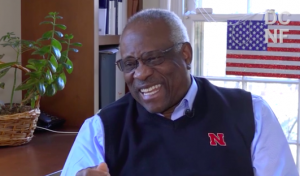
Justice Clarence Thomas (Screencap via Daily Caller News Foundation)
For me, racial gerrymanders are where my distaste for gerrymandering explodes into open war against my desire for diverse political representation. It’s an intellectual knot for which I do not have a clear preferred solution. I want there to be districts that are majority-minority so that minorities can at least have a shot at electing their “own” representatives. I am well aware of the racist history of this country that too often splits apart minority neighborhoods so that their voices are drowned out by white people when it comes time to vote. However, I’m also aware that herding — essentially ghettoizing — minorities into one or two districts leaves white candidates in other districts free to run and behave as if minority people don’t even exist. I know how the racial gerrymander can be used not to promote diverse representation, but subvert it. And I’m also aware and annoyed by the assumption that a district even needs to be majority-minority in order for minority candidates to have a real chance at being elected.
Everything about this issue is complicated, and those complications make my thinking intellectually inconsistent and unsatisfying. I want “good” racial gerrymandering, not “bad” racial gerrymandering. And I don’t trust most any white politician to know the difference.

What Even Is AI ‘Competence’? It Depends.
Takeaways from a Legalweek panel on evolving malpractice risks.
In this way, I envy Clarence Thomas’s intellectual clarity when it comes to racial gerrymandering. Don’t get me wrong, I don’t agree with him. Like I said, promoting diverse representation in government is a nuanced, complicated thing, and it’s a project that Clarence Thomas doesn’t give a rat’s ass about. But, his instincts to crush minority opposition to tyrannical, majoritarian rule leave him with a clear point when it comes to racial gerrymanders: they’re bad, always, and unconstitutional. Say what you will, dude, but at least it’s an ethos.
We’re about to find out if Thomas has the intellectual strength to carry out his ethos on gerrymandering, even when it hurts his clearly preferred political party. The case Virginia House of Delegates v. Bethune-Hill was argued again before the Supreme Court today, and this time Clarence Thomas is going to have to make a choice.
At issue is the state maps drawn up to govern the Virginia House of Delegates. Drawn in 2011, those maps went out of their way to keep certain districts at least 55 percent minority. The effect was to “pack” districts, and free the rest of Virginia’s districts up to be overwhelming white, with somewhat predictable results. Republicans have barely been able to maintain control of the House in Virginia. A more even distribution of minority voters would almost surely flip the House into Democratic hands.
When it comes to racial gerrymanders, the Supreme Court has ruled that race cannot be the “predominant factor” in the drawing of districts. Lower courts have ruled that this Virginia map violates that principle. The case has been up to the Supreme Court before, kicked back down, and now is being addressed again, but as it stands now, the Virginia map is out and the court is proceeding with drawing up a new map. The Supreme Court could have stayed the process of drawing a new map, but it did not, which is interesting.

Labor and Employment Federal Litigation Trends 2026
Drawing on more than a decade of data, the report equips law firms and corporate legal teams with actionable insights to better assess risk, refine strategy, and anticipate outcomes in today’s evolving workplace disputes.
It suggests that there is not a majority on the Court right now to overturn the lower court ruling. Given the known history of Chief Justice John Roberts to allow discrimination whenever it can take away the rights of non-whites to vote, and the general history of the other conservative Supreme Court justices, one must assume that Clarence Thomas is the key vote in this case.
On ThinkProgress, Ian Millhiser has an excellent breakdown of where things might stand after today’s oral arguments:
Thomas was characteristically silent, and he was nearly matched by his frequent ally, Neil Gorsuch, who asked just one brief question. Yet, in a partial dissent in the first Bethune-Hill case, Thomas took a rigid position, suggesting that any consideration of race in redistricting may need to be struck down.
“To comply with [the fully operational Voting Rights Act, a State necessarily must make a deliberate and precise effort to sort its citizens on the basis of their race,” Thomas wrote in his first Bethune-Hill opinion. “But that result is fundamentally at odds with our ‘color-blind’ Constitution, which ‘neither knows nor tolerates classes among citizens.’”
Thomas’s opinion suggests, in other words, that Virginia could not apply a 55 percent threshold no matter what the circumstances. It strongly suggests that he will ultimately vote to strike down Virginia’s maps.
Should the court split 5-4 (or 6-3) with Thomas (and maybe Gorsuch) in a majority striking down the Virginia maps, that would be a stunning indictment of Roberts and Alito. Roberts is the author of the court’s decision nuking much of the Voting Rights Act, and he often calls for lawmakers to take a color-blind approach in other cases involving race. If Roberts abandons this color-blind worldview in a case that benefits the Republican Party, he risks undermining his own image as a justice who places the law above partisanship.
I feel like you could lose a fortune betting on Republicans to be intellectually consistent when they have an opportunity to influence elections.
But Thomas isn’t just ideologically invested in this issue, he’s been strident about it in the past. He does not suffer my handicap of wanting to promote diverse representation in a pluralistic society.
He should vote to affirm the lower court and strike down this racial gerrymander. Unless he cares about Republicans winning elections more than any other belief he claims to have.
The fate of one of America’s worst gerrymanders appears to rest in Clarence Thomas’ hands [ThinkProgress]
Elie Mystal is the Executive Editor of Above the Law and a contributor at The Nation. He can be reached @ElieNYC on Twitter, or at [email protected]. He will resist.