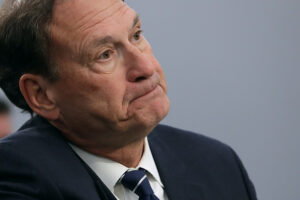
There’s a report out from NOTUS this week that Philip Alito, son of Supreme Court Justice Samuel Alito and former Gibson Dunn attorney, has been working at the Treasury Department. But um, no one at Treasury was in a hurry to advertise that fact. “Alito’s employment with the department is something of a closely guarded secret,” NOTUS reports. “He doesn’t maintain a public resume or LinkedIn, the Treasury Department website makes no mention of him, and his three professional bar listings are outdated or incorrectly list previous employers.”
The reason for the secrecy isn’t hard to infer. “Everybody knew who he was,” one source told NOTUS. “I think it’s fair to say he kept a pretty low profile. I kind of had the impression that he was kind of a little bit sheepish about his celebrity affiliation. You’d go into a meeting and if people were introducing themselves by first and last name, he’d just say ‘Phil,’ not Phil Alito.” According to a second source, Alito was made an attorney-adviser who would get briefed on all kinds of important Treasury matters and offer legal feedback, meaning he was, as that source put it, “in all the meetings” and “knew all the issues across the board.” The same source was direct about how he got there, “There’s no doubt he got that position because of who he is.”
All of which would be mildly noteworthy on its own. But it takes a turn to the ethically questionable because Philip Alito was working at Treasury while the Treasury Department, along with other agencies, was actively defending Trump’s tariffs before the Supreme Court. His father, Justice Samuel Alito, did not recuse himself and sat on those cases.
Protégé™ In CourtLink® Explains The Whole Case Faster
Designed to reduce manual docket work by prioritizing what litigators need most: on-demand full docket summarization that explains the whole case to date, followed by on-demand document summaries for filing triage, and AI-powered natural language searching for faster search and retrieval.
The official responses have been, let us say, carefully worded. “Philip Alito is currently detailed from the U.S. Attorney’s Office for the Eastern District of Virginia as a Counselor in the Office of the General Counsel, and his portfolio covers a broad range of topics,” a Treasury spokesperson said. “As a matter of both professional and personal judgment, Phil does not counsel on any matters reasonably expected before the Supreme Court.” Treasury Secretary Scott Bessent added: “I am sure that Mr. Alito follows all legal and ethical guidelines and I can assure you that at Treasury, we follow all the legal and ethical guidelines.” And the Supreme Court’s public information officer stated flatly: “While there, he has not worked on any matter related to the tariffs imposed by the federal government. As a result, Justice Alito has not recused in those cases.”
And that Phil Alito’s role was a weird secret is just a coinkydink is what we’re all supposed to buy, I guess.
The problem is that the entire predicate of this situation — a justice’s son working at a department actively defending administration policy before that same Supreme Court, in a role kept deliberately low-profile — is exactly the kind of thing that the recusal framework exists to address. The question isn’t only whether Philip Alito personally worked on the tariff cases, it’s whether a reasonable person could question the impartiality of a justice whose son holds a position of trust at one of the agencies whose most consequential policy was simultaneously before the Court. The answer to that question seems fairly obvious, which may be why the whole arrangement was handled with such conspicuous quiet.
This would be jarring from any justice. From Sam Alito, it lands differently because this is not his first, second, or even third ethics controversy. This is the same justice who flew an upside-down “Stop the Steal” flag outside his home after January 6th and then blamed his wife, refused to recuse himself from Trump-related cases despite the flag controversy, got caught accepting luxury travel from a donor with business before the Court and then denied the relationship despite the fact it was noted way back in 2009, and has serially declined to explain his recusals even after the Court adopted a new ethics code specifically designed to address that kind of opacity. A federal judge was literally rebuked for calling Alito’s flag behavior “improper and dumb” — because the Supreme Court, which considers itself exempt from all judicial ethics rules, took the position that criticizing a justice’s ethics is itself an ethics violation. You cannot make this up.

What Biglaw Can Learn From Personal Injury Firms
How a former insurance agent built a Houston injury practice around systems, empathy, and disciplined advocacy.
The Supreme Court has spent years resisting meaningful ethics oversight on the grounds that it is a co-equal branch of government that can govern itself. Philip Alito’s quiet Treasury role, and his father’s non-recusal in the tariff case, is a pretty good illustration of how that’s going.
Kathryn Rubino is a Senior Editor at Above the Law, host of The Jabot podcast, and co-host of Thinking Like A Lawyer. AtL tipsters are the best, so please connect with her. Feel free to email her with any tips, questions, or comments and follow her on Twitter @Kathryn1 or Bluesky @Kathryn1