
Ed. note: Please welcome Renee Knake Jefferson back to the pages of Above the Law. Subscribe to her Substack, Legal Ethics Roundup, here.
Welcome back! I hope August gave you some time to step away, look up, and enjoy the remains of summer.
One of my favorite moments was sailing beneath Michigan’s Mackinac Bridge, five miles of steel suspended between the mitten state’s two peninsulas and dividing Lake Michigan from Lake Huron. Looking up from the bow of the boat, I was overwhelmed by both its scale and the intricate structure required to keep something so consequential standing. (Lake Michigan also took on a more personal place in my life this summer, though I’ll save that story for another day.)

From ‘Associate’ To ‘Doppelganger’: The Evolution Of The Legal AI Persona
Confronting Biglaw’s ‘snake eating its own tail’ problem.

I’ve found myself thinking about how our institutions are a lot like that bridge. Courts, law schools, the legal profession, and our democracy can appear enduring from a distance. Up close, their strength depends on structures that require attention, maintenance, and people willing to take responsibility for them. There is a great deal happening in our corner of the legal world, and, as ever, plenty that captivates, concerns, surprises, and inspires me.
I’m glad to be back, and very happy you are here with me.
The Year Ahead

Willkie Elevates Legal Work with Lexis+ with Protégé
Willkie AI and Innovation leader Todd Friedlich spoke to LexisNexis about firm’s thoughtful approach to legal AI
As we enter our fourth year, my reason for offering this free resource remains unchanged: there has never been a greater need to understand the ethical duties of lawyers and judges. I’m grateful for this community of lawyers, judges, students, academics, journalists, and others who care about the role legal ethics plays in our democracy.
I look forward to continuing this service over the coming year. A few reminders:
FIRST, as always, the LER remains free to all subscribers. So, if you haven’t subscribed, take a moment now to sign up at the link below and you’ll never miss the latest edition.
SECOND, the LER will largely continue in the same format. On Mondays you’ll receive a summary of the top ten legal ethics headlines. On the first Monday of the month, you’ll receive a longer version (“First Monday Edition”) with the headlines plus reading recommendations, teaching resources, job postings, events, and other features. And occasionally you’ll receive bonus content posts, free to all subscribers, for breaking news that can’t wait until Monday or for other special announcements. This year I’m adding a new “On My Calendar” feature to share some of theconferences, programs, and professional conversations I’m helping to shape, along with opportunities for LER readers to join in, contribute ideas, and connect in person.
THIRD, please also consider becoming a paid subscriber, which helps to support this newsletter and demonstrates that you value its content. Paid subscribers also receive special access to past posts which become paywalled after six months. (If you need a comp paid subscription to read an older post, let me know at [email protected].)
FOURTH, I welcome feedback as well as news tips, announcements, events, job postings, and reading recommendations via email.
Since this is my first Monday post of September, you get a ‘First Monday Edition,’ even though technically we’re already on the second Monday of the month. And because I’ve been away for a while, we will begin with fifteen headlines instead of the usual ten. Let’s dive in!
Highlights from the Past Few Weeks – Top Fifteen Headlines
#1 “How Two Men Without Lawyers Got Their Cases to the Supreme Court.” From The Wall Street Journal: “An Orthodox Jewish father of five who plays rock music in his spare time. A federal prisoner serving a 20-year sentence for a Mafia-linked racketeering conviction. These two men have one unlikely thing in common. Without legal representation, they asked the Supreme Court to hear their cases. And against long odds, the court said yes.” Read more here (gift link).
#2 “What We Learned from a US Bus Tour of Judges.” From Waging Nonviolence: “A recent bus tour of US judges proves the power of meeting people in their communities to talk about why the rule of law matters in their everyday lives. Over four days in July, roughly 30 judges, sitting and retired, state and federal, climbed on and off a bus at courthouses, coffee shops, a Cracker Barrel, and community centers and libraries from Greensburg, Pennsylvania, to Grosse Pointe, Michigan. The goal was straightforward — to visit with people in their communities to talk about why the rule of law matters in their everyday lives. They engaged one on one, in small groups and in front of large audiences. The tour was called Justice in Motion, and was created and run by our organization, Democracy Rising Collaborative, together with Keep Our Republic. We borrowed the model from judges in Poland, who figured out, the hard way, how to defend an independent judiciary when the traditional tools weren’t enough.” Read more here.
#3 “Ninth Circuit Delivers Sweeping Victory to News Service on Public Access.” From Courthouse News: “A three-judge panel on the highest federal court in the Western states ruled that Idaho had violated the First Amendment by enforcing a ‘process-first’ policy that resulted in a blackout of new court pleadings when they are received. In clear and undiluted language, the Ninth Circuit addressed and rejected the arguments against public access advanced by Idaho and other states in fighting cases brought by Courthouse News. ‘The right of public access to judicial proceedings ensures that the individual citizen can effectively participate in and contribute to our republican system of self-government. The right therefore falls within the heart of the First Amendment’s coverage,’ wrote Judge Margaret McKeown.” Read more here.
#4 “An Unconventional Solution to Trump’s Student Loan Caps.” From Politico: “Republicans capped federal student lending for graduate degrees, so a few schools are starting their own loan programs.” Read more here. Meanwhile, from Law360: “This year’s U.S. law school applicant pool is up nearly 8% over 2025 with significant growth in Asian and Black prospective attorneys, according to new data from the Law School Admissions Council.” Read more here.
#5 “How Wall St. Profits When Personal Injury Lawsuits Pay Out.” From The New York Times: “Personal injury cases have exploded, in number and magnitude, funded by companies betting on a win — and offering investors a piece of the action.” Read more here (gift link).
#6 “Florida Bar Rejects Bid to Review DHS Lawyer Over Judge Posts.” From Bloomberg Law: “The Florida Bar has declined to investigate a complaint by dozens of retired judges against the Department of Homeland Security’s top lawyer over a social media thread highlighting the ‘worst of the worst’ judges. The Florida Bar ‘does not investigate or prosecute sitting officers appointed under the U.S. Constitution while they are in office,’ Christopher Stephen Wackes, bar counsel, wrote in a letter to Peggy Ann Quince, a retired Florida Supreme Court justice who led the complaint against DHS General Counsel James Percival.” Read more here.
#7 “Federal Judges’ Interns May Accept Stipends From Law Firms, Ethics Panel Says.” From the ABA Journal: “The U.S. Judicial Conference’s Committee on Codes of Conduct has determined that law students who work as unpaid interns for federal judges may accept stipends from law firms looking to recruit them as summer associates—so long as the payments meet certain requirements.” Read more here.
#8 “Supreme Court Holds That Filing a State Bar Charge May Support a Lawsuit for Wrongful Institution of Civil Proceedings.” From the Arizona Supreme Court Administrative Office of the Courts: “The Arizona Supreme Court today held that a State Bar of Arizona charge filed with malice and without probable cause may qualify as a ‘civil proceeding’ for purposes of a wrongful institution of civil proceedings claim. The Court’s decision came in Accursio v. Tree House Labs, LLC. … The Supreme Court held that the State Bar process may qualify as a civil proceeding because filing a charge starts a process governed by court rules that may (1) require a respondent to respond to a charge by providing information and documents and being subject to a deposition; (2) result in the issuance of investigative subpoenas and the initiation of civil contempt proceedings; (3) require the respondent to pay restitution to people financially injured, civil penalties, and fees and costs relating to the proceeding; and (4) subject the respondent to professional discipline, disbarment, sanctions, and other substantial consequences.” Read more here.
#9 “Formal Opinion 525: Client With Decision-Making Limitations.” From the American Bar Association: “The American Bar Association Standing Committee on Ethics and Professional Responsibility released a formal opinion today providing updated guidance for lawyers representing clients with decision-making limitations. Formal Opinion 525 is intended to help lawyers fulfill their professional responsibilities while respecting the rights, preferences and dignity of clients with decision-making limitations.” Read more here.
#10 “The Birth of the New Legal Right.” From Alex Wagner in The Atlantic (previewing her new book The Steal: Four Right-Wing Hard-Liners, One Republican Presidency, and the Raid on America’s Courts): “America’s highest court didn’t take on a deeply partisan, conservative bent overnight. This transformation began decades ago, with a simple purpose: In the early 1980s, three law students were fed up with what they saw as a liberal monoculture at their elite universities. They wanted a place to freely debate conservative ideas and to refine their arguments. So the students—Lee Liberman, Steve Calabresi, and David McIntosh—decided to build one.” Read more here (gift link).
#11 “ACLJ Files Supreme Court Petition Defending Professor and Former Trump Lawyer John Eastman From Politicized Disbarment.” From a press release by the American Center for Law and Justice: “Months ago, we told you the fight to defend Professor John Eastman was headed to the Supreme Court of the United States. Today, the ACLJ filed a petition for a writ of certiorari asking the Supreme Court to review – and reverse – the disbarment of Professor Eastman by the State Bar of California.” Read more here and read the cert petition here, which was filed this past Friday.
#12 “Has the Supreme Court Sandbagged Democracy?” From Daniel Immerwahr in The New Yorker reviewing the books Separation of Powers by Cass R. Sunstein and Supremacy by Nikolas Bowie and Daphna Renan: “A new legal history argues that the Justices should be stripped of their power to overrule coequal branches of government. It arrives at an awkward moment.” Read more here (gift link).
#13 “5th Circuit Vacates $125M Award After Discovery of Federal Judge, Trial Counsel’s Friendship.” From the ABA Journal: “A federal appeals court on Tuesday tossed a $125 million award in a complex contract dispute between IFG Port Holdings and the Port of Lake Charles, Louisiana, citing an undisclosed longtime friendship between the U.S. magistrate judge who heard the case and IFG Port Holdings’ lead trial counsel. In its Sept. 8 opinion, the 5th U.S. Circuit Court of Appeals at New Orleans noted that now-former U.S. Magistrate Judge Kathleen Kay of the Western District of Louisiana disclosed that the daughter of IFG Port Holdings attorney William Monk of Stockwell, Sievert, Viccellio, Clements & Shaddock had clerked for her and would be screened from the case. But Kay did not disclose that she had known Monk for 40 years, that he had been a groomsman at her wedding, and that she officiated his daughter’s wedding. ‘Judge Kay’s disclosure was incomplete, at best, and perhaps misleading,’ according to the 5th Circuit. ‘The partial disclosure implied that Monk’s daughter’s clerkship was the extent of their ties, when the friendship was far closer.’” Read more here.
#14 “ED Threatens ABA’s Ability to Accredit Law Schools.” From Inside Higher Education: “The Trump administration is trying to strip the American Bar Association’s accreditation council of federal recognition—a move that could disrupt legal education more broadly.” Read more here. [Full disclosure: I am a member of the accreditation council.]
#15 “Should Wachtell Litigators Launch Their Own Boutique Firm?” From David Lat in Bloomberg Law: “‘To the extent that this enables clients to have more choice, it could be an advantage,’ said University of Houston law professor Renee Knake Jefferson, an expert in legal ethics. ‘With no longer any presumption that the client will use Wachtell’s litigation team, there’s a built-in, structural autonomy for the client.’ So that’s the argument for a litigation spinoff at Wachtell Lipton. But will it actually happen? Probably not.” Read more here.
On My Calendar
Planning is underway for the ABA Center for Professional Responsibility National Conference at the University of Houston, June 2–4, 2027, which I am chairing this year. The call for proposals is now open, and I hope to see ideas from LER readers. Submissions are due October 9, but we are reviewing on a rolling basis so I encourage you to submit yours soon. Looking for other upcoming ethics events? You’ll find a list here.
Ethics Reforms
In August, the ABA House of Delegates approved numerous revisions to the ABA Model Rules of Professional Conduct. Fortunately, the ABA Center for Professional Responsibility created a handy chart for tracking all the changes.
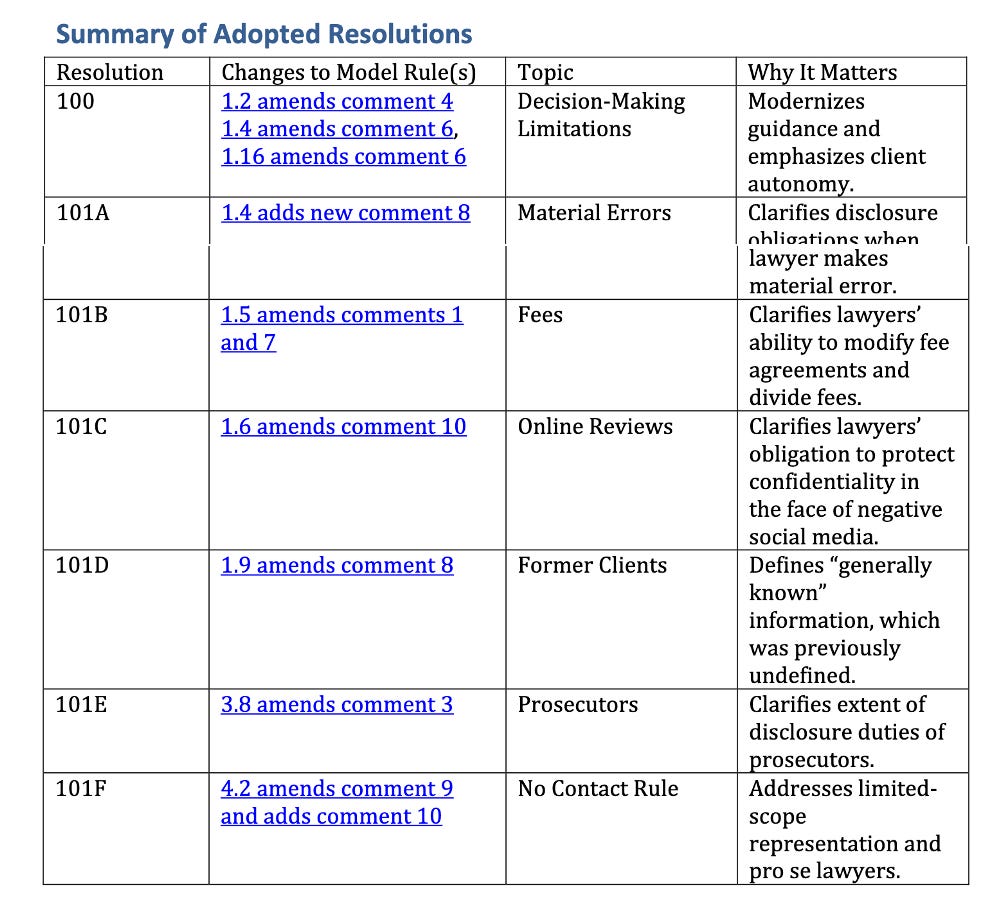
And here’s a high-level overview of the reforms:
The ABA Center for Professional Responsibility is pleased to report on the successful adoption of seven ethics-related Resolutions by the ABA House of Delegates at the 2026 ABA Annual Meeting. Together, the Resolutions enhance and clarify guidance in various Model Rule Comments by incorporating important guidance from longstanding ABA Formal Ethics Opinions. The adoption of Resolutions 101A through 101F marks the culmination of a project initiated in 2025 to evaluate whether important guidance contained in ABA Formal Opinions should be incorporated directly into the Model Rules Comments. Drafts were circulated broadly and refined through stakeholder feedback over the last 2 years. In addition, Resolution 100 aligns Comments to Rules 1.2, 1.4, and 1.16 with the new Model Rule 1.14 on clients with decision-making limitations. The amendments to these Comments emphasize supports, accommodations, and communication techniques that maximize client participation in legal decision-making.
Recommended Reading
Taken together, this month’s selections raise a fundamental question for the profession: who should provide legal services, under what ethical constraints, and what responsibilities do lawyers bear for preserving access to justice and the rule of law? Enjoy.
“Frail Professionalism? Lawyers’Ethics after the Post Office and Other Cases” by Richard Moorhead (University of Exeter). You can download the entire book for FREE(!) thanks to generous funding from the Economic and Social Research Council. Here’s an excerpt from the introduction:
This book, and the Hamlyn lectures on which it is based, come at a time of unparalleled interest in lawyers’ ethics. Several phenomena drive this interest. There has been growing political concern about the role of lawyers in enabling grand corruption by kleptocrats and oligarchs. Putin’s invasion of Ukraine forced many law firms to rethink their business interests in Moscow and question whether there were wealthy clients for whom they will not act. This sort of client relationship, and the challenge to law firms representing businesses said to engage in the destruction of the environment, called into question lawyer claims to be simply promoting the rule of law through their representation. As I write these words, Donald Trump has begun a campaign as president, using executive orders to punish law firms for cases they have brought for their clients, including for Trump’s opponents, or their support for diversity, equity, and exclusion policies. …
The book touches on many of these examples, and others. It was also written at a critical juncture: a moment of calamity for the legal profession and the legal system. That moment of calamity was the Post Office (PO) scandal. This has been described as the most widespread miscarriage of justice in England and Wales. It is a story that is set out in the rest of this book. Hundreds and hundreds of ordinary men and women, as well as their families, had their lives ruined by legal action conducted for the PO. That legal action, and what followed it, involves questionable conduct by a great many lawyers across many years and many cases. The scandal is emblematic of how individual ethics and system failures can lead to profound injustice. It also speaks, I would say, to a significant problem of honesty and responsibility in political, commercial, and legal life. That problem is encapsulated in broader concerns about a cover-up culture but also a sense, amongst so many of the scandal’s victims, that there is one law for them and another for the powerful: two-tier legality driven by what I define later as aggressive lawyering. I will argue that such two-tier legality and aggressive lawyering pose a risk to the rule of law.
Download the book here.
“Farm Advocates: Unearthing an Access to Justice Success Story” by Ellen Murphy (Wake Forest). From the abstract:
This is the untold story of a grassroots group of lay legal advocates who – in defiance of unauthorized practice of law restrictions – provided legal assistance to countless farmers and farm families during the 1980s Farm Crisis. The Farm Crisis followed a period of unprecedented prosperity in farm country. But when the boom ended, many farmers were saddled with unmanageable debt. Farm country and much of rural America faced catastrophic loss of people, community, and institutions. Pressured by class actions against government lending agencies, Congress (eventually) responded with statutory relief for the farmers. However, obtaining the relief was legally complex and, as remains true today, farm country faced a simultaneous crisis: access to justice. Farmers needed legal assistance, but lawyers were scarce, cost-prohibitive, and unfamiliar with agriculture’s legal complexities and cultural norms. The farm advocates stepped up to provide the legal services that farmers needed. …
The farm advocates’ legal work saved countless farms and restored hope to rural communities. Analyzing hundreds of pages of training materials and oral histories, this article unearths their contribution to access to justice. The farm advocates were a small but mighty force in the history of access to justice. Their story challenges the foundational premise of lawyer regulation: that legal services can be competently provided only by lawyers and that law practice by unlicensed practitioners invariably harms the public. The farm advocates’ story shows, to the contrary, that legal services can thrive outside of the lawyer monopoly, and that strict enforcement of unauthorized practice of law restrictions can deprive people of help that is essential to their lives and livelihoods.
“The Jailhouse Bar” by James Stone (University of Chicago). From the abstract:
Every state prohibits nonlawyers from practicing law. For a century, that prohibition has run wide and deep, criminalizing nearly any legal help by the unlicensed. As defended by the bar, this ban is necessary to properly protect clients’ legal interests. As critiqued by a ballooning band of scholars and stakeholders, the bar’s professional gatekeeping has restricted the legal-aid pool to catastrophic effect. Both sides of this debate assume that today, nonlawyer advocacy is rare or cabined, and—lacking evidence of its efficacy—armchair theory abounds.
But a startlingly robust, longstanding form of nonlawyer advocacy has gone almost entirely ignored in this debate. Jailhouse lawyers—incarcerated people who teach themselves the law—provide a kaleidoscopic array of legal help to other prisoners, from advice to motion practice to in-person advocacy, on everything from divorces to postconviction petitions and civil rights actions. Courts quietly welcome them, the American Bar Association supports them, and almost every prison permits their practice. Indeed, several prisons go further, operating de facto law firms staffed by incarcerated law clerks who litigate for the prison population. With prison-inflected cases a huge share of state and federal dockets, these nonlawyer advocates wield a profound, if unnoticed, influence on our law.
What justifies this broad departure from the license-or-bust status quo? Drawing on an expansive array of sources, the Article looks for answers in jailhouse practice on the ground, describing how freelance and prison-employed jailhouse lawyers learn the law, build reputations, attract clients, and interact with staff and courts. … The Article concludes that despite prison’s obvious differences from the free world, the jailhouse bar betrays an unjustified incoherence in the regulation of legal services. Without deciding how to resolve that inconsistency—that is, whether to extend nonlawyer practice beyond prison or eliminate it within—the Article concludes by reflecting on lessons the jailhouse bar might teach as we stare down an increasingly unstable future world of legal aid.
“Lawyers, the Rule of Law, and the Executive Orders Targeting Law Firms” by Bruce Green (Fordham) and Eli Wald (Denver). From the abstract:
In the spring of 2025, President Trump issued a series of executive orders, and threatened to issue more, sanctioning major American law firms largely in retaliation for their choice of clients and causes. The legal community widely perceived this move as an attack on the rule of law, in large part because the executive orders were designed to restrict future clients’ access to legal assistance, which is regarded as essential to the fair administration of justice, especially in disputes with the government. Four law firms targeted by the executive orders brought so-far successful constitutional challenges, while one targeted firm, along with others that anticipated being targeted, entered into agreements with the President requiring the firms, among other things, to donate pro bono services to mutually acceptable clients and causes. The litigating firms and their counsel were lauded for defending the rule of law, while the law firms that settled or declined to join amicus briefs opposing the executive orders faced criticism. Although rules of professional conduct do not impose an enforceable obligation on lawyers to protect and defend the rule of law, we suggest that the legal profession has a collective obligation to defend the rule of law, and that individual lawyers and law firms have an obligation to contribute. Further, BigLaw firms are particularly well situated and predisposed to assume this role, given their resources, their elite professional status, and their traditional and ongoing cultural commitment to the rule of law in other respects. Like several other scholars, we therefore wonder why many or most BigLaw firms abdicated what might be regarded as their professional responsibility. Our answer is that the abstract obligation to defend the rule of law is insufficiently articulated, unenforceable, and informal, while the market incentives to maintain good working relations with the executive branch are more tangible and compelling. The organized bar, however, could endeavor to change law firms’ calculus in the future by better articulating and formalizing lawyers’ professional obligation to protect and defend the rule of law.
Legal Ethics Trivia
From the Texas Center for Legal Ethics, here’s the question of the month: “Did this pro se lawyer violate the [ethics rules] by communicating directly with a person represented by counsel?” Test yourself at this website where you can read a short hypothetical, select an answer, and see your results. So far, only 21% have gotten it right. Will you?

Get Hired
Did you miss the 500+ job postings from previous weeks? Find them all here.
Compliance & Ethics Counsel Specialist, Accenture — Mumbai. From the posting: “The objective of the role is to provide comprehensive support to the Global Integrity & Financial Crime team within Ethics & Compliance to review and assess new Ventures and Acquisitions and Joint Ventures for Trade Compliance, AML and Anti-Corruption risks. Key Responsibilities: Understanding Ethics & Compliance principles, including the ability to identify, assess, and escalate compliance risks.” Learn more and apply here.
Corporate Counsel, Business Conduct & Ethics Investigations, Amazon — Arlington or Seattle. From the posting: “Amazon’s Legal Department is looking for an attorney with significant experience in corporate investigations and compliance programs to join its Business Conduct & Ethics Investigations Program.” Salary range $153,900 to $208,200. Learn more and apply here.
Director of Litigation and Policy, Center for Ethics and the Rule of Law, University of Pennsylvania — Philadelphia. From the posting: ”CERL seeks a full-time Litigation and Policy Director to lead its nationwide initiatives in U.S. courts, supporting and advising members of Congress, executive branch officials, and actors in state and local government. This position will work in close collaboration with CERL’s Faculty Director, post-doctoral fellows, members of CERL’s Executive Board, Advisory Counsel and Faculty affiliates and Penn Carey Law students to align CERL’s litigation and policy work with strategic defense for the rule of law and Penn’s pedagogical mission.” Learn more and apply here.
OGC Counsel – Conflicts & Ethics, Latham & Watkins — Multiple Locations (Remote). From the posting: ”The OGC Counsel is an integral part of Latham’s Office of the General Counsel team. This role will be responsible for resolving professional ethics conflicts and related compliance issues by applying legal ethics rules, professional responsibility principles, Latham & Watkins policies, and practical judgment to lateral clearances, new business matters, outside counsel guidelines, engagement terms, waivers, ethics walls, and related risk-management issues, while coordinating with partners, Ethics Committee Members, and other stakeholders to resolve conflicts issues, communicating status updates and following through until the matter is resolved or appropriately escalated.” Salary range $170,000 to $200,000. Learn more and apply here.
Senior Program Analyst, Office of Professional Competence, State Bar of California — San Francisco or Los Angeles (Hybrid). From the posting: “This role is ideal for someone who thrives at the intersection of research, writing, and public service. You’ll field real questions from attorneys navigating complex issues — conflicts of interest, confidentiality, unauthorized practice of law — and help shape the guidance resources attorneys across California rely on.” Salary range $104,308 to $139,079. Learn more and apply here.
Sr. Corporate Counsel – Ethics & Conflicts, Littler Mendelson P.C. — Multiple Locations (Remote). From the posting: ”The Senior Corporate Counsel – Ethics & Conflicts will serve as a senior advisor on attorney ethics and professional responsibility matters, including analysis and guidance on obligations arising under applicable rules of professional conduct across all jurisdictions where Littler attorneys are licensed to practice.” Salary range $171,800 to $225,700. Learn more and apply here.
Keep in Touch
News tips? Announcements? Events? A job to post? Reading recommendations? Email [email protected] – but be sure to subscribe first, otherwise the email won’t be delivered.
Renee Knake Jefferson holds the endowed Doherty Chair in Legal Ethics and is a Professor of Law at the University of Houston. Check out more of her writing at the Legal Ethics Roundup. Find her on X (formerly Twitter) at @reneeknake or Bluesky at legalethics.bsky.social.