 By now, you must have heard that a legal education in 2016 costs quite the pretty (debt-financed) penny. At the vast majority of law schools, the cost of a law degree, including tuition and fees, is well in excess of six figures. Take, for example, the average 2015 graduate of Thomas Jefferson School of Law, who has $172,726 in debt and a 24.5 percent chance of working as an attorney in a full-time, long-term job 10 months after graduation. That is truly, truly frightening.
In a world where the average class of 2015 law school graduate carries a debt load of $112,748 (up from an average of $111,899 for the class of 2014), there must be a few schools out there that won’t destroy a would-be lawyer’s financial footprint forever.
Which law school graduates have the least debt of all? U.S. News has a ranking for that.

Beyond Recall And Precision: Strategic Oversight Of AI Managed Review
AI can accelerate document review, but metrics alone aren't enough. Learn how Managing Attorney oversight turns AI-driven review into a more adaptive, strategic and defensible process.
These are the 10 law schools with the lowest average indebtedness for 2015 graduates:
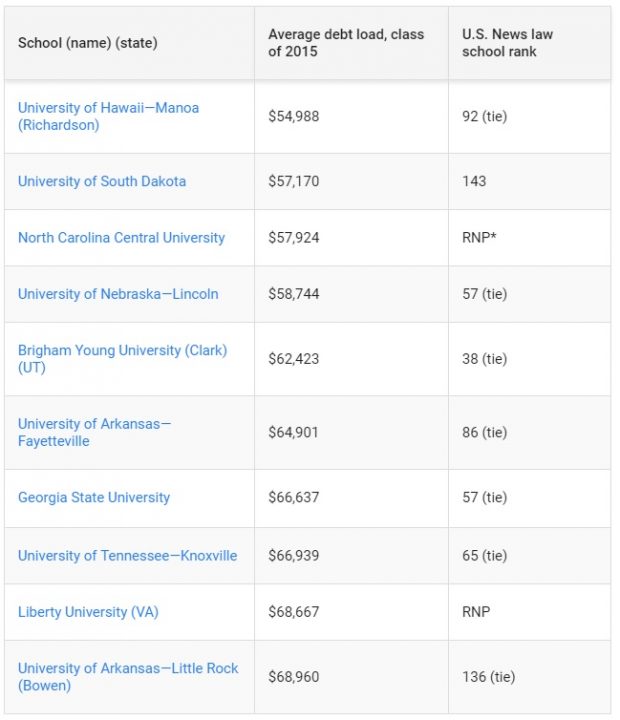
Before you get too excited, we would be remiss if we didn’t mention that just because you’ll be likely to leave these law schools with a lower debt load, it doesn’t mean you should drop everything and run to apply. Here are the relevant employment statistics for the class of 2015 at these 10 law schools where grads have lower than average debt loads:
- Hawaii: 54.5 percent employed in full-time, long-term jobs as lawyers
- South Dakota: 55.7 percent employed in full-time, long-term jobs as lawyers
- North Carolina Central: 32.7 percent employed in full-time, long-term jobs as lawyers
- Nebraska: 69.6 percent employed in full-time, long-term jobs as lawyers
- Brigham Young: 56.4 percent employed in full-time, long-term jobs as lawyers (without BYU Law’s nine school-funded positions, it’s really 49.6 percent employed in full-time, long-term jobs as lawyers)
- Arkansas-Fayetteville: 64.6 percent employed in full-time, long-term jobs as lawyers
- Georgia State: 64.3 percent employed in full-time, long-term jobs as lawyers
- Tennessee: 65.6 perccent employed in full-time, long-term jobs as lawyers
- Liberty: 50.8 percent employed in full-time, long-term jobs as lawyers (without Liberty Law’s one school-funded position, it’s really 49.2 percent employed in full-time, long-term jobs as lawyers)
- Arkansas-Little Rock: 52.4 employed in full-time, long-term jobs as lawyers

Managing Partners are Navigating the AI Inflection Point.
New executive research from Ari Kaplan explores how law firm leaders are responding to changing client expectations, evolving economics, talent transformation, and AI governance.
Unfortunately, it seems that even if you attend a law school that leaves its graduates with a lower than average debt load, it’s still a 50/50 toss-up in most cases as to whether you’ll actually be employed as a lawyer. But look on the bright side: at least if you don’t have a job, your overall debt burden won’t be as worrisome as it could’ve been.
10 Law Schools Where Alumni Have the Least Debt [Short List / U.S. News & World Report]
Staci Zaretsky is an editor at Above the Law. Feel free to email her with any tips, questions, or comments. Follow her on Twitter or connect with her on LinkedIn.