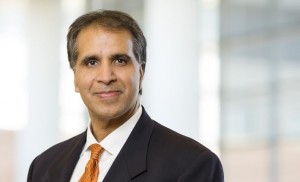
Dean Vikram David Amar
Ed. note: Please welcome our newest columnist, Dean Vikram Amar of the University of Illinois College of Law, who will be writing a monthly column about legal education.
Near the beginning of the fall semester, as I was diving in to my new job as the Dean of the College of Law here at the University of Illinois, David Lat and Above the Law were kind enough to interview me about some of my inclinations, expectations, and objectives. Now that the spring semester is winding down and I’m close to wrapping up my first academic year as a dean, I am delighted to begin writing a regular monthly post for the website (provisionally entitled “First Monday Musings by Dean Vik Amar”), in which I will, among other things, share some of the lessons I am learning as a dean about legal education and the legal profession, and discuss areas in which my thinking has evolved.

AI Is Reshaping Legal Practice—But Tools Aren’t The Real Differentiator.
Explore the mindset, cultural shifts, and training strategies that define the AI‑savvy lawyer, revealing why human judgment, standardized competence, and integrated learning—not technology alone—will shape the future of the profession.
I am still very much a work-in-progress as a law school dean, but I surely feel more informed and sophisticated than I did eight months ago. While no doubt my understandings of many important topics will continue to develop, I offer below my views on two particular themes that have been on my mind a lot recently.
Bureaucracy
Let’s start with the fact that large research universities have more bureaucracy than anyone outside of them can probably begin to appreciate. Coming to Illinois, as I did, from the University of California, I wondered how the red-tape burden would compare, and I regret to say both university systems (and I expect all large universities) have lots of room for improvement. I fully appreciate that public universities in particular need to go through complex and seemingly cumbersome processes on account of due process, but the level of detail and redundancy in the memos that must to be written, reincorporated, reconfigured, and reprocessed, and the number of distinct bodies through which certain decisions need to be run, can be mind-numbing. And as was true in California, the relationship between the system-wide Office of the President and the various campuses is often complicated and opaque, leading critics to question its efficiency.
The difficult blending of bureaucratic systems and academic missions is not a challenge unique to public universities; Jeannie Suk of Harvard has written, for example, about the difficulties that arise when non-academic administrators at private as well as public schools play key roles in safeguarding against sexual harassment (and others have written in a similar vein about bureaucratic compliance with the Americans With Disabilities Act). As a dean looking for ways of saving and generating revenue, I am particularly struck by cumbersome and costly procurement processes, and by limitations on the use to which revenues can be put. Sometimes it is even hard to know where the legal (or other) sources of the limitations are, and yet everyone seems constrained by them.

AI Built for Litigation. Verified by Design.
Grounded in authoritative content and verified at every step, Protégé is the only legal AI tool that delivers work you can trust—without exception.
For example, at Illinois there is apparently a requirement that revenue generated from non-degree programs (like executive education or continuing education) can be used to operate only those programs themselves, and cannot be spent to pay for the faculty and other costs associated with the degree programs (JD, LLM, etc.). In a world (and a university) where some students, units, and departments cross-subsidize others, why it makes sense to differentiate in a bright-line way between degree and non-degree program revenues is certainly non-obvious, especially when the rule creates some perverse incentives concerning innovation and worthwhile revenue generation. Worse yet, it’s hard to even find out where the limitation – let alone a compelling rationale for it – actually comes from.
Metrics
A second issue to which I’ve had to give some thought of late is which metrics to care and crow about. The U.S. News law school rankings came out recently, and even before they were announced I had begun to think about what, if any, kind of public statement I would make about Illinois’ performance. I decided that whether we went up or down, I would not feel the need to comment on our movement, largely because I – like almost all knowledgeable analysts – see deep flaws with the U.S. News methodology. Even before I arrived at Illinois, I knew that the law school here had over the last several years been ranked in as high as 21 and as low as 47, even though the underlying quality of the faculty, programs, employment prospects, etc., had not changed appreciably during this recent period. This kind of volatility over a short period of time strongly suggests that some aspects of the survey may be heavily influenced by extrinsic factors (in the case of Illinois, by an admissions data misreporting episode that may still be in the minds of some folks but that is more than five years old and that involves no one still connected with the administration of the law school). So whether we go up or down in U.S. News, don’t expect to see me dwell on it.
But to say that U.S. News is not a good metric is not to say that metrics are unimportant. I do want to make sure we are on the right tracks as a law school, which requires that I identify the most important things great law schools should be doing. The two that stand out for me are: (1) training students for the most sophisticated and selective job opportunities, and (2) producing scholarship that others in search of knowledge and wisdom find useful.
As to the former, I am paying attention to the National Law Journal’s statistics on the percentage of recent graduating classes to find employment at the largest 100 or 250 law firms. It is certainly not that I think these are necessarily the best law jobs for all law students to pursue, but they are the law jobs (along with federal judicial clerkships and teaching fellow positions) as to which there is the keenest competition – that is, the jobs as to which employers have the strongest set of applicants from which to choose. (I believe the ATL law school rankings also embrace that view, at least to some extent.) So it is a point of pride to me that Illinois continues to do very well in this metric, outperforming all the other public law schools in the Midwest region except the University of Michigan, and indeed doing better than all but a very small number of public law schools located at some distance from the east or west coasts. There is always more work to be done in facilitating job opportunities for students (and that’s what I feel we do – students themselves deserve the credit for obtaining the jobs, but the law school can provide the entrees – and I would say that it is an aspect of my job as dean on which I spend quite a large amount of time).
And as to the latter (scholarly impact), while citation counts in articles and cases, and journal article download counts are not free from manipulation and imprecision, I do care about our aggregate performance in those areas, and hope to continue if not improve upon our excellent standing among the nation’s top schools in comparative rankings of scholarly influence. Important questions in the future include how citation counts will fully capture the important interdisciplinary work that many law professors do that is published (and cited) in non-law journals. But since, to paraphrase Chief Justice John Marshall in McCulloch v. Maryland, we must never forget it is a law school we are operating, keeping track of how legal idea consumers (other legal academics and lawyers/judges) are making use of our work is the most important aspect of scholarly influence.
Earlier: Meet A New Law School Dean: An Interview With Vikram Amar
Vikram Amar is the Dean of the University of Illinois College of Law, where he also serves the Iwan Foundation Professor of Law. His primary fields of teaching and study are constitutional law, federal courts, and civil and criminal procedure. A fuller bio and CV can be found at https://www.law.illinois.edu/faculty/profile/VikramAmar, and he can be reached at [email protected].