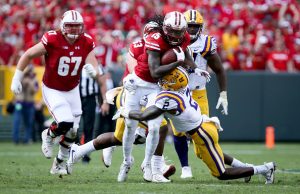
(Photo by Dylan Buell/Getty Images)
As LSU limped off of the Not-So-Frozen Tundra of Lambeau field on Saturday, victims of a punishing 16-14 defeat at the hands of then-unranked Wisconsin, sports media reveled in the mammoth upset as just one more highlight of the “best opening weekend ever.”
But LSU economists Naci Mocan and Ozkan Eren had another reason to rue the loss. The pair of professors knew full well that the Tigers loss would bring life-changing misery to juveniles facing sentencing this week. The authors of Emotional Judges and Unlucky Juveniles looked at 8,200 sentences involving 207 judges and the results were as predictable as a Cam Cameron play call. As described in Emily DeRuy’s latest in The Atlantic:

Why Experience Still Matters In An AI-Driven Legal Industry
A conversation with Trustpoint.One CEO Christopher Gallagher.
In looking at decisions handed down by judges in Louisiana’s juvenile courts between 1996 and 2012, the pair found that when LSU lost football games it was expected to win, judges—specifically those who had earned their bachelor’s degrees from the school—issued harsher sentences in the week following the loss. When the team was ranked in the top 10 before the losing game, kids wound up behind bars for about two months longer, on average. When the team was not as highly ranked, it was a little more than a month.
It’s not entirely surprising that communities that put such all-encompassing emotional investment into the outcome of a few precious games every year would see disappointment manifest itself in other, more destructive ways throughout the week. That a human being could be subjected to 60 days of confinement because an overgrown adolescent sports fan can’t find some perspective after a group of 18- to 22-year-olds lose a game is a terrifying statement about America.
The pair found that the harsher sentences disproportionately affected black defendants.
Of course they did. Did we even need this sentence?

Beyond Recall And Precision: Strategic Oversight Of AI Managed Review
AI can accelerate document review, but metrics alone aren't enough. Learn how Managing Attorney oversight turns AI-driven review into a more adaptive, strategic and defensible process.
Remember, as bad as these results are, at least LSU is an underdog once in awhile. Can you imagine the sentencing hellscape in Alabama after a Utah or a Louisiana-Monroe reaches up and knocks the smirk off Nick Saban’s face?
A 12-year-old got the chair for jaywalking that Monday.
But, what are you going to do? Sentencing guidelines only codify biases and guarantee all situational nuance is lost. And we can’t just close down sentencing hearings until the weekend they play The Citadel or some other tomato can of an opponent. Actually… why can’t we do that? Just don’t let Southern judges issue sentences until creampuff weekend. It’s so simple! Those games are sure-thing layups for an SEC and… oh God no!
I give up. Sentencing is broken always and forever.
But in the meantime, for the sake of the children of Louisiana… it’s time to fire Les Miles.
Judge’s Football Team Loses, Juvenile Sentences Go Up [The Atlantic]
Joe Patrice is an editor at Above the Law and co-host of Thinking Like A Lawyer. Feel free to email any tips, questions, or comments. Follow him on Twitter if you’re interested in law, politics, and a healthy dose of college sports news.