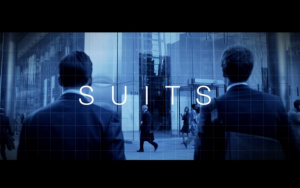
 I can excuse Suits for depicting a judge decide an important motion to dismiss as she casually embarks on a walk-and-talk with the opposing lawyers in the hallway. I can excuse Suits for the fact that lawyers nonchalantly walk into their opposing counsel’s offices, completely bypassing any security. I can even excuse Suits for the fact that their lawyers engage in complicated legal work at their desks on the tiniest computers known to man. But the Suits plot twist that occurred a few weeks ago – in which the show pretended that the attorney-client privilege did not exist – is inexcusable, and it’s a microcosm of the issues I have with this show (this column will contain spoilers through last week’s mid-season finale).
As I’ve written about before, the major arc this half-season is Harvey Specter’s attempt to get Mike Ross released from prison after Mike was incarcerated for practicing law without a license. In order to do so, Harvey and Mike embark on a complicated scheme in which the government agrees that Mike can leave prison if he convinces his cellmate, Kevin Miller, to testify against his father-in-law, financial kingpin William Sutter. In order to help Mike, Harvey agrees to represent Sutter, without Sutter knowing that Harvey is really working to set Mike free. But Mike discovers that it is actually Kevin’s wife Jill, and not Kevin, who has information that could send Sutter to prison. Unsurprisingly, Jill does not want to testify against her father. In order to convince her otherwise, Harvey surreptitiously tapes Sutter (Harvey’s client) telling Harvey that Sutter would not go to prison in order to save Jill. Harvey then plays the tape for Jill (not his client), which convinces her to turn on her father. Accordingly, the government agrees to let Mike leave prison.
I understand that Suits is not a model of verisimilitude, but it is just flat-out unconscionable for a major storyline to be resolved by a flagrant violation of the attorney-client privilege. Indeed, Sutter even complains to Harvey that he violated the privilege, but Harvey condescendingly responds that his behavior was permissible because another one of his clients (Kevin) was in the room when he played the tape of Sutter to his non-client Jill. Someone in the Suits writers’ room thus clearly recognized that this was an issue, but resolved it in the most cursory way possible (note that I haven’t actually done independent research into this situation, so someone will surely correct me if by some reason I am wrong and Harvey is right).

Opus 2 Steps Up Its AI Game With Acquisition Of A Legal Tech Startup
With the addition of Uncover’s technology, the litigation software is delivering rapid innovation.
Furthermore, I never really cared about Kevin, Jill, or Sutter. In particularly, Kevin’s relationship with Mike was tedious; there were numerous occasions where Mike and Kevin would get into a fight about Sutter (including one physical brawl) only to have the two make up immediately afterwards. Their relationship did not develop at all.
The other main plot point in this half-season is Rachel Zane and Jessica Pearson’s pro bono representation of death row inmate Leonard Bailey, who they believe has been falsely convicted of murder. For the vast majority of the season, this has been mainly Rachel’s story; she initially takes the case through her law school class and in order to take her mind off of her fiancé Mike’s own incarceration. But in the mid-season finale, the narrative pivots, focusing instead on Jessica.
The mid-season finale opens with a flashback to young Jessica walking in on a fight between her mother and her workaholic surgeon father, who are on the verge of separating. In another flashback in that episode, a college-age Jessica is admonished by her father for deigning to attend Harvard Law School instead of applying to become a doctor. After her father says that she will become a bottom-feeder attorney instead of helping people, Jessica responds that he does not know her. Fast forward to the present, and Jessica is so moved by her successful defense of Leonard that she resigns from corporate law to do something else with her life. Gina Torres, the actress who plays Jessica, is leaving Suits to join ABC’s The Catch (as a big Torres fan from her Firefly days, I really wish she had instead joined a prestige show; she would make a great addition to Mr. Robot as one of Dom DiPierro’s colleagues or to Silicon Valley as a Pied Piper investor), and I do not know how much lead time the writers received before having to write her off the show. But Jessica’s decision to quit Biglaw comes out of nowhere. Suits did not properly lay the groundwork in the previous episodes to justify why she would make such a monumental decision. Indeed, for most of the season, Jessica had been the partner most strongly urging the others to save Pearson Specter Litt after the fallout from Mike’s arrest.
Just like Harvey’s flagrant disregard for privilege, this plotline is also undermined by a lack of realism. To begin with, the death penalty is not an available penalty in New York. Moreover, the judge overseeing Leonard’s retrial permits Rachel – who is a law student and not an attorney – to examine Leonard and almost lets her cross-examine an important prosecution witness (given that Leonard received a new trial due to ineffective assistance of counsel in his first trial, the judge’s inclination to have Leonard represented by a law student is laughable). Then, Jessica almost misses the climatic cross-examination of the victim’s father because Pearson Specter Litt’s biggest client is about to have a board meeting to vote on potentially hiring new counsel. Jessica ignores Harvey and Louis’s pleas to attend the board meeting and declines to leave the courtroom, but then she finishes the cross-examination – which culminates with the prosecutor dropping all charges – in less than five minutes. Why didn’t she immediately run to the board meeting? Instead, Harvey and Louis are able to keep the client because Pearson Specter Litt’s subtenant – a hedge fund – buys a majority stake in the client. I have no idea what the client’s business is, but I have my doubts that a hedge fund could buy a majority stake in a company in a mere matter of minutes.

AI Is Reshaping Legal Practice—But Tools Aren’t The Real Differentiator.
Explore the mindset, cultural shifts, and training strategies that define the AI‑savvy lawyer, revealing why human judgment, standardized competence, and integrated learning—not technology alone—will shape the future of the profession.
I praised the half-season of Suits that aired earlier this year for its momentum and sense of purpose. But this half-season has left a lot to be desired, so hopefully the show improves when it comes back in 2017. If not, I look forward to seeing what other legal doctrines the show will ignore.
Harry Graff is a litigation associate at a firm, but he spends days wishing that he was writing about film, television, literature, and pop culture instead of writing briefs. If there is a law-related movie, television show, book, or any other form of media that you would like Harry Graff to discuss, he can be reached at [email protected]. Be sure to follow Harry Graff on Twitter at @harrygraff19.