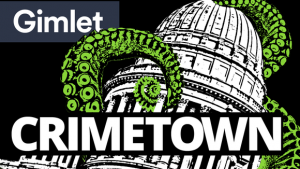
Crimetown (by Gimlet Media)
Remember Robert Durst? No, not the cousin of the lead singer of Limp Bizkit; I am instead talking about the primary subject of HBO’s early 2015 documentary series The Jinx (which I reviewed at the time, including another Fred Durst joke). The Jinx was terrific, probably the best of the recent “true crime” trend. Thankfully, two of the primary crew members of The Jinx, Marc Smerling and Zac Stuart-Pontier, are back at it again, this time with the new podcast Crimetown, in which each season will revolve around crime in a specific city (this column will contain light spoilers through this past Sunday’s episode).
This season of Crimetown tells two parallel stories: (1) organized crime in Providence, Rhode Island, particularly the crime family led by Raymond Patriarca; and (2) the rise and fall of Providence mayor Buddy Cianci. In Crimetown’s first episode, Cianci is a young prosecutor who takes on the mob, trying Patriarca for murder. Even though Cianci is unsuccessful in putting Patriarca behind bars, Cianci becomes well-known in Providence and soon tries his hand at politics. Despite being a Republican in Rhode Island, Cianci takes advantage of a unique split in the more popular Democratic Party and is elected mayor of Providence in 1974 on an anti-corruption platform. However, in order to attain political success, Cianci is forced to align himself with the Patriarcas.

Managing Partners are Navigating the AI Inflection Point.
New executive research from Ari Kaplan explores how law firm leaders are responding to changing client expectations, evolving economics, talent transformation, and AI governance.
Crimetown does an excellent job establishing why Buddy is such a fascinating character. Buddy is clearly a fantastic politician, and as an Italian-American and a Republican, he is elected as mayor of Providence against all odds. Indeed, Buddy speaks at the 1976 Republican National Convention and decries the treatment of Italian-Americans by politicians, such as then-presidential candidate Jimmy Carter’s condescending over-pronunciation of the first I in “Italian.” Buddy also becomes ubiquitous in Providence, booking his days full of meetings with his constituents.
At the same time, Buddy goes against any beliefs he actually has. As a young attorney, he takes on the Providence mob and almost wins. But just a few years later, he relies on the mob to further his own political career. This comes with a cost; Buddy is forced to appoint some of Patriarca’s goons to major governmental positions. Partially as a result of having so many unqualified government employees, Buddy’s economic policies are not successful and Providence’s budget deficit grows. Later, although Buddy gains a very important PR victory by seemingly crushing a strike by sanitation workers, in actuality the strike ended because of a backroom deal with the Patriarca family that essentially preserved the status quo. And, the opening scenes of the first episode tease that Cianci will eventually be forced to testify in front of a grand jury on assault charges.
Cianci died in January 2016, though his voice does appear in the documentary through archival footage, mostly interviews he gave while promoting his autobiography. While I obviously cannot fault Stuart-Pontier and Smerling for this, the lack of compelling interviews between the production and the lead documentary subject prevents Crimetown from being quite as compelling as The Jinx.
Crimetown focuses the other half of its story on the Patriarca crime family, particularly through the eyes of former Patriarca enforcer Jerry Tillinghast. Tillinghast is the clear breakout star of the series so far, a raconteur telling stories of life in the mob in the 1970s. One of the most entertaining of these episodes is the 1975 robbery of Hudson Fur Storage, which is secretly a bank for the Patriarcas. After successfully stealing from the Patriarcas, the robbers predictably cannot keep their newfound wealth quiet, and soon turn on each other (if I have learned anything from films like Reservoir Dogs, it is that robbers will always turn on each other). The story of this bonded vault heist also has a great twist about who was really behind the robbery. It is frankly shocking that the robbery has not yet been made into a Martin Scorsese film.

From ‘Vendor’ To ‘Partner’: How LexisNexis Is Deepening Law Firm Relationships
The company is emphasizing ‘white glove service’ in the AI era. Here’s what the initiative is delivering for clients.
In telling these mob stories, Crimetown relies heavily on sound effects. For example, in describing a crucial phone call during one mob hit, the show uses the effect of a coin being placed into a payphone. While I appreciate that Stuart-Pontier and Smerling are doing the best they can to tell a story in an audio medium, these effects occasionally come off as tacky.
While not ostensibly a legal podcast, Crimetown does contain several lawyers and legal trials. For example, in the show’s first episode, Cianci is a young attorney prosecuting Patriarca for murder. The episode entertainingly describes how Cianci believes he has a slam-dunk case until Patriarca and his attorneys call a surprise alibi witness, who happens to be a priest. Cianci and the detective working the case are able to investigate and figure out that the priest is lying, but the damage has been done to Cianci’s case. Later in the series, Crimetown describes the raucous scenes in the courthouse as some of the defendants in the bonded vault heist are put on trial. Amusingly, Tillinghest’s attorney states how he was forced to implore Tillinghest to stop going to court so he would not start any fights. Lawyers will surely appreciate Crimetown’s depiction of this break from the usual courtroom decorum.
This season of Crimetown is expected to last several more episodes, so I may write about it again later if there are any more notable episodes focusing on the law or lawyers. In any event, Crimetown is a perfect choice if you want to avoid all human contact this holiday season.
Crimetown [Gimlet Media]
Harry Graff is a litigation associate at a firm, but he spends days wishing that he was writing about film, television, literature, and pop culture instead of writing briefs. If there is a law-related movie, television show, book, or any other form of media that you would like Harry Graff to discuss, he can be reached at [email protected]. Be sure to follow Harry Graff on Twitter at @harrygraff19.