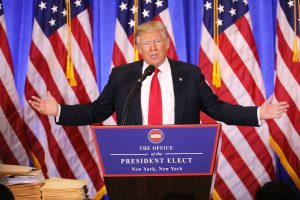
(Photo by Spencer Platt/Getty Images)
The Trump administration faces several glaring hurdles in accomplishing its agenda: recalcitrant Democrats, a fractured Republican Party, a hostile media, and a judiciary stacked with liberals.
Consider Judge William Orrick III. Orrick served as a “bundler” for Obama’s 2008 election, gathering over $200,000 in donations to support the former president’s election. In addition to bundling hundreds of thousands of dollars, he personally donated $30,000 to pro-Obama groups.

LexisNexis Practical Guidance Rolls Out Dedicated Practice Area for AI & Technology
The new generation of AI-related legal issues are inherently cross-disciplinary, implicating corporate law, intellectual property, data privacy, employment, corporate governance and regulatory compliance.
A few years later, Obama appeared to return the favor by nominating Orrick as a federal judge in the Northern District of California.
Perhaps predictably, Orrick’s opinions have not exactly been favorable to conservatives. He thwarted the release of undercover videos that exposed potential Planned Parenthood wrongdoing. And on Tuesday, he blocked President Trump’s executive order, which threatened to withhold funding from sanctuary cities.
Orrick’s temporary injunction comes on the heals of the Ninth Circuit temporarily restraining Trump’s first travel halt executive order, a decision that prompted the Trump administration to issue a second, revised travel halt intended to be more palatable to the courts.
The judicial rulings prompted the president to tweet: “the Ninth Circuit… has a terrible record of being overturned (close to 80%). They used to call this ‘judge shopping!’ Messy system.”

Keeping Law School Accessible When Federal Loans Fall Short
As federal borrowing caps tighten financing options for law students, one organization is stepping in to negotiate the terms they can't secure alone.
The president has a point. The Ninth Circuit is notoriously liberal, and politically motivated partisans do indeed try to place their challenges in front of friendly judges.
Even so, a hostile judicial climate is a reality that Trump must learn to navigate. One way to do this would be to narrow executive actions as tightly as possible, even if the administration believes its broader order is on firm footing.
For example, Trump’s first temporary travel halt would have denied some Legal Permanent Residents (LPRs) reentry into the United States – an action that would certainly run afoul of the Constitution. Upon realizing the oversight, White House Counsel offered authoritative guidance, stipulating that LPRs would actually be exempt from the executive order’s reach.
This verbal correction was not enough, prompting the Ninth Circuit to say, “The White House counsel is not the President…. [and] we cannot say that the current interpretation by White House counsel… will persist past the immediate stage of these proceedings.”
Another circuit might have accepted the White House Counsel’s clarification, but the Ninth Circuit did not. Had the first executive order been narrower from the beginning, the court might have ruled differently. Instead, the broad order left a gaping constitutional hole.
Trump’s recent sanctuary city executive order suffered from the same overly broad fate that doomed his temporary travel halt.
The order does not actively deprive sanctuary cities of federal funding; rather, it threatens it. It does not define “sanctuary jurisdiction,” nor does it state which funding is at risk of being pulled. The order additionally did not specify what funding would be taken away from noncompliant states.
This is problematic. In NFIB v. Sebelius, the Supreme Court struck down an Obama-era provision that deprived states of Medicaid funding if they did not acquiesce to certain federal demands. The Court said, “The threatened loss of over 10 percent of a State’s overall budget is economic dragooning that leaves the States with no real option but to acquiesce in the Medicaid expansion.”
Trump’s broad executive order in theory could have deprived states of not just 10 percent of federal funding but all federal funding, an outcome that clearly would have violated the holding of Sebelius.
The Trump administration sought to rectify the confusion surrounding the level of deprived funding and the definition of sanctuary city. As CNN’s Tal Kopan reports, “At a hearing earlier this month, attorneys for the Justice Department offered a far narrower interpretation of the order than Trump, saying it would only apply to jurisdictions that refuse to share citizenship information as required by law, and that it would apply to only three federal grants from the Departments of Justice and Homeland Security that require compliance as a pre-condition.”
Orrick – like the Ninth Circuit judges – did not accept this interpretation, stating, “This interpretation renders the order toothless. The government can already enforce these three grants by the terms of those grants and can enforce 8 U.S.C. 1373 to the extent legally possible under the terms of existing law.”
While I fully grant the administration that the ruling might have been different under a less liberal court, Trump must learn to operate within the reality he faces. And the reality he faces is liberal litigants appealing to a liberal circuit.
If Trump wants a successful presidency, he must narrowly tailor executive action to fit judicial reality. That is the only way to turn electoral promises into concrete realities.
 Kayleigh McEnany is a CNN political commentator. She is a graduate of Harvard Law School and Georgetown University’s School of Foreign Service, and she also studied politics at Oxford University. In addition to writing a column for Above the Law, she is a contributor for The Hill. She can be found on Twitter at @KayleighMcEnany.