 In the past four months, I’ve had the privilege of interviewing four federal judges for the pages of Above the Law: Judge Richard Posner (7th Cir.), Judge Raymond M. Kethledge (6th Cir.), Judge Frederic Block (E.D.N.Y.), and Judge Michael Ponsor (D. Mass.). One thing these judges share in common, besides their service on the federal bench, is that they’re all authors — not just of opinions you can find on Westlaw, but of books you can find at Amazon or Barnes & Noble.
Do you aspire to join the ranks of lawyers and judges who are also published authors? It’s not easy, but it is possible. Just ask Judge Michael Ponsor, the critically acclaimed, New York Times bestselling author of two (excellent) legal thrillers, The Hanging Judge and The One-Eyed Judge.
In this second part of our two-part interview (read the first part here), Judge Ponsor offers advice to aspiring authors on how to juggle a demanding legal job with a literary career — and for those of you with strictly legal ambitions, he offers advice on how to become a federal judge.

Managing Partners are Navigating the AI Inflection Point.
New executive research from Ari Kaplan explores how law firm leaders are responding to changing client expectations, evolving economics, talent transformation, and AI governance.
Once again, my thanks to Judge Ponsor for taking the time to share his wisdom with our readers. Happy holidays to all!
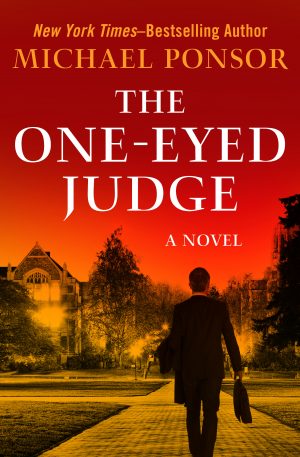
DL: Tell us a little about The One-Eyed Judge, the sequel to The Hanging Judge.
MP: It begins with an elderly professor at Amherst College who gets caught in a child-pornography sting, after accepting delivery of a DVD containing revolting child pornography. A good part of the plot centers on whether the professor is truly guilty or the victim of a set-up orchestrated by a jealous colleague or disgruntled student.
Things get complicated because the professor/defendant is a good friend of Judge Norcross’s girlfriend Claire, who also teaches at Amherst. In a situation like this, I would have recused myself, but Judge Norcross doesn’t, and the plot unfolds from there. The stakes are high, since the potential sentence for the old professor is effectively life. People tell me it’s a good read.

Beyond Recall And Precision: Strategic Oversight Of AI Managed Review
AI can accelerate document review, but metrics alone aren't enough. Learn how Managing Attorney oversight turns AI-driven review into a more adaptive, strategic and defensible process.
DL: Recusal is actually a plot point in the novel – a sign of how realistic your books are, informed by your experiences as a lawyer and judge.
Here’s one passage that exemplified to me the way your writing penetrates into the nitty-gritty of judging. Judge Norcross is on the bench, deciding whether to detain the defendant, Professor Cranmer. Norcross observes that if he releases Cranmer, and Cranmer absconds or hurts someone, then Norcross will have made a “visible” mistake (p. 70). But if he keeps Cranmer locked up, even unnecessarily, it would be an “invisible” mistake.
You then write, “It was always tempting to avoid visible mistakes simply by making sure only to commit invisible ones. Bad judges did that.” Did you have any particular “bad judges” in mind?
MP: No. I did, however, recall situations early in my career doing defense work when it was clear that the judge had little to lose by locking my client up and a lot, potentially, to lose by releasing him. Facing this situation honestly, and doing the right thing, can be challenging for a judge. We are supposed to be the guardians of liberty.
DL: Here’s another part I especially liked. Professor Cranmer’s academic specialty is Lewis Carroll, author of Alice’s Adventures in Wonderland. Judge Norcross notes that, like Wonderland, the legal universe has its own past, present and future (p. 132): “Facts found on the record defined the judicial past, no matter what had occurred in the actual world. The tappity-tap of the stenographer’s fingers created the present, in the form of a transcript, no matter what was actually being said or intended. And the court’s legal rulings, relying on the absence of objections or tossing them aside, outlined the landscape of the future.”
Do you really think that judges and lawyers, when in the courtroom, are down the rabbit hole, like Alice?
MP: Oh, undoubtedly, to some extent. Anyone who has followed an actual event from the street, to the courtroom, to the court of appeals, and sometimes to the Supreme Court, has found himself, or herself, on that distorting trail. Courts often live in their own reality, which sometimes bears little relation to what you might call “real” reality, whatever that is. It was fun to try to capture that in the book. You’re picking my favorite passages!
DL: How would you compare the process of writing the two books?
MP: The One-Eyed Judge took me much less time than The Hanging Judge. By 2014, I was fully on senior status, in fact as well as name. I started coming to court three days a week and working on my writing over four-day weekends, putting in many more hours.
I had help near the end of writing The Hanging Judge from a wonderful editor, Maggie Crawford. With The One-Eyed Judge, Maggie was on board from the beginning, giving me invaluable feedback throughout the whole process.
DL: And how has The One-Eyed Judge been received?
MP: It came out in June 2017 and received very nice reviews, including ones in Booklist and Massachusetts Lawyers Weekly. The Amazon reviews have been very strong, mostly four and five stars – even more positive than the ones for The Hanging Judge. I’ve been doing a lot of readings, and the book is starting to gain momentum.
I love both of my books the same, just as I love both of my kids the same. But I think The One-Eyed Judge might be better than The Hanging Judge. I’m handling more complex issues in The One-Eyed Judge, and it’s just a little tighter, with a pace that’s maybe more urgent.
DL: Do you have your next book in the works?
Yes – and I’m hoping it will be my best so far. I think of my books as “50 percent Jane Austen and 50 percent Tom Clancy,” with a domestic plot sharing space with a suspense plot. In this book, I’m reducing the proportion of the domestic plot and focusing more on the suspense.
The book also features Judge Norcross, now married to Claire and still serving as a federal judge. The story takes place mainly in Boston rather than western Massachusetts. A monster piece of high-stakes securities litigation starts out with one judge and, by a fluke, is re-drawn to Judge Norcross. Some extremely bad characters decide they have to get Norcross off the case, and they don’t care how. The story unfolds from there.
DL: Your novels are compelling and – forgive the cliché – true page-turners. Any talk of turning them into movies?
MP: The Kirkus review of The Hanging Judge said the book would make a great movie, and of course I agree wholeheartedly! I could also imagine an HBO on Netflix series called Norcross, about a federal judge presiding over different interesting cases. But I have not tried my hand at writing a script, which would be a whole new learning experience. We have not yet sold the TV or film rights for the books, but there has been some interest.
DL: Who would you want to see as Judge Norcross in a TV or film adaptation?
MP: Imagine a younger Tom Hanks. Hanks can be serious and funny, and there is comedy and drama in both books, which I think that is the key to their energy. So someone like Tom Hanks, but maybe ten to fifteen years younger.

Judge Michael Ponsor (via Open Road Media)
DL: You’ve been honored for your judicial as well as fiction writing, receiving the Golden Pen Award from the Legal Writing Institute in 2015. How would you compare your legal and literary writing, and do you enjoy one more than the other?
MP: I enjoy my legal writing, and I pride myself on doing it as well as I can. But I find my fiction writing to be thrilling, and I enjoy it on a deeper level. A good day of writing fiction is like falling in love – you just feel ecstatic. Solid judicial writing can be very satisfying, but not intoxicating in the same way.
DL: Speaking for myself, I find fiction writing so much harder than non-fiction. Writer’s block comes more frequently, and progress can be painfully slow. How do you keep things moving forward?
MP: I write in scenes. It’s like stringing pearls. I’ll work on a four- or five-page scene, and then another maybe slightly longer scene, and just push forward, scene by scene. If I sat down and told myself I was going to write a 400-page novel all at once, I’d lose hope and go jump off a bridge. But when I sit down and tell myself I’m going to write the scene where the defendant meets his lawyer for the first time, that I can handle.
DL: But the fiction writing is still much tougher, isn’t it?
MP: Definitely. I had a case a few years ago involving the Alien Tort Statute, which raised many interesting, complex issues. I was on vacation in Nova Scotia, and I set aside the time to work on this opinion. In three full weeks, without the pressure of any other work, my clerk and I produced a 65-page opinion that we were proud of.
But compare that to 65 pages in one of my novels. Those 65 pages of published fiction would take me months to write, to rewrite, and to edit – drawing the characters, perfecting the pacing, ensuring the consistency of the imagery, and so forth. Fiction involves a much slower, more laborious process, full of polishing and repolishing.
Even thoroughly edited judicial writing is like a good first draft for fiction. You want the opinion to be clear, you want readers to understand the issue, and you want them to know what you’re doing and why. And then it’s time to move on to the next case.
DL: For all the current and aspiring writers out there, can you share your current writing schedule?
MP: I try to write four days a week, five hours each day. Mornings are still best for me; I’ve always been a morning person, and this has been getting more and more the case as the years accumulate. I’ll get up, make tea, sit down at my computer, write for a few hours, have breakfast, and then continue writing until one in the afternoon. My IQ between 8 a.m. and 1 p.m. is about double my IQ between 1 p.m. and bedtime.
DL: What other advice would you offer to lawyer-authors?
MP: Write for the pleasure of writing, and if you want to be serious about it, do it in a disciplined way.
Some people do water color, or play a musical instrument. They’ll never hang a picture in a museum, or play in a symphony orchestra, but the creative process gives a person deep-down pleasure. Because there is no guarantee that anything one writes will ever get published, you have to love the writing itself to avoid despair.
Also, at least for me, you have to write on a regular basis and be willing to keep doing it, even when it’s not going well. It’s a “butt-in-chair” occupation. So many things in your life will call you away from it, and you have to shut them out. You have to put the hours in.
Unlike non-fiction, where you can often get a contract and an advance with an outline and some draft chapters, in fiction you almost always need a solid draft of the whole thing. That means months, usually years, of work, with no guarantee that the words you are putting on the page will ever see the light of day. You have to love it, at least some of the time, and you have to have the discipline to stick to it.
DL: What advice would you have for our readers who would like to emulate your legal career and take the federal bench at a young age?
MP: Develop a reputation as a good lawyer. Work hard. And be in the right place at the right time.
After clerking and working in Boston for two years, I moved out to western Massachusetts. I loved the area and always intended to settle there. By good luck, I immediately fell into a position as a monitor for a consent decree involving the state mental hospital in Northampton, assisting the local federal judge, my predecessor Frank Freedman.
When a new position for a Magistrate Judge arose, Judge Freedman was asked, as the only district judge out here, “You’re going to be working closely with this person – who do you want?” He said he wanted me; it was my connection with this specific judge that helped me become a judge. (The judge for whom I clerked, Joe Tauro in Boston, supported me strongly as well.)
I worked very hard as a Magistrate Judge. I generated many reports and recommendations and I tried many cases, which I could do with the consent of the parties. By the time Judge Freedman took senior status, I’d established a good reputation. Senator Ted Kennedy, whom I had never met, took a completely meritocratic approach to judicial appointments. His screening committee picked ten candidates for five openings. The senator interviewed all ten personally, and he sent my name along to President Clinton.
It was a fluky process then, and it still is today. After I was sworn in, after two or three glasses of wine, I looked back on the process and counted ten people who, I was told, were definitely getting the position ahead of me. But when the spinner stopped spinning, it was pointing at me.
It wasn’t entirely arbitrary, but chance played a significant role. So, my advice is: work hard and trust to luck.
DL: Anything to share with our readers in closing?
MP: As I was taking the bench, a judge friend warned me: be sure not to let the hem of your robe get caught in the casters of your chair. When you get up to exit the courtroom, it’s embarrassing to have the chair clattering along behind you.
In my writing, I’m trying to bring together the elements of the judge as a figure of justice, with a touch of nobility, essential to a free society, and the judge as a funky human being, whose robe can get tangled up in the casters of his chair.
I deeply love and respect our system of justice. An independent judiciary is the difference between a free people and a tyranny. It is very rare, both in the history of humanity and in the world today. Mostly, whoever is on top just tells everyone else what to do. If they don’t, they get hit on the head or chased into the woods.
What judges are doing is critical to freedom. It is profound. Our justice system is very human and flawed, to be sure, but it’s dedicated to dispensing equal protection and due process. Long ago, as I told you, I was ambivalent about going to law school and living a life in the law. Now I feel that our system of justice is one of mankind’s most impressive creative acts. I’m honored to be a part of it, and I love trying to depict it in a compelling story.
The Hanging Judge [Amazon (affiliate link)]
The One-Eyed Judge [Amazon (affiliate link)]
 David Lat is editor at large and founding editor of Above the Law, as well as the author of Supreme Ambitions: A Novel. He previously worked as a federal prosecutor in Newark, New Jersey; a litigation associate at Wachtell, Lipton, Rosen & Katz; and a law clerk to Judge Diarmuid F. O’Scannlain of the U.S. Court of Appeals for the Ninth Circuit. You can connect with David on Twitter (@DavidLat), LinkedIn, and Facebook, and you can reach him by email at [email protected].