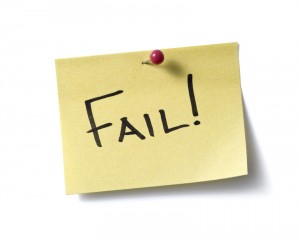
 Right now, there’s a pop-up exhibition, the Museum of Failure, showing in downtown Los Angeles (or DTLA as it’s now called). If you live in SoCal or will be here any time until early February, it’s worth seeing, if only to remind you that your flameouts pale in comparison to what’s on display, and how, in most cases, your failure, your flop, whatever you choose to call it, is private compared to the very public “whoops” the show presents. The permanent collection is in Sweden.
I loved the exhibit. The show is composed of various consumer products, tech products, and other things that crashed and burned, some in more spectacular fashion than others, but all in public view.
Examples of some spectacular goofs by companies that overcame failure and went on to success with different products:

AI Is Reshaping Legal Practice—But Tools Aren’t The Real Differentiator.
Explore the mindset, cultural shifts, and training strategies that define the AI‑savvy lawyer, revealing why human judgment, standardized competence, and integrated learning—not technology alone—will shape the future of the profession.
- The Ford Edsel. Dinosaurs will remember that car from the late 1950s that lasted only a short period of time. The term “Edsel” became synonymous for flop. However, it was only a few years later than Ford introduced the Mustang and dinosaurs all will remember how fast the “Pony” car took off, both literally and figuratively.
- The Apple Newton and the Apple Pippin. Does anyone remember the Pippin? Apple’s gaming console was a complete bust. Sony’s Play Station ate Apple’s Pippin without so much as a burp. Another flop: the Apple Newton, a very early personal digital assistant. Remember the Palm Pilot?
- Do you know that Colgate was in the frozen food business, at least for a while, with its Beef Lasagna? The packaging alone did not look very appetizing. Kellogg’s had “OJ Cereal,” flavored with orange juice and having nothing to do with you know who. And then there was Olestra, a product that ostensibly reduced calories in certain foods, like potato chips, but had unpleasant side effects, and I will spare you the details.
- Does anyone remember Coke’s “New Coke?” How about “Crystal Pepsi?” “Life Saver Holes?”
- How about “Bic for Her?” Since when have we needed to classify pens by gender? I can understand labeling pens that are “good for lefties,” since smearing ink is often a problem for southpaws (I am one), depending on how they hold pen and paper, but really? Gender-based pens? Did this product deserve its very own hashtag? Perhaps some of the hilarious reviews of the Bic for Her hastened its demise.
- What about Harley-Davidson cologne? I am not making this up.
- How about the Nike Magneto? The Monoski that eventually morphed into the snowboard? The Segway? The XFL Football League?
Every reader, regardless of age (the show has some more recent flameouts as well) will remember at least one, if not more, of these consumer failures. No matter how big our failures seem to be to us, they didn’t have the exposure that these did. Failing in public is a lot worse than failing in private.
The exhibit’s Failure Board was the most interesting and poignant part of the exhibit. It’s is just that, a two-sided board filled with different color Post-Its of personal failures, at least those that people who attended the exhibit were willing to share anonymously. The board was overflowing with Post-Its, many of them rueful about opportunities lost, chances not taken, failures past and present. A sample and I think you can figure out the ages of the writers without too much difficulty:
“Not failing enough.” “Not keeping the prettiest girl happy. What a fool.” “Going to Vegas instead of taking a midterm exam for my 21st birthday. F.” “Taking too much time ruminating instead of living.” “Moving to California instead of Oregon.”

Managing Partners are Navigating the AI Inflection Point.
New executive research from Ari Kaplan explores how law firm leaders are responding to changing client expectations, evolving economics, talent transformation, and AI governance.
What does failure look like to you? Everyone has a different definition of what that means and what it looks like. It could be anything from not getting a good score on the LSAT (or GRE), not getting into the law school of choice, not making law review, not being at the top of the class upon graduation, not passing the bar the first time, not getting that job you wanted or any job for that matter, not making partner, not being promoted within the corporate legal department, not getting that big bonus you were counting on, or any bonus, not getting the court to see the case the way you and your client saw it, not persuading the jury that you should win. Shall I go on?
Permutations are endless and what can be one person’s failure can be another person’s springboard to success. We dinosaurs are well acquainted with failure, we’ve lived long enough that failures (note the use of the “s”) are a part of life, and the more you’ve lived, the more you’ve failed. If anyone tells you otherwise, don’t believe them. It’s “liar, liar, pants on fire.”
Lessons learned from my visit to The Museum of Failure? We all fail, all the time, in all different ways. No one is immune to it. In most cases in our profession, failure is relatively private, unless it’s some Biglaw firm that crashes and burns, losing a big publicity-focused case, attorneys who get caught up in the criminal justice system as defendants and not as defense lawyers, and attorneys get caught with their hands in the clients’ cookie jars. Stories of clients who sue lawyers for malpractice rarely make headlines. I don’t think anyone really cares about your personal failures, as they are yours and no one else’s.
So, what’s my point here? We all talk about our Plan B if Plan A doesn’t work. There’s a wonderful quote by “Anonymous” posted at the exhibit: “If Plan A doesn’t work, there are 25 more letters in the alphabet.” Thank goodness.
 Jill Switzer has been an active member of the State Bar of California for 41 years. She remembers practicing law in a kinder, gentler time. She’s had a diverse legal career, including stints as a deputy district attorney, a solo practice, and several senior in-house gigs. She now mediates full-time, which gives her the opportunity to see dinosaurs, millennials, and those in-between interact — it’s not always civil. You can reach her by email at [email protected].