 In the wake of Legalweek 2018, there’s been a lot of talk about how artificial intelligence software can help lawyers practice law. I joined in and offered my two cents, and others suggested that AI in legal was more hype than reality.
But what about running your law firm? There hasn’t been much discussion about using AI tools to run the business end of your law firm. Is it really possible to use AI tools to help you launch and manage your small law firm? I would suggest that all signs point to “yes.”
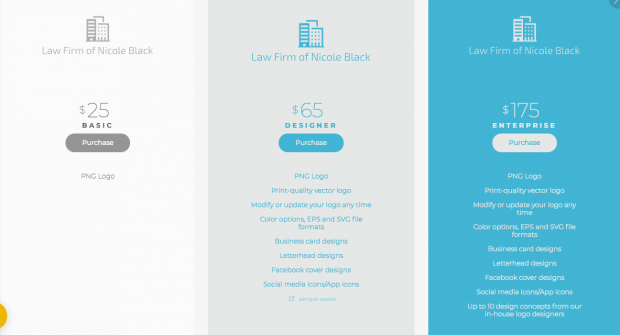
I hadn’t given the idea of using AI tools to run law firms until last week when a post about using AI software for design purposes showed up in my RSS feed. One software company mentioned in the post was Brandmark, which offers a very affordable AI tool that will generate a logo for you. It offers some really good options, as long as you give it a bit of direction when choosing keywords. I gave it a quick test drive and asked it to create a logo for my fictional law firm, “Law Firm of Nicole Black.” Here’s the sample logo that was generated and the price points for different logo packages:

AI Built for Litigation. Verified by Design.
Grounded in authoritative content and verified at every step, Protégé is the only legal AI tool that delivers work you can trust—without exception.
But, you can use AI for more than just logo generation. Another way to use AI in your law practice is for hiring employees. One company, Uncommon, has developed software powered by machine learning. It was launched in beta last week and uses AI to streamline the hiring process. Fifty million résumés were uploaded to “train” the software and it uses keywords to identify the best — and most diverse — job applicants gleaned from multiple online sources. With this service, you only pay for qualified and interested job applicants ($9.95 per lead).
Another way for lawyers to use machine learning in their practices is to engage the services of an AI-powered personal assistant. Two examples are x.ai or Clara, both of which provide a “personal assistant” to handle email management and calendar scheduling. I’ve signed up for both of these services in the past, but have never used them to their full potential since I’ve been reluctant to give up control of my calendar to anyone — a living, breathing human being or an AI-powered assistant. But I’ve interacted with scheduling AIs used by others and have found that scheduling a meeting time with them was quick and painless. Both Clara and x.ai offer reasonable pricing plans — especially compared to hiring a human assistant: x.ai starts at $17/month, while Clara rings in a bit higher, starting at $99/month.
And last, but not least, AI can help you with your law firm’s email marketing campaigns. Conversica is a great example of this type of tool and is designed to assist with automated email campaigns and follow up conversations with potential clients. With Conversica, initial conversations with potential clients are handled by the AI software and you determine the parameters for interaction, including the number of and type of follow up emails.

Schenck Price Works Smarter with Lexis+ AI and Protégé
LexisNexis sat down with John Ursin, Managing Partner at Schenck Price, to learn how the firm is using legal AI to strengthen client service and daily legal work.
So don’t discount AI just because it sounds too futuristic for your needs. Even if you’re not ready to use AI to help you practice law, that doesn’t mean that machine learning has no utility for your law firm. It’s entirely possible that the selective use of AI software could save you time and money and help you run a more efficient, responsive law firm.
 Nicole Black is a Rochester, New York attorney and the Legal Technology Evangelist at MyCase, web-based law practice management software. She’s been blogging since 2005, has written a weekly column for the Daily Record since 2007, is the author of Cloud Computing for Lawyers, co-authors Social Media for Lawyers: the Next Frontier, and co-authors Criminal Law in New York. She’s easily distracted by the potential of bright and shiny tech gadgets, along with good food and wine. You can follow her on Twitter @nikiblack and she can be reached at [email protected].