 Will someone please tell me what the term “next level” means? I hear and read that term in the context of so many situations: promotions, job changes, hoped for improvements (although not said so directly) and other events. Here’s a definition: When someone is hired to “take it to the next level,” what exactly does that mean? What level is the firm or company currently at? What does the “next level” entail in terms of accomplishments to be achieved, or has it become a euphemism for promotion without explaining the goals, the expectations? Or is it a term for a higher position from which to fall off, that is, the glass cliff?
Similarly, the term the “best and the brightest” doesn’t mean what people think it means. David Halberstam’s book “The Best and the Brightest,” about our failure in Vietnam, is about people who thought they were the smartest people in the room, and they were, until they ran smack up against Vietnam and flamed out. Much like the Enron guys who were the smartest people in the room until they weren’t.
Far smarter minds than mine will analyze, dissect, and criticize decisions made about the withdrawal from Afghanistan. But it’s a segue into another round of my asking “What were they thinking?” Not about foreign affairs, but about legal doings. There is always enough cringeworthy material for endless columns about how lawyers and judges are, sorry to tell them this, mere mortals.
Keeping Law School Accessible When Federal Loans Fall Short
As federal borrowing caps tighten financing options for law students, one organization is stepping in to negotiate the terms they can't secure alone.
What I don’t understand (and probably never will) is that the refusal to be vaccinated against COVID-19 is considered to be a badge of honor (by some). The refusal reminds me of that great scene in one of Clint Eastwood’s Dirty Harry movie where, while pointing a gun at a suspect’s head, he asks the suspect if he feels “lucky.” Why lawyers, who are supposed to be smarter than average, think that they need not be vaccinated is beyond me. If you decide not to be vaccinated, please spare us your thinking. Dead is dead. There are way too many “shoulda, woulda, couldas” to count in the COVID-sphere.
Since I am on my vaccine rant, here’s a story about a magistrate judge who was suspended for disruptive behavior for his reaction to the court’s COVID-19 safety behavior. He was not happy with the chief magistrate’s plan and said so.
In addition to the six-month suspension, the South Carolina Supreme Court ordered the magistrate to undergo anger management counseling. His interactions with the chief magistrate about a safety order makes me wonder how he interacts with those who appear before him.
Perhaps dinosaur lawyers will remember the CBS show “Candid Camera.” Pranks were played on unsuspecting people and when the prank was revealed, the victim was told “Smile, you’re on Candid Camera.” Some incidents were funny, but others truly cringeworthy and embarrassing. I guess nothing really changes, as a partner at a London firm resigned after his romantic adventure at the office was caught on video. It was an older man and a younger woman, nothing new there.
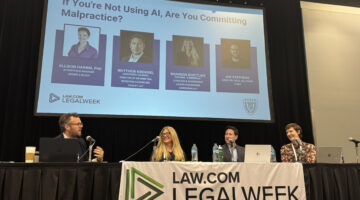
What Even Is AI ‘Competence’? It Depends.
Takeaways from a Legalweek panel on evolving malpractice risks.
Memo to hiring partners, managers, and the HR departments: do a better job of vetting prospective employees. In this case, a former employee is off to prison for 41 months for embezzling $425,000 from MoFo by using a firm credit card for purchases unrelated to the firm. He doctored invoices (how unoriginal) to show purchases were legitimate. But wait, there’s more! This employee was on parole for previously embezzling $700,000 from another firm. Convicted felons should have the opportunity for a fresh start, but who was minding the store at MoFo not to notice the misuse of a corporate credit card?
What would happen if there were no social media so that you couldn’t friend someone on Facebook, even someone you knew? Shouldn’t peeps stop and think (assuming facts not in evidence) before talking about matters on Facebook Messenger? Especially where there could be blowback, like where one of the participants had an interest in something of a judicial nature and his Facebook friend was a judge? An Ohio judge’s suspension has been stayed if he completes training on ex parte communications or appropriate use of social media by judicial officers. At least the judge had the good sense to close his social media accounts. What was he thinking? Judgment? What judgment? Isn’t that what we pay judicial officers for?
And file this under “no good deed goes unpunished.” I think most people, even lawyers, believe in second chances (see story above), but no lawyer should do so when it comes to managing client funds. Even if the bookkeeper is the wrongdoer, it’s the attorney who pays the price.
Failing to supervise is a huge no-no. Here the attorney gave his bookkeeper a second chance after she had ripped off money from his aunt’s estate. He reimbursed the estate for the funds, forfeiting his attorneys’ fees. Subsequently, the bookkeeper stole money from other estate accounts for a grand total of $191,000. What was the attorney thinking? He wasn’t. He wasn’t tech savvy and he relied, to his detriment, on the “trusted bookkeeper” defense. Where have we heard that before? He received a six-month suspension, although he’s now retired from practice.
So, some words that all lawyers should heed: former President Ronald Reagan said, albeit in a completely different context, “Trust but verify.” Enough said.
 Jill Switzer has been an active member of the State Bar of California for over 40 years. She remembers practicing law in a kinder, gentler time. She’s had a diverse legal career, including stints as a deputy district attorney, a solo practice, and several senior in-house gigs. She now mediates full-time, which gives her the opportunity to see dinosaurs, millennials, and those in-between interact — it’s not always civil. You can reach her by email at [email protected].