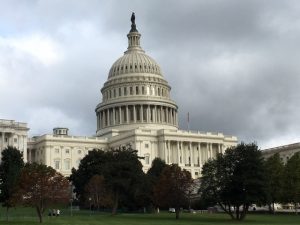
The U.S. Capitol (photo by David Lat).
Almost no one owns individual stocks. According to the Pew Research Center, only about 14 percent of American families are invested directly in individual stocks.
That is probably a good thing. Most people are not going to beat the market by dabbling in individual stocks. For the Americans who do own stocks, the majority of their exposure to the stock market tends to come in the form of some type of index fund owned through retirement accounts like 401(k)s.

What You Didn’t Learn In Law School
How do you keep up with the competition? Share your perspective in this brief survey to help us benchmark your lifelong training in professional skills. As a thank you, qualified respondents receive a chance to win a $250 gift card.
One of the reasons most normal people cannot beat the market is because they are on a level playing field. Members of the public generally cannot find out more about any given company than other members of the public, and when new information does come out about a particular company, they cannot act upon it any faster than their peers.
Having knowledge that is not available to other people, or gaining relevant knowledge more quickly than others, gives someone a district advantage when trading stocks. That is why insider trading is illegal.
But, while the big federal laws governing insider trading for the rest of us have been on the books since the 1980s, there is one group of people who have conveniently dodged serious scrutiny regarding their stock trades: lawmakers.
There is not much at all stopping people in Congress, within the framework of a limited amount of oversight, from trading stocks based on knowledge they gained from their positions.

How To Avoid Hallucinations: A Legal Research AI That Works Like A Junior Lawyer
Can we make legal research AI stop hallucinating? The answer is yes – and it’s how attorneys approach legal research with their associates.
The Stop Trading on Congressional Knowledge Act of 2012 — or the “STOCK Act” (really Congress, enough with the cute legislation names) — was meant to put the brakes on congressional stock trading abuses.
Although the STOCK Act helped address the problem in some ways, it lacked teeth, and led to way too many judgment calls (all of them subject to the whims of partisan decisionmakers) about whether lawmakers were trading stocks incorrectly.
Just back in February of 2020, shortly after attending congressional intelligence briefings and relevant committee sessions, several senators sold off stock holdings in companies destined to be hit hard by the coronavirus pandemic. Some of these lawmakers also quickly plowed money into things like telework stocks, which suddenly had a huge upside.
That was, of course, just days before the broader stock market took a gigantic Covid-related dive. None of these lawmakers had to face any major consequences directly related to their stock trades (although Kelly Loeffler did lose her election).
Other than the members of Congress making a killing off it, there is not a huge constituency for letting lawmakers profit off of the ignorance of the rest of us. More than three-fourths of voters support a ban on members of Congress trading stocks while in office. Still, it’s a complicated and highly partisan world. Very few people are going to base their vote solely on whether a particular candidate supports closing the congressional insider trading loophole.
Soon, however, they might not have to. There is reportedly renewed bipartisan support in Congress for a ban on congresspeople trading stocks. Belatedly, there seems to be concern in Congress about those suspiciously timed pre-pandemic stock trades by congresspeople, and the resulting investigations and public scrutiny.
There are several bills floating around at the moment. One of the most stringent was introduced in the Senate by Georgia Senator Jon Ossoff and Arizona Senator Mark Kelly, and would prohibit not only legislators, but also lawmakers’ spouses and their dependent children (probably children shouldn’t be trading stocks regardless of parentage) from trading stocks. Congresspeople would have to put their investments into independently managed blind trusts for the duration of their tenures.
Under this bill, the penalty for an infraction would be a fine equivalent to the violator’s total congressional salary — some real teeth (albeit shy of the prison time the rest of us might face for insider trading, and perhaps not a terror-inducing potential consequence in a chamber populated mostly by millionaires).
Could it really happen this time? A stock trading ban for top government officials has been proposed many times before. But when you have Matt Gaetz and Alexandria Ocasio-Cortez broadly agreeing on an issue, our system would really have to be broken to not see some kind of movement.
Jonathan Wolf is a civil litigator and author of Your Debt-Free JD (affiliate link). He has taught legal writing, written for a wide variety of publications, and made it both his business and his pleasure to be financially and scientifically literate. Any views he expresses are probably pure gold, but are nonetheless solely his own and should not be attributed to any organization with which he is affiliated. He wouldn’t want to share the credit anyway. He can be reached at [email protected].