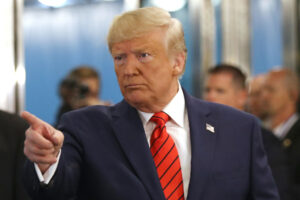
(Photo by Spencer Platt/Getty Images)
The Justice Department lost a round in court yesterday to Pete Strzok and Lisa Page, two former FBI officials targeted by Trump as a means to discredit the Mueller investigation.
As Deputy Assistant Director of the FBI’s Counterintelligence Division, Strzok led the investigation into Russian interference in the 2016 United States elections. Page, a lawyer at the Justice Department, worked with him on the Crossfire Hurricane investigation and later for Special Counsel Robert Mueller. But the two were removed from the assignment after it emerged they’d had a brief affair and texted each other negative comments about Trump on their government devices.

From ‘Associate’ To ‘Doppelganger’: The Evolution Of The Legal AI Persona
Confronting Biglaw’s ‘snake eating its own tail’ problem.
Deputy AG Rod Rosenstein and his comms flack Sarah Isgur leaked some of those texts to reporters on the eve of Rosenstein’s testimony before the House Judiciary Committee on December 12, 2017, in hopes of currying favor with Republicans. Page and Strzok then found themselves at the center of a whirlwind of harassment, egged on by Trump himself, who tweeted relentlessly demanding they be fired.
Page eventually quit, but Strzok was terminated, despite the recommendation by the FBI’s internal disciplinary authority that he instead be demoted, an offer which he accepted. In 2019, they filed separate suits against the government — Page for violation of her civil service privacy rights because of the leaked texts, and Strzok for the same, as well as wrongful termination.
Strzok alleges that Trump himself forced the FBI to fire him. But, citing the apex doctrine, Judge Amy Berman Jackson forced him and Page to work their way up through the DOJ hierarchy, deposing every other potential witness before she would authorize them to take testimony from FBI Director Chris Wray and the former president. In March, the DOJ informed the court that the Biden administration would not invoke executive privilege to block the testimony, and Trump himself seemed amenable, even scheduling the deposition with Strzok’s lawyers. But since then the government has backpedaled, even threatening to seek a writ of mandamus from the DC Circuit if Strok’s lawyers deposed Trump before Wray.
And so it’s hardly surprising that the DOJ is now asking the court to rescind its order authorizing a limited deposition of the former president “in light of new evidence that was previously unavailable to the Court and the parties.” In a motion for reconsideration filed Wednesday, the government argued that FBI Director Christopher Wray, FBI Deputy Director David Bowdich, and General John Kelly, who was chief of staff at the time of Strzok’s termination, all confirm that Trump was not the driver behind Bowdich’s decision to override his own disciplinary officer’s recommendation and fire Strzok.

PI Firms Don’t Need More Tools. They Need Fewer.
Every new tool a PI firm buys solves one problem and connects nothing. The real fix isn't another purchase — it's keeping the whole case in one place, from accident to resolution. Here's how.
A day later, Judge Jackson brushed off the government’s motion in a brief minute order, unsubtly alluding to the former president’s habit of spamming federal and state dockets with garbage defamation suits:
After review of the sealed materials submitted in connection with the 116 Motion for Reconsideration, the motion is DENIED. While to the extent the individuals deposed to date recalled the events in question, their testimony did not advance plaintiffs’ theory that the former President was involved in the decision making at issue in this case, the fact remains that the former President himself has publicly boasted of his involvement. Given the limited nature of the deposition that has been ordered, and the fact that the former President’s schedule appears to be able to accommodate other civil litigation that he has initiated, the outcome of the balancing required by the apex doctrine remains the same for all of the reasons previously stated.
The court did not accede to the government’s request to stay its ruling “for at least 14 days to allow the Solicitor General time to consider whether to seek relief from the D.C. Circuit.” So now the ball’s in Attorney General Garland’s court, to decide if he really does want to take a flyer on the DC Circuit issuing that long shot writ of mandamus.
Why on earth is Garland going to the mat on these relatively minor lawsuits, when he settled a wrongful termination suit with former deputy FBI Director Andy McCabe about five seconds after taking office?
Ah, well. DOJ gonna DOJ.
Strzok v. Garland [Docket via Court Listener]
Page v. DOJ [Docket via Court Listener]
Liz Dye lives in Baltimore where she writes about law and politics and appears on the Opening Arguments podcast.