
It wasn’t 1929 for the legal tech industry, but it wasn’t great either. Thomson Reuters lost around 15 percent of its value. LexisNexis’s parent company dropped about 14 percent. DocuSign fell 11 percent. A lot of the industry isn’t publicly traded, so we didn’t get to see how their investors responded to the news, but it probably looked similarly grim over at Harvey HQ.
The catalyst for this carnage — which the Jefferies Group is calling the “SaaSpocalypse” — had nothing to do with the ongoing hallucination and slopification problems unleashed by artificial intelligence. We’ve had those for months now and they’ve only succeeded in inflating the tech bubble further. Instead, the precipitous decline arrived because Anthropic released a plugin.
And threatened to take over legal tech in the process.

Opus 2 Steps Up Its AI Game With Acquisition Of A Legal Tech Startup
With the addition of Uncover’s technology, the litigation software is delivering rapid innovation.
The company behind Claude has been riding high recently off its Claude Code buzz. The company reportedly used their fancy coding agent to write up Claude Cowork, offering more user-friendly access to its agentic properties. Yesterday, they dropped a legal plugin for Cowork, promising to automate a number of legal workflows from contracts to briefings. It’s open source and therefore configurable to meet whatever shop idiosyncrasies a firm wants to include.
For the first time, a foundation-model company is packaging a legal workflow product directly into its platform, rather than merely supplying an API to legal-tech vendors.
Therein lies the problem for every legal AI company that’s been building on top of Anthropic all this time.

Most Law Firms’ AI Strategies Have a Big Blind Spot. Here’s How One Am Law 200 Firm is Solving It.
Most law firms, big and small, that have adopted AI are making the same mistake: they bought a tool for their lawyers and called it a strategy.
For years, the legal tech playbook has been straightforward: take a foundation model from Anthropic or OpenAI, wrap it in legal-specific prompts and guardrails, add some integrations, slap a subscription fee on it, and call yourself a legal AI company. The assumption was that the model providers would stay in their lane, happy to collect API fees while legal tech startups captured enterprise value.
Anthropic just announced “I can haz enterprise value.”
What’s legal tech going to do now that their supplier is their competitor? Personally, I’d prefer tools designed by professionals with industry experience as opposed to a plugin built by a robot coder. But this is where AI’s persistent limitations work against companies adding value. If it’s going to hallucinate so much that lawyers need to review it with a fine-tooth comb either way, why not use the retail solution?
Well, a lot of reasons. As Artificial Lawyer noted, legal data titans have spent decades building proprietary datasets and customer relationships that can’t be easily replicated by a plugin. As Prompt Armor notes, Cowork also brings serious security risks that everyone seems to be shrugging off at their peril. That said, when an industry is built on a “model + wrapper + workflow” model — as Ambrogi calls it — if the model creator can cut out the middle, it creates a crisis. Even if most lawyers stick with the old standbys, at least some chunk of the market will walk away from high fees and give Claude a whirl.
Legal tech companies have been hyping “agentic AI” as the future for a year now without a whole lot to show for it. Now a foundation model company is releasing an agentic legal tool, and suddenly the market decides that democratizing legal AI could also democratize legal tech’s customer base into oblivion.
But major law firms and legal departments already have deals with sophisticated vendors they’re not going to abandon overnight. They still need the massive datasets offered by Thomson Reuters and LexisNexis, which should keep most customers signed up for now.
And, as someone who has experimented with Claude Cowork a lot over the past two weeks, there’s also the way that it screws up most workflows that involve more than a couple tasks. That’s not to say there aren’t success stories floating around out there, but to the extent I’ve been able to put it through its paces, the results have been… underwhelming. Maybe pump the brakes before putting your contract workflow in there.
If investors think lawyers will walk away from Thomson Reuters and put their faith in a plugin for a product written by a robot coder over the last couple weeks… well, then the market may be the one with the problem.
UPDATE:
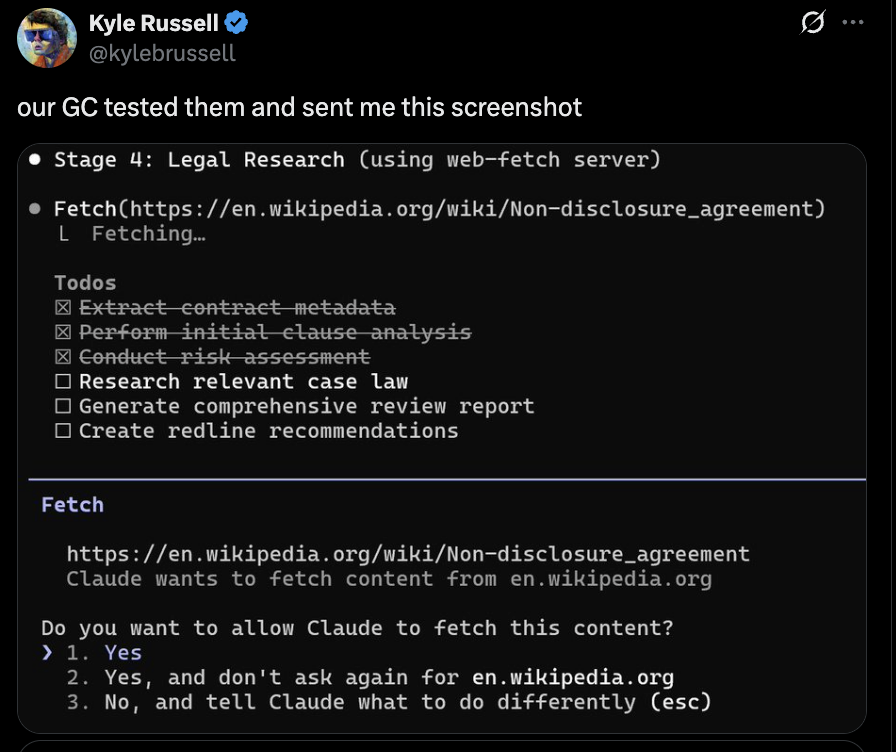
Yeah… this has pretty much been my experience too.
 Joe Patrice is a senior editor at Above the Law and co-host of Thinking Like A Lawyer. Feel free to email any tips, questions, or comments. Follow him on Twitter or Bluesky if you’re interested in law, politics, and a healthy dose of college sports news. Joe also serves as a Managing Director at RPN Executive Search.