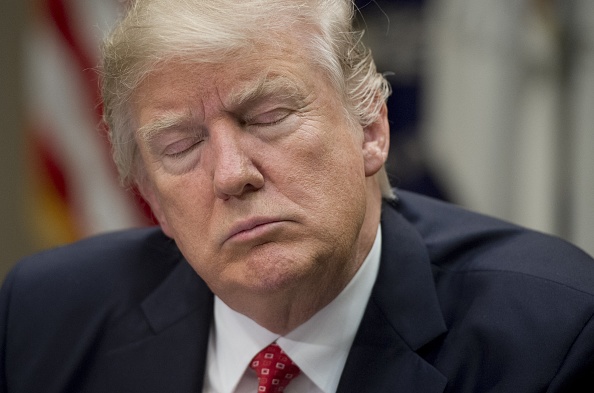
Donald Trump has met his match.
Twice.

Managing Partners are Navigating the AI Inflection Point.
New executive research from Ari Kaplan explores how law firm leaders are responding to changing client expectations, evolving economics, talent transformation, and AI governance.
First, Trump has probably learned that one should not pick online fights with the Vicar of Christ. Those fights are hard to win — maybe because the Pope’s got a certain someone on his side.
Having failed in jousting with the Pope, Trump decided to up the ante. The President suggested that the Pope is merely the Vicar of Christ, whereas Trump is Christ himself. But when Trump posted a picture of himself as Christ — dressed in a toga, surrounded by angels, and hands glowing with heavenly light — even the MAGA faithful wouldn’t buy it. Trump had to explain his blasphemy. He decided to say that he didn’t realize this was an image of Trump as Christ; he thought it was an image of Trump as a physician.
How many ways is that excuse pitiful? Let me count the ways. First, look at the picture. Any person who thinks that’s an image of Trump as a physician is a moron. But Trump says he thought the picture was of him as a physician. Is Trump a moron?
The alternative is that Trump is not a moron. He knows full well that the picture shows himself as Christ, but he decided to lie about the picture in order to excuse himself.

Why Experience Still Matters In An AI-Driven Legal Industry
A conversation with Trustpoint.One CEO Christopher Gallagher.
How does this explanation reflect on Trump? He’s ready to lie about his understanding of the image. He disdains the public, thinking that the public is stupid enough to believe this obvious lie. And his previously keen political instincts are fading, as Trump believes that blasphemy, coupled with telling an obvious lie, coupled with disdain for one’s voters is somehow a useful public relations strategy.
Protip: Politicians should not pick fights with the Vicar of Christ.
Or Christ himself.
Got it?
What’s another target that’s too hot to troll?
Iran.
In the battle of military might, the United States is defeating Iran. The U.S. is destroying the targets that it attacks, and the Iranian counter-attacks are doing only modest damage.
U.S. 1; Iran 0.
In the battle of political wills, however, Iran is winning. Iran may be suffering economically, but the Iranian government consists of religious fanatics who aren’t worrying about the Iranian people. And the Iranians have managed to close the Strait of Hormuz with relatively little firepower, thus creating a crisis for the U.S. and the world. The Iranian government may be feeling less political pressure than Trump, who’s haunted by higher gas prices and upcoming midterm elections.
U.S. 1; Iran 1.
In the battle of controlling the narrative, the victor probably depends on how you look at the situation. Iran says Trump started this war two months ago by launching an unprovoked attack on it. Trump says the war actually started in 1979, with the Iranian revolution and later attacks that Iran or its proxies launched on American targets. Iran, of course, could say that the war started in 1953, when the United States returned the Shah to power in a coup against Prime Minister Mohammad Mosaddegh.
And why stop there? I bet historians could keep going back in time, blaming the United States and Iran for various things that occurred ever since the sixth century B.C., when King Croesus misinterpreted the prophecy saying that, if Lydia attacked Persia, a mighty empire would fall. (Oops! His bad.)
But think about it differently. You don’t need to go back 2,500 years to see how this problem started. The Obama administration negotiated the Iran nuclear deal, which restricted Iran’s right to enrich uranium. Trump decided this was the worst deal ever negotiated, and he tore it up in 2018. Relieved of the obligations of Obama’s deal, Iran started to enrich uranium to a higher level. This posed a threat to the United States, which the U.S. supposedly obliterated in its attack on Iran last year, and had to re-obliterate in its follow-up attack on Iran this year.
I’d say the war is Trump’s fault, because he never should have abandoned the Obama nuclear deal, but I guess there’s room to argue about that.
Finally, who’s winning the battle of the online trolls?
It’s very hard to troll Iran. Even if Iran is an Islamic republic with a theocratic core, thousands of its people, many of them innocent, have died. Pete Hegseth can post his online images of powerful American weaponry, but that’s not really trolling. It’s more like showing the bully kicking sand in the face of the 98-pound weakling. Trump can spout about how he’s going to instruct the military to bomb Iran back to the Stone Age, but at this point those repeated bluffs sound like a senile old man who’s had one too many.
So the U.S. is not trolling Iran effectively. But the Iranians, for their part, are actually pretty good at trolling. Iran has done a remarkably good job of using images created out of Legos or artificial intelligence to poke fun at Trump, divide America, and move global public opinion to its side.
Trump, the ultimate cyberbully, is getting out-cyberbullied. Iran is owning the Trumpists.
And the Pope and Iran are targets too hot to troll.
Who’d a thunk it?
Mark Herrmann spent 17 years as a partner at a leading international law firm and later oversaw litigation, compliance and employment matters at a large international company. He is the author of The Curmudgeon’s Guide to Practicing Law and Drug and Device Product Liability Litigation Strategy (affiliate links). You can reach him by email at [email protected].