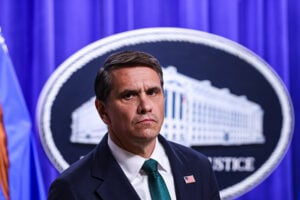
Todd Blanche went to Congress today. It went as well anyone could expect considering the Trump slush fund the DOJ just dropped.
The Acting Attorney General appeared before a Senate Appropriations subcommittee Tuesday for what was nominally a budget hearing — the White House has requested a staggering $40.8 billion for the Justice Department, a 13% increase from the prior fiscal year — but what was actually his first congressional testimony since taking the reins at DOJ, and his first opportunity to answer for the $1.776 billion “Anti-Weaponization Fund” the department announced Monday without congressional approval. Senators had questions. Blanche had answers. The answers were not great.
Let’s start with the basics. The fund, drawn from the Treasury Department’s Judgment Fund, is part of a deal to drop Trump’s $10 billion lawsuit against the IRS over the leak of his tax returns. Beneficiaries could include Proud Boys and other January 6 Capitol rioters, many of whom Trump has already pardoned. Payouts will be determined by a five-member commission appointed by Blanche himself, and the body will apparently be called — we are not making this up — The President Donald J. Trump Truth and Justice Commission.

Beyond Recall And Precision: Strategic Oversight Of AI Managed Review
AI can accelerate document review, but metrics alone aren't enough. Learn how Managing Attorney oversight turns AI-driven review into a more adaptive, strategic and defensible process.
When Sen. Chris Van Hollen (D-Md.) pressed Blanche on whether people convicted of assaulting law enforcement officers would be eligible, Blanche confirmed that yes, basically anyone could apply. “As was made plain yesterday, anybody in this country is eligible to apply if they believe they were a victim of weaponization,” Blanche said. Van Hollen, who called the fund “pure theft of public funds” and told Blanche he was “still acting as the president’s personal lawyer, not as acting attorney general,” was not done. He then raised the case of a pardoned Trump ally who allegedly went on to molest two children and reportedly told his victims he would pay them off using money from the slush fund. Blanche’s response was to tell a sitting U.S. senator that he was “obviously lying.” The exchange did not end with Blanche committing to keep the child molester off the eligibility list.
Here is the thing about that: the case Van Hollen was describing is not obscure. It has been extensively reported. The man in question is Andrew Paul Johnson, a J6 rioter Trump pardoned in January 2025. After his release, Johnson started posting online that he expected to receive restitution money from the Trump administration. A notion Johnson got from DOJ official Ed Martin! When Johnson was arrested and ultimately convicted for the sexual abuse of two children, it came out that Johnson promised “Trump bucks” to his victims if they kept quiet.
Blanche also tried to find a historical precedent for the fund. Asked by Sen. Susan Collins (R-Maine) about the arrangement, Blanche acknowledged it was “unusual” but compared it to an Obama-era Department of Agriculture settlement with Native American farmers who had been denied loans on discriminatory grounds, the Keepseagle settlement, approved by a federal court in 2010. Sen. Chris Coons (D-Del.) was not impressed. The critical differences, which Coons was happy to point out, include that the Keepseagle settlement had specific eligibility criteria, was approved by a federal judge, and was designed to compensate people who had actually been discriminated against by the government. The Anti-Weaponization Fund has no judicial oversight, no specific eligibility criteria, and is designed to compensate people who feel like they were targeted — including, per Blanche’s own testimony, people convicted of beating police officers.

Why Experience Still Matters In An AI-Driven Legal Industry
A conversation with Trustpoint.One CEO Christopher Gallagher.
Asking Blanche to compare those two things is like asking someone to compare a soup kitchen to a casino because both involve people getting things for free. The analogy just does not hold.
None of this, of course, is entirely surprising from a man who has been keeping busy. Blanche has warned white-collar lawyers that the DOJ “notices” when they publicly criticize the administration. He has floated the theory that women who heckled the president at dinner might be a RICO enterprise. He has been sued for allegedly directing the DOJ to violate the Epstein Transparency Act. And he went on Meet the Press to defend voter ID laws by explaining that restaurants check your ID when you walk in, which — as you obviously know — they do not.
Now he is before Congress, unable to rule out writing a check to a child molester, comparing a taxpayer-funded no-oversight slush fund to a court-approved civil rights settlement, and insisting that a senator is lying to his face.
The commission that will decide who gets paid, lest we forget, answers to Blanche. And Blanche, as Van Hollen noted this morning, answers to Trump.
The fund has a disclaimer, by the way. Once recipients have received their money, the Trump administration has “no liability whatsoever for the protection or safeguarding of those funds, regardless of bank failure, fraudulent transfers, or any other fraud or misuse of the funds.”
The Trump Truth and Justice Commission will not be taking questions. Of fucking course.
Kathryn Rubino is a Senior Editor at Above the Law, host of The Jabot podcast, and co-host of Thinking Like A Lawyer. AtL tipsters are the best, so please connect with her. Feel free to email her with any tips, questions, or comments and follow her on Twitter @Kathryn1 or Bluesky @Kathryn1