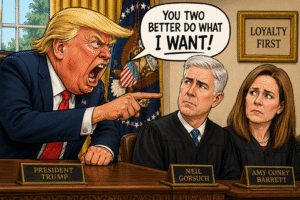
Donald Trump took to Truth Social over the weekend to do what Donald Trump does when things don’t go his way: write an extremely long post that reads like a stream of consciousness from a man who has never heard of the separation of powers and would like a refund.
The screed is nominally about the Supreme Court’s tariff decision, in which a 6-3 majority that included Trump appointees Neil Gorsuch and Amy Coney Barrett struck down his tariff authority. But it is really about something much simpler: Trump believes that the justices he appointed owe him their votes, and he is furious that they have not delivered them. … And also some likely tea-leaf reading about the birthright citizenship case that’s in front of the Court.
The post opens with what can only be described as a hostage negotiation with his own feelings: “I ‘Love’ Justice Neil Gorsuch! He’s a really smart and good man, but he voted against me, and our Country, on Tariffs, a devastating move. How do I reconcile this?” It continues through Barrett, through a lengthy detour about how Democrat-appointed justices “always remain true to the people that honored them” (they don’t, but sure), through a suggestion that he should be the one packing the Court, through a complaint that the Court didn’t acknowledge him when he showed up to watch the birthright citizenship arguments, and finally to a remarkable conclusion: “it’s really OK for them to be loyal to the person that appointed them.”

AI Is Reshaping Legal Practice—But Tools Aren’t The Real Differentiator.
Explore the mindset, cultural shifts, and training strategies that define the AI‑savvy lawyer, revealing why human judgment, standardized competence, and integrated learning—not technology alone—will shape the future of the profession.
NOPE, the only thing the justices (or really any member of the bar) owe “loyalty” to is the Constitution. We need to reckon with the ways it is genuinely strange and nakedly authoritarian, despite how commonplace it has become in the Trump regime. A sitting president publicly declaring that his Supreme Court appointees should vote for him out of personal loyalty — not because the law requires it, not because the Constitution demands it, but because he gave them the job — is not normal. It is, in fact, the specific thing that lifetime tenure was designed to prevent. But more to the point, this is not an isolated sentiment: Trump has been openly transactional about loyalty for his entire presidency, and the people around him have learned to perform it on cue. Just yesterday, at a White House event announcing a new maternal health resource, Trump turned to Senator Katie Britt and said, “I hope she always remains loyal to me so I can continue to support her,” before adding: “I would hate to go against her. That will never happen, Katie, right?” Britt’s response: “That’s right, sir.” It’s the same energy — I gave you something, you owe me something, and I will remind you of that in public — applied to a senator, to justices, to anyone in his orbit. The difference with the Supreme Court is that the justices have lifetime tenure and are, at least in theory, not supposed to care. Gorsuch and Barrett occassionally take that seriously. Trump appears to find this inexplicable.
This is, of course, not the first time Trump has publicly melted down over justices showing a modicum of judicial independence. When the tariff decision first came down, Trump told a room full of Republican members of Congress that Gorsuch and Barrett “sicken me… they sicken me because they’re bad for our country.” That’s the same Barrett whose nomination party was a COVID superspreader event that sent Trump to the hospital, so she has a complicated history with sickening the man regardless. And as we noted at the time, an earlier Truth Social eruption declared the Court “little more than a weaponized and unjust Political Organization” and said he was “ashamed of certain members of the court, absolutely ashamed of them for not having the courage to do what’s right for our country.” He thanked Alito, Thomas, and Kavanaugh for their “wisdom and courage” while flaying the majority — which is a pretty clear statement of exactly what kind of “courage” he’s looking for.
The current post adds some new rhetorical flourishes. There’s the electoral mandate argument — “I got elected in a Landslide, including winning the Popular Vote, all seven Swing States, an Electoral College ‘clobbering,’ and all U.S. Counties, by 86%, 2,750 to 525” — which is not a legal argument for anything but does seem to be Trump’s all-purpose justification for why the rules shouldn’t apply to him. There’s the threat of court-packing, which is darkly funny given that Democrats have been proposing exactly that for years and Trump has opposed it. And there’s the closing warning that a negative birthright citizenship ruling on top of the tariff decision “is not Economically sustainable for the United States of America,” which suggests the president may not fully understand that the Supreme Court’s job is constitutional interpretation, not economic forecasting.
The birthright citizenship anxiety is not unfounded, and, tbh, reading the tea leaves on that case may just be part of the motivation for this particular rant. The oral arguments did not go well for the administration, with Gorsuch and Barrett both pressing the government’s lawyer hard, the same two justices Trump is currently describing as having “had a really bad day” on tariffs. At this point Trump’s relationship with his own appointees resembles nothing so much as a Yelp review from a customer who is shocked to discover that the restaurant has a menu and not just his personal order.

Filevine’s New Legal AI Platform LOIS Turns AI Into A True Legal Coworker
Legal work isn’t slowing down, and the firms that win won’t be the ones working harder — they’ll be the ones working smarter.
The deeper tell in the post is the line about Democratic appointees: “Democrat Justices always remain true to the people that honored them for that very special Nomination. They don’t waver, no matter how good or bad a case may be.” This is, empirically, not true. But more importantly, it reveals exactly what Trump thinks the job is. In his view, a justice’s role is to vote for the appointing president’s agenda. The fact that Republican-appointed justices occasionally follow the law instead is, to him, a betrayal. The fact that this would make the Court not a court but an extension of the executive branch is not a bug in his analysis. It is the feature.
“I don’t want loyalty,” he writes, “but I do want and expect it for our Country.”
Sure. That’s definitely what he wants.
Kathryn Rubino is a Senior Editor at Above the Law, host of The Jabot podcast, and co-host of Thinking Like A Lawyer. AtL tipsters are the best, so please connect with her. Feel free to email her with any tips, questions, or comments and follow her on Twitter @Kathryn1 or Bluesky @Kathryn1