The Pope’s interventions in public policy over the last few years have been very interesting. We’ve seen Pope Francis taking our current administration to task for their treatment of migrants and refugees and Pope Leo’s apology for the Church’s role in legitimizing slavery. But a recent statement, namely Pope Leo’s published thoughts on humanity’s use of AI, has people asking questions about what that means for respecting religious exemptions:
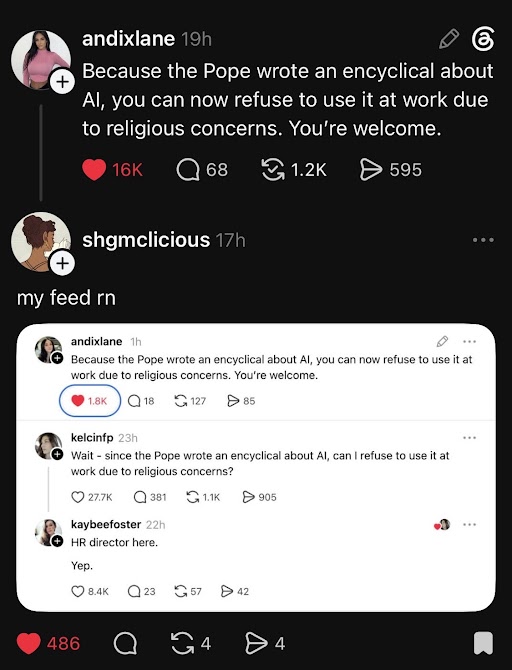
Pope Leo isn’t the only one grappling with AI’s purpose. UC Berkeley Law just released a strict AI policy for pedagogical reasons, but law schools with more relaxed policies could be forced to accommodate or change their use of AI for religious reasons. Utah just passed a law that lets students opt out of religious content that goes against their religious beliefs. At the time of drafting, the violating content in mind was more likely to be women kissing and geological modules on the existence of fossils, but I see no reason why professors assigning students to use AI on an assignment or requiring students to take a test that the professor used AI to create wouldn’t run the risk of violating a student’s religious sensibilities. Many Utahns identify as members of The Church of Jesus Christ of Latter-Day Saints and their Church’s stances on AI use are more focused on salvation and exaltation than legal pedagogy, but nothing should prevent a Catholic law student from availing the new law to get reasonable accommodations made for them if they believe that a teacher’s assignment requires an ungodly use of AI.

Beyond Recall And Precision: Strategic Oversight Of AI Managed Review
AI can accelerate document review, but metrics alone aren't enough. Learn how Managing Attorney oversight turns AI-driven review into a more adaptive, strategic and defensible process.
As I sat to write this, I thought about reading the entirety of Pope Leo’s “Magnifica Humanitas: On Safeguarding the Human Person in the Time of Artificial Intelligence” so that I could make well-supported and nuanced arguments about how his (and the Church’s) stance on God honoring AI use could affect policies like Utah’s religious vibe law if other states were to adopt it. But then I remembered the text doesn’t actually matter — it isn’t like courts check to see if the professed religious beliefs are in line with the religion’s dogma. There is nothing barring students from opposing aspects of exam content via mutually exclusive religious viewpoints, even if a common sense reading of the text would show that both students made clear interpretive errors in their reasoning. I understand why that would be the case. The main purpose of the separation clause is to ensure that there is no state-established religion, and if courts were vested with the authority to determine out which religious beliefs were worth honoring, that’s just the state endorsing some religions while excluding others. For example, a court ruling that Catholic teachings on blood transfusions are fair game but Jehovah’s Witnesses’ beliefs go too far is just “This state punishes JWs for their faith” with extra steps.
Opting out of an assignment that requires AI is an easy fix: professors are usually creative enough that they can find a workaround. The trickier objection would be if the student held that doing an assignment generated in part by AI was against their religious beliefs. Would that put the onus on professors to prove that they wrote their assignments without any help from LLMs? What is the threshold for reasonable accommodation of religious preferences in the classroom?
There’s no clear answer as to the exact waters law students and professors need to become comfortable wading into to do their jobs effectively.

Why Experience Still Matters In An AI-Driven Legal Industry
A conversation with Trustpoint.One CEO Christopher Gallagher.
UC Berkeley Cracks Down On AI Use With New Policy
Chris Williams became a social media manager and assistant editor for Above the Law in June 2021. Prior to joining the staff, he moonlighted as a minor Memelord™ in the Facebook group Law School Memes for Edgy T14s . He endured Missouri long enough to graduate from Washington University in St. Louis School of Law. He is a former boat builder who is learning to swim and is interested in rhetoric, Spinozists and humor. Getting back in to cycling wouldn’t hurt either. You can reach him by email at [email protected] and by Tweet/Bluesky at @WritesForRent.