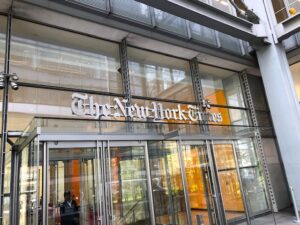
The Justice Department walked into a Manhattan courtroom Thursday with grand jury subpoenas for New York Times reporters, and it walked out without them.
The subpoenas went to Julian Barnes, Eric Lipton, Tyler Pager, Eric Schmitt, and Adam Goldman over their reporting on security concerns surrounding the Qatari-donated Boeing 747 that Trump has been trying to use as Air Force One. Federal agents managed to serve three of them. They could not serve Pager or Goldman.
The underlying reporting was that Trump flew home from Turkey on the old Air Force One as a security precaution, and that the gifted plane lacked the antimissile capabilities the old model had. The subpoenas came from Jay Clayton, the U.S. Attorney in Manhattan, and in some cases federal agents delivered them to reporters at home. Clayton has since been nominated to run the Office of the Director of National Intelligence, which tells you pretty much all you need to know about why reporting on this Trump pet project wound up in court.
Schenck Price Works Smarter with Lexis+ AI and Protégé
LexisNexis sat down with John Ursin, Managing Partner at Schenck Price, to learn how the firm is using legal AI to strengthen client service and daily legal work.
Naturally, the Times sought to squash the subpoenas, calling them “abusive and improper.”
Enter U.S. District Judge Arun Subramanian, a Biden appointee. He did not need much convincing. Subramanian had already signaled that the paper raised “profound First Amendment” issues in challenging the subpoenas. From the bench, he framed it as elementary, “It’s a matter of basic compliance with the law.”
“Subpoenas are the last step, not the first step, but the last step,” he said, before spending roughly 90 “increasingly tense” (per Courthouse News Service) minutes pressing Sean Buckley, chief counsel to the U.S. Attorney for the Southern District of New York, on why the department had blown past its own press regulations to get there. Subramanian offered two options: withdraw the subpoenas, or watch them get quashed.
Then it got worse for the government.
AI Is Reshaping Legal Practice—But Tools Aren’t The Real Differentiator.
Explore the mindset, cultural shifts, and training strategies that define the AI‑savvy lawyer, revealing why human judgment, standardized competence, and integrated learning—not technology alone—will shape the future of the profession.
Subramanian called Assistant U.S. Attorney Kevin Sullivan up from the gallery to explain the separate subpoenas for the reporters’ phone records. According to the judge, Sullivan had misled a different judge about how public the investigation already was in order to get them signed off. “It was an oversight on the government’s part,” Sullivan said.
The phone-record subpoenas swept in relatives as well. One number belonged to a reporter’s mother, a mental-health professional with confidential client relationships. Two others belonged to reporters’ spouses, one of whom is the general counsel of a major law firm. The government’s explanation is that it believed those numbers belonged to the reporters. So a department running a national security leak investigation could not reliably determine whose phone was whose, and in the process pulled toll records on a lawyer whose entire job is privileged communication and a clinician whose entire job is confidential ones. Two of the subpoenas reached back to January 1, months before the reporting that supposedly prompted the investigation.
Buckley apologized for those. “That was an error, judge, which we own,” he said. “It was a consequence of trying to move quickly.” He characterized the government’s missteps as inadvertent, and offered the line that will outlive this hearing: “No one was trying to pull a fast one.”
Subramanian, by this point seemed testy. “These things are starting to pile up,” he said. And then he went where judges go when the misstatements stop looking like accidents: “When you see something like this, if this were a civil proceeding, what I would normally do is ask the parties to show causes why sanctions should not be issued.”
The department’s response to all this was to attack the judge. Subramanian, the DOJ said in a statement after the hearing, “threatened our attorneys with sanctions unless subpoenas were withdrawn, and blocked us from presenting the meticulous process of this investigation.”
The statement kept going. “The grand jury has a right to hear testimony from all material witnesses in a federal criminal investigation. This judge’s conduct overrides clear longstanding principles and common sense — blocking the grand jury from receiving core evidence in a national security investigation.” And a closing promise: “Make no mistake, this investigation remains ongoing, and we will pursue justice against those threatening national security by leaking classified information, a serious federal crime.”
None of this is a surprise. Todd Blanche told us it was coming, out loud, on the internet, warning that any witness with knowledge of a leak — reporters explicitly included — shouldn’t be shocked to find a subpoena in their hands. And the department’s documented allergy to candor in front of federal judges is not a new development either. DOJ had already withdrawn similar subpoenas to the Washington Post and the Wall Street Journal.
But don’t call it a comeback if these subpoenas rear their heads again. Gabe Rottman of the Reporters Committee for Freedom of the Press doubts this is the last attempt, though he hopes the department’s courtroom record gives it pause. Subramanian’s written order at least requires that “the Government will come to the Court in advance of issuance” if it decides to renew.
Kathryn Rubino is a Senior Editor at Above the Law, host of The Jabot podcast, and co-host of Thinking Like A Lawyer. AtL tipsters are the best, so please connect with her. Feel free to email her with any tips, questions, or comments and follow her on Twitter @Kathryn1 or Bluesky @Kathryn1