Eight months after Donald Trump “sued” the IRS and four months after the case was officially dismissed, the agency has finally sauntered into court in Florida to register its objection.
Sort of.
The only remaining legal question is whether to sanction Trump’s personal lawyers in Florida along with “his lawyers” at the Department of Justice for unethically conspiring to defraud the court with a sham lawsuit. The government’s position is there was too adversity, and thus the settlement, which grants Trump and his family immunity for any and all tax crimes they may have committed to date, is totally legit.

PI Firms Don’t Need More Tools. They Need Fewer.
Every new tool a PI firm buys solves one problem and connects nothing. The real fix isn't another purchase — it's keeping the whole case in one place, from accident to resolution. Here's how.
And yet the DOJ’s conduct at this late date effectively concedes that the two parties are one and the same and always have been.
Me, myself, and I
In January, Trump’s current sparklemagic lawyer, Alejandro Brito, sued the Internal Revenue Service, demanding $10 billion for the 2020 leak of the Trump family’s tax returns.
The lawsuit was hot garbage. It was filed long after the two-year statute of limitations had expired. It claimed a preposterous amount in damages, roughly equal to two-thirds of the IRS’s entire yearly budget, without pointing to a single dollar lost. And it sought to hold the IRS responsible for republication by journalists, in direct contravention of the statute.

Managing Partners are Navigating the AI Inflection Point.
New executive research from Ari Kaplan explores how law firm leaders are responding to changing client expectations, evolving economics, talent transformation, and AI governance.
But if Trump had managed to get himself in front of one of his own appointees to the US District Court for the Southern District of Florida, maybe even Judge Aileen Cannon, it might not have mattered. Had the judicial wheel kicked out someone else, Trump’s flunkies inside and outside the government might have happily cooked up a “settlement” to put untold millions of taxpayer dollars directly in Trump’s pocket.
But it was not meant to be. Instead he drew Judge Kathleen Williams, an Obama appointee, who was never going to sign off on blatant looting of the Treasury. So Trump’s lawyers pivoted. Instead of a cash payout to himself, they announced a settlement agreement creating a $1.8 billion slush fund for anyone “harmed” by the Biden administration, plus civil and criminal immunity for all tax crimes for the extended Trump family.
The deal provoked immediate backlash, but Trump and his lawyers had taken pains to ensure that Judge Williams wouldn’t be allowed to weigh in. Rule 41(a)(1) of the Federal Rules of Civil Procedure allows a plaintiff to dismiss his lawsuit without seeking approval from the court if notice of dismissal is filed before the opposing party has responded to the complaint. If the defendant has already answered, the lawsuit can only be dismissed “by court order, on terms that the court considers proper.”
In this case, no lawyer for the government even entered an appearance. Brito requested and was granted multiple extensions for the government to answer his complaint, and in every instance he simply represented to the court that the government did not object.
And so, after a bunch of procedural shenanigans, Trump filed a notice of dismissal on May 18. Judge Williams closed the case the same day, noting that her order could not be construed as judicial imprimatur for the deal, which she’d never even seen.
Sanctions
Judge Williams may have thought there was nothing she could do to stop the obvious collusive fraud on her doorstep, but 35 eminent former federal judges disagreed. Nine days later they urged Judge Williams to reconsider, noting that a trial judge retains jurisdiction to impose sanctions when parties commit a fraud on the court. Two months later, Judge Williams issued a 56-page opinion sanctioning the parties for their unethical conduct and calling out the DOJ’s obvious wheeze to avoid submitting to her jurisdiction.
“For the 109 days that this case was pending, no attorney representing the United States filed a notice of appearance or any document indicating the government’s position, interest, or awareness of this matter,” she wrote.
The order punished Trump’s private attorneys, including Alejandro Brito (who is barred in Florida) and Daniel Epstein (who isn’t). Brito was referred to the Florida Bar for disciplinary proceedings, and Epstein was barred from appearing pro hac vice in the Southern District of Florida for a year. The clerk was instructed to mail a copy of the order to the state bars of New York and D.C., where Attorney General Todd Blanche and Associate Attorney General Stan Woodward are facing disciplinary investigations.
Judge Williams also prohibited both Trump and the IRS from citing the collusive settlement as evidence, effectively declared it null and void:
The Parties are prohibited from referring to the purported “settlement agreement,” or using, offering, admitting, or citing any of its provisions in any judicial, administrative, regulatory, arbitration, or any other official proceeding as evidence of a “settlement” reached in this matter, Case No. 26-cv-20609-KMW (S.D. Fla. 2026).
The 11th Circuit
Three weeks later, Trump appealed to the 11th Circuit and moved to stay Judge Williams’s sanctions order. That same day, the IRS finally poked up its head, saw its shadow, and noted an appearance in the appeal.
Deputy Attorney General W. Trent McCotter identified the IRS as the “appellee” — affecting to have been dragged in as an adversarial party. That made sense, because Judge Williams’s order imposed zero burden on the agency. (It might potentially embarrass McCotter’s bosses at the DOJ, but that’s not a cognizable harm to the IRS or the Treasury.)
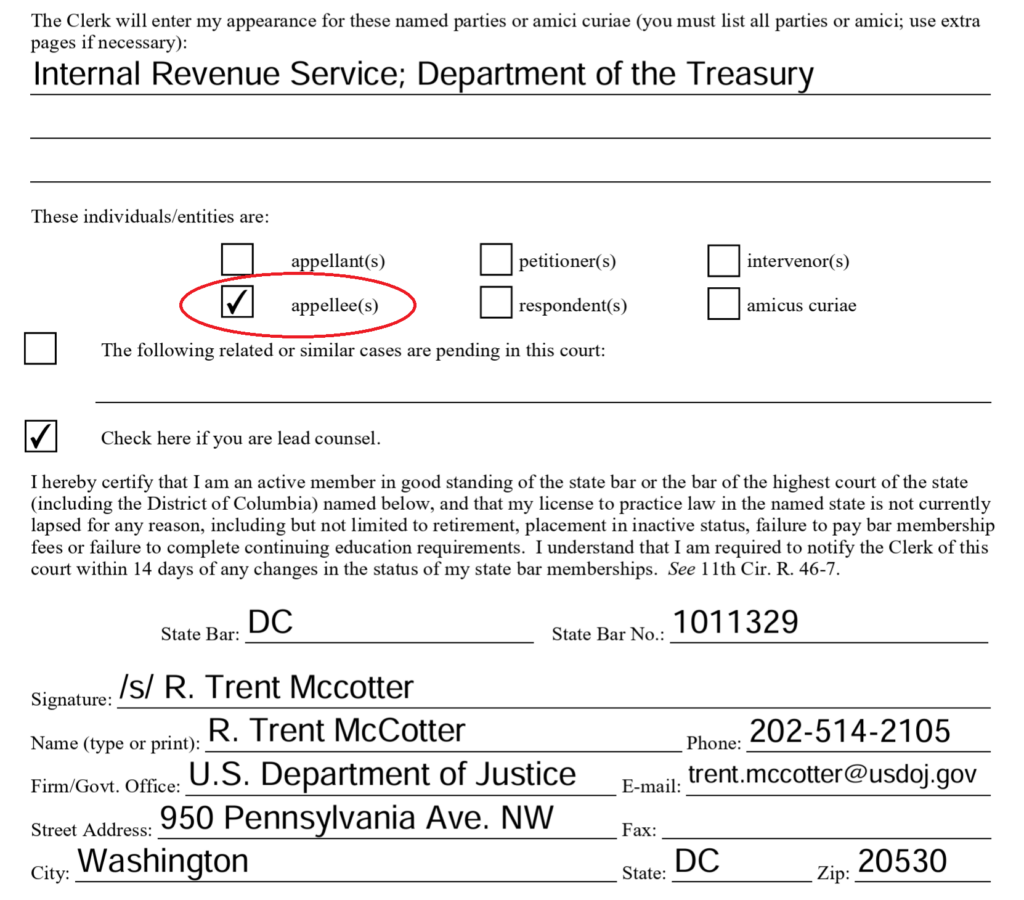
In fact, Judge Williams’s order conveyed a massive benefit to the IRS by blowing up the collusive settlement and allowing Trump’s dismissal with prejudice to stand. The agency is relieved of a potential $10 billion in liabilities and is now free to pursue civil and criminal charges against the Trumps for any tax fraud they may have committed. (Stop snickering.)
And so it was more than a little odd that the IRS, as appellee, joined Trump’s motion, demanding that Judge Williams’s order “be stayed immediately.” The supposedly adversarial parties insist that they are absolutely entitled to treat the “settlement” as binding, and any ruling otherwise amounts to an unconstitutional gag order and prior restraint of their free speech rights.
Why are you even here?
To get immediate relief, Trump would have to demonstrate that the trial judge’s order constitutes irreparable harm. But Trump will only be harmed if he intends to introduce the settlement-that-dare-not-speak-its-name as evidence in another official proceeding, i.e., to dismiss pending tax charges against himself. Obviously, there are no such charges and there won’t be while he’s in office — the entire point of this exercise was to provide immunity in the event that a Democratic president controls the DOJ in 2029. But, as the 35 judges point out, to concede that is to admit that the entire lawsuit was a collusive sham all along:
If the parties actually intend to reference or introduce or use the purported “settlement agreement” in any other “official proceeding” “as evidence of a ‘settlement’ reached in this matter,” then they should say just that, and explain why their current inability to do so (until they are ultimately permitted to appeal the District Court’s ruling) is causing them “serious, perhaps irreparable,” harm.
But the parties will not try to make such a showing, because doing that would prove that the District Court was absolutely right in recognizing that the parties were using their sham “settlement” of this sham litigation to try to achieve something substantive in some other forum.
The 11th Circuit ignored Brito’s demand to stay Judge Williams’ order. Instead, the panel questioned whether it might lack jurisdiction at all and instructed the parties to brief the issue of “whether the district court’s order is immediately appealable, including whether that order is appealable as an injunctive order.”
This apparent skepticism seems to have triggered some alarm at the DOJ. As the appellees, the government is effectively in the passenger seat while Brito drives … over a cliff. And since it was the putative “winner” at the lower court, where it never even deigned to show up, the government effectively has nothing to appeal. And so, on the eve of the 60 day deadline, McCotter raced back to the trial court to notice his appearance.
Sort of.
“Reserving all rights and waiving nothing, Defendants appear solely for the purpose of noticing their appeal to the United States Court of Appeals for the Eleventh Circuit from this Court’s July 13, 2026, ECF docket entry #106 and any orders and decisions merged therein,” he wrote.
But the IRS has not noticed an appeal to the 11th Circuit where it continues to litigate in the posture of appellee. Clearly, the IRS isn’t trying to overturn the dismissal of a $10 billion lawsuit against it. The only thing they want is to undo the order whacking Trump’s personal lawyers for misconduct — a whacking the DOJ largely avoided by never entering an appearance in the case.
But the United States has no cognizable interest in protecting the professional reputation of “opposing” counsel! And yet, the DOJ is so invested in redeeming Alejandro Brito’s honor that it will go back and put itself in the line of fire, after studiously keeping well clear of it for nine months.
What better proof could there be that the appellants and appellee are one and the same?
Trump v. IRS [SDFL Docket]
Trump v. Thirty-Five Former Federal Judges [11th Circuit Docket]
Liz Dye produces the Law and Chaos Substack and podcast. You can subscribe by clicking the logo: