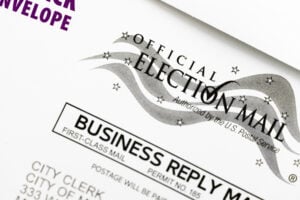
Donald Trump’s white whale got away again Monday night. In U.S. Postal Service v. California, the Supreme Court denied the administration’s application to stay Judge Indira Talwani’s injunction — the one blocking the USPS rule that would have routed every mail-in ballot through a citizenship-verification portal before November. This means the rule stays dead, at least through the midterm elections. And the Court needed exactly three sentences to say so:
The application for stay presented to Justice Jackson and by her referred to the Court is denied. The Government is unlikely to succeed on the merits of its challenge to the District Court’s preliminary injunction. And the equitable factors applicable for obtaining emergency relief from this Court do not favor a stay.
Note the majority went out of its way to identify two independently fatal problems for the government, that they’re likely to lose on the merits and the equities don’t favor a stay. Which is a vastly different tune than just three weeks ago. Recall that when this same shadow docket handed Trump his mail-in ballot wish in August, the conservatives insisted the blue states had sued too early — that they’d have to wait for the Postal Service to finalize its rule before anyone could complain. So the Postal Service finalized the rule. Talwani reviewed it, exactly as ordered, and found it just as unconstitutional as before. And now the Court is considering the finalized rule, and left the block in place.

Why Bigger Legal Budgets Buy Less Relief Than Ever
Introducing Axiom’s 2027 In-House Legal Budget Report. Read on to see the details.
Then there’s the Kavanaugh wrinkle. He concurred in the denial but on his own theory. In his view, there’s “at least a fair prospect” the rule falls within the Postal Service’s statutory authority. What killed it for him was timing, cramming the rule into the 2026 elections is arbitrary and capricious under the APA because state and local officials don’t have anywhere near enough time to implement it. In other words, the administration spent months insisting the harm was too speculative and distant to sue over, then rushed a rickety verification portal into production so late that even a sympathetic justice had to bounce it for showing up without its homework.
Alito, joined by Thomas, spent eight pages disagreeing. His theory: some plaintiffs lack standing, and the rest are running an ultra vires “Hail Mary pass” that “rarely succeeds” because the Postal Service’s power to regulate the mail is broad, and the states are leaning on a “highly technical provision tucked away in a corner” of the Postal Reorganization Act. He’d have let the rule take effect, midterms be damned, and faulted the states and the courts for the timing crunch — even sparing a swipe at his own colleagues for burning late July through August “drafting nearly 40 pages of opinions” while the government waited.
What you will not find anywhere in those eight pages is the voter. Confronted with the reality that his preferred outcome would disenfranchise millions of people who vote by mail, Alito’s answer was: “I take that problem very seriously, but it is not enough to convince me to deny the application.” Cool, cool, cool, cool, cool. Steve Vladeck called it a “rather stunning disregard for the interests of eligible voters in having their lawfully cast votes counted” and it’s hard to read the dissent any other way, the disenfranchisement isn’t weighed and rejected so much as noted and shrugged off.
Rick Hasen put it more bluntly:

From ‘Associate’ To ‘Doppelganger’: The Evolution Of The Legal AI Persona
Confronting Biglaw’s ‘snake eating its own tail’ problem.
Totally absent from Alito’s balancing were the voters. They weren’t an afterthought; their interests were not considered at all. This is unsurprising, considering that the justice has done more to hurt the cause of voting and voting rights than anyone else on the court in at least a century.
Trump, predictably, is taking the loss just about as well as he takes every loss. In a lengthy Truth Social post Tuesday, the president declared that the Court’s “inability and unwillingness to do the right thing for our Country will go down, in a very negative way, in the annals of History,” and that a bench he largely built is now “bullied and cajoled by the Radical Left.” His own appointees, he lamented, are “not the people I interviewed to serve on the United States Supreme Court, they are merely a shell of their original selves,” a Court that has, per Trump, “set America back at least a hundred years.” He signed off by casting his tantrum as an act of statesmanship: “It is not easy for me to write this criticism,” he wrote, predicting it “will likely cost me dearly for years to come.”
Cost him? The president wins at this Court roughly 84% of the time, most of it through the very shadow docket that spent this summer bailing him out. He has been busy stacking the federal bench, and it has repaid him handsomely. Losing the ability to unilaterally disenfranchise millions of elderly, disabled, military, rural, and Native American voters — the people who depend on voting by mail — is not a steep price.
Kathryn Rubino is a Senior Editor at Above the Law, host of The Jabot podcast, and co-host of Thinking Like A Lawyer. AtL tipsters are the best, so please connect with her. Feel free to email her with any tips, questions, or comments and follow her on Twitter @Kathryn1 or Bluesky @Kathryn1