
According to a law clerk who reported the behavior to the Eleventh Circuit, a federal judge — on multiple occasions — “engaged in sexual activity with a uniformed law enforcement officer in chambers during work hours within earshot of the judge’s staff.” Probably inaccurate to say “uniformed,” but you get the gist. After an investigation that included the judge “making false statements to the Chief Circuit Judge and Chief District Judge that were material to the investigation of the allegations” including denying the allegations as “outrageous” and “baseless,” the judge fessed up to the extramarital affair in chambers.
Look, with a legal landscape dominated by qualified immunity, it’s refreshing to see federal judges can still screw law enforcement.
Despite this, the Eleventh Circuit responded with a private reprimand. Last week, the Committee on Judicial Conduct and Disability affirmed that order. To call this a wrist slap is an insult to wrist slaps.

How Checkbox’s ‘Legal Front Door’ Can Transform Your Workflow
Leveraging agentic AI to triage, prioritize, and automate the law department inbox.
Sex in the office is certainly frowned upon, but what makes this case especially troubling is that during the two years of the affair, the police officer’s department was involved in numerous criminal and civil cases being litigated in the district. The judge never disclosed the affair and therefore could have been assigned a matter implicating the officer as a litigant at any point, but apparently dodged that bullet.
Was the chambers sofa as lucky?
As for corroborating evidence, the Chief District Judge reported that: (1) according to Law Clerk A, at least one other term clerk, identified in the letter, saw and heard similar things; and (2) one of the cushions on a sofa in the Subject Judge’s chambers was stained in a manner that was consistent with being caused by semen.
Some further misadventures of the cushion are relegated to a footnote, explaining that the clerk thought the cushion was subsequently cleaned… “However, one day, when the Subject Judge was not in the office, Law Clerk A entered the office, turned over a cushion, and found the stain. This led Law Clerk A to reasonably surmise that the Subject Judge had attempted to conceal the cushion by turning it over.” A judge who’s not afraid of being overturned.

Keeping Law School Accessible When Federal Loans Fall Short
As federal borrowing caps tighten financing options for law students, one organization is stepping in to negotiate the terms they can't secure alone.
It seems the court decided to check out the couch, but wrote about this in the most comically stilted way:
Removing the above-referenced sofa cushion from the Subject Judge’s chambers and arranging for a qualified biological laboratory to conduct an acid phosphate test of the cushion to determine whether semen was present;
The result was negative, by the way. Since this is in the South, we’ll just assume it tested positive for Duke’s.
The investigation also involved “Inspecting the layout of a judge’s chambers similar to the Subject Judge’s chambers to determine whether a law clerk seated outside of a judge’s office (with the door closed) could hear the noises Law Clerk A claimed to hear,” and I’m really interested to know how that went down. “All right, Tom… you go in there and start moaning and me and the other fellas will sit here and see if we can hear it.”
“Undoubtedly, a bad actor could have used these facts to try to blackmail the Subject Judge,” the Eleventh Circuit committee report notes. “Even absent a blackmail attempt, the publication of these facts would have greatly damaged the Subject Judge’s credibility as a judge and brought disrepute to the federal judiciary.” YES! Probably something deserving of more than a private reprimand.
It’s also worth noting that Article III Sexcapades weren’t the only allegations in the complaint.
As for the staff-treatment and staff-supervision allegation, counsel, on behalf of the special committee, questioned the former law clerks about the allegation. The supervision aspect of the allegation related primarily to civil case work. The Subject Judge’s longstanding practice was to handle all criminal case work without law clerk assistance.
Yeah they did. Definitely hearing no argument that the judge wasn’t personally handling the criminal work.
Each of the six former law clerks interviewed reported that: (1) when assigning a clerk to work on a substantive civil motion, the Subject Judge did not indicate to the clerk how the judge was inclined to rule on the motion or otherwise provide any direction; (2) it was generally understood that the Subject Judge did not wish to discuss substantive civil-case related issues with clerks; and (3) the Subject Judge rarely, if ever, substantively edited civil orders the clerks drafted. Multiple clerks stated that, given their inexperience, they were uncomfortable with the level of discretion they appeared to exercise in handling civil cases.
So civil cases in this courtroom are being decided by clerks? Fantastic! The judge later “reported making edits to between 30 and 40 percent of draft orders.” The judge admitted that they do “not offer clerks guidance, in advance, as to whether a motion should be granted or denied,” meaning they enter the dispute from the frame introduced by the clerk. Even if the judge edits a third of the drafts, how often are those edits making significant changes? This seems like a fundamental betrayal of the role of a judge.
That should also warrant at least a public reprimand.
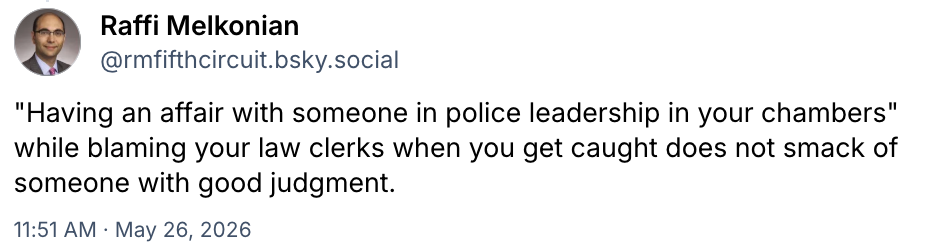
No, it does not.
Instead, they gave the judge this…
In light of these findings, the special committee recommends that the Judicial Council issue the Subject Judge a private reprimand. The Subject Judge informed Chief Judge Pryor that the Subject Judge would not oppose or challenge this sanction. The Subject Judge has also agreed to (1) issue letters of apology to the six former law clerks interviewed by investigation counsel (with the special committee to provide to the Subject Judge a list of those law clerks); (2) forego service as chief judge should the Subject Judge be otherwise eligible to serve in that capacity; and (3) indefinitely refrain from service on any Judicial Conference committee.
The judge will never have to deal with extra administrative hassle. That’ll show ’em!
For what it’s worth, the judge asked that they “be allowed to word the letters of apology vaguely so as to ensure that a letter could not be ‘used against [the Subject Judge] in some way.'” Because when being given a slap on the wrist it’s always important to ask if it can be even lighter. In response, “The special committee recommends that the Judicial Council instruct the Subject Judge to use the judge’s best judgment in drafting letters of apology that communicate the judge’s sentiments without risking undue embarrassment to the Subject Judge or the judiciary.”
To quote Melkonian’s response to this footnote, “I’m really slowing boiling into an angry kettle over here.”
For its part, the Eleventh Circuit report provides three reasons for keeping this quiet. First, “the Subject Judge’s correction of the judge’s false statements and subsequent candor with the special committee,” which is nonsense. It’s all well and good to credit normal people for recanting, but judges should be held to a higher standard. Indeed, in rejecting the recantation defense to liability, the report found that the judge only began recanting after there was “a high likelihood that… the judge knew that the falsehood had been or would soon be exposed.” That really should bear upon the sanction too.
Second, “the unlikelihood that the Subject Judge will engage in similar misconduct in the future, evidenced by the judge discontinuing the relationship with the Officer and commitment to avoid future partisan political events.” We didn’t even get into the partisan political events stuff, which dealt with an allegation that the judge went to a fundraiser for a DA. But in any event, this doesn’t seem like much of a guarantee that the judge won’t close the office door and declare “All rise” with someone else down the road.
Third, “the Subject Judge’s otherwise exemplary service to the court.” What part of “exemplary” is having clerks decide your civil motions for you? The committee balked on labeling the civil docket allegations as misconduct, but admitting that it was “troubled.” How does that not carry over to preempt the phrase “otherwise exemplary service”?
The clerks who reported this conduct had to stick their necks out. The judge — the one who actually did the thing, then lied about it — gets anonymity and to keep the gavel. The judiciary’s own climate survey suggests roughly one in 17 federal judges is abusive toward staff, and almost none of it is ever formally reported, because clerks correctly understand that the system protects the institution and not them. This case is the rare one that got investigated and proven. And the lesson the next clerk will draw from it is that none of that matters.
This is the response to multiple layers of misconduct. The federal judiciary stared down the misconduct and just flipped over the cushion.
 Joe Patrice is a senior editor at Above the Law and co-host of Thinking Like A Lawyer. Feel free to email any tips, questions, or comments. Follow him on Twitter or Bluesky if you’re interested in law, politics, and a healthy dose of college sports news.