Squeezing The Middle Class For Legal Fees Is Like Trying to Get Blood From A Turnip
What does the shrinking of the middle class mean for small-firm and solo lawyers?
What does the shrinking of the middle class mean for small-firm and solo lawyers?
Seriously? Come on with this absurdity.

Drawing on more than a decade of data, the report equips law firms and corporate legal teams with actionable insights to better assess risk, refine strategy, and anticipate outcomes in today’s evolving workplace disputes.
Entitled lawyers, stop your whining; nobody owes you anything.
It's not that the pay is necessarily worse -- though when all is said and done, it almost assuredly is -- it's that the job is a delicious cocktail of overwhelming responsibility and bad public policy.
The former SEC and Skadden lawyer was the second Deutsche Bank executive to commit suicide this year.
Woohoo, the results of the July 2014 New York bar exam have been released!
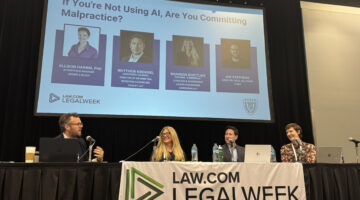
Takeaways from a Legalweek panel on evolving malpractice risks.
Law firms of all sizes tend to sit on the sidelines of our feedback culture; is this a mistake?
* Some observers do not appreciate the U.S. Supreme Court’s recent Delphic pronouncements on a slew of hot-button issues. [New York Times] * The New York Court of Appeals does international banks a solid — but is it bad policy? [Reuters] * Fired Canadian radio host Jian Ghomeshi hires Dentons to sue CBC, which dismissed him over allegations of sexual misconduct. [American Lawyer] * Is post-Citizens United money polluting judicial elections? [New York Times via How Appealing] * An Englishman sues Sotheby’s, alleging that the auction house negligently failed to inform him that a painting he sold through Sotheby’s was by Caravaggio and worth millions. [BBC] * If you’re a lawyer looking for extra income, check out Avvo’s new service, which offers consumers on-demand legal advice for a fixed fee. [Law Sites via ABA Journal] * Is it reversible error for a judge to refuse to ask voir dire questions related to sexual-preference prejudices? [Southern District of Florida via How Appealing]
Over the weekend, Justice Thomas, Justice Alito, and Justice Sotomayor participated in an extraordinary joint interview at their alma mater, Yale Law School.
* After being temporarily suspended as part of “Porngate” for trafficking in “highly demeaning portrayals of members of various segments of the population, including women, elderly persons, and uniformed school girls,” Seamus McCaffrey retires from the Pennsylvania Supreme Court. [Philadelphia Daily News] * A group of women lawyers in Miami has called for NBC to cancel Bad Judge because it “depicts a female judge as unethical, lazy, crude, hyper-sexualized, and unfit to hold such an esteemed position of power.” Indeed there’s no place for depicting women judges that way on TV. Especially when Miami is perfectly capable of depicting them that way in real life. [Crushable] * Epic trademark infringement. [Legal Cheek] * Crazy pro se guy slapped down in Canada. [Lowering the Bar] * While almost everyone else is seeing lower applications, USC Law saw a 5 percent bump. [USC Gould School of Law] * Stanford and Dartmouth in hot water over election law charges in Montana. Apparently piercing the imaginary veil of non-partisanship in judicial elections is the problem and not the whole idea of judicial elections in the first place. [Montana Standard]

Depositions by Filevine help with scheduling, tracking goals, and trial prep.
The hypocrisy of our country's gambling laws also infringes on state's rights.
Justice Breyer screened one of his favorite films, then shared some thoughts on Bush v. Gore and Citizens United.
Recently, The Washington Post published a student loan calculator to assist students out there in figuring out exactly how much they will suffer for their education. And the answer for lawyers is "much more than they can afford."
Stop applying to law school so those who came before you can get jobs.
Why do institutions bother with this happy claptrap, and why do some employees seem to lap it up?