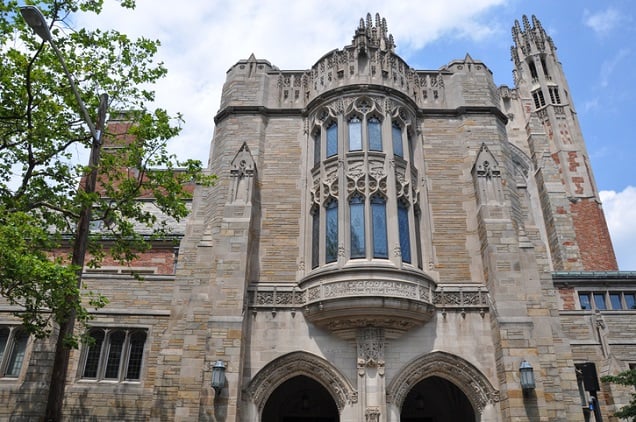
Over the weekend, the emerging West Coast powerhouse added a new impressive statistic to its quickly filling trophy case. This year, the school boasts one of the highest federal clerkship placement rates in the country.
Keep reading to see which elite law schools have been edged out by UC Irvine….
Congratulations to the 2012 Bristow Fellows, who learned of their selection earlier this month. These one-year fellowships in the U.S. Solicitor General’s Office, awarded to recent law school graduates with outstanding academic records and top clerkships, are generally regarded as second only to Supreme Court clerkships in prestige (and often lead to SCOTUS clerkships as well). You can read more about the Bristow Fellowship, including the job responsibilities and application process, on the Justice Department website.
Let’s take a look at the next crop of Bristow Fellows. Which law schools did they graduate from, and for whom did they clerk?
Also: over the past three years, which law schools and judges have minted the most Bristow Fellows?
If Learned Hand’s opinions are like the products of a bespoke tailor, the opinions coming out of the Ninth Circuit are like the products of a factory that is staffed by machines and menial workers who are overseen from afar by a handful of overworked managers.
– Justice Samuel Alito, in a recent speech at Rutgers School of Law (Newark), lamenting the decline of craftsmanship in judicial opinions.
(An interesting fact about Justice Alito and the Ninth Circuit, after the jump.)
Several prominent judges, like Richard Posner (left) and Alex Kozinski (right), hire 'off-plan.'
Over the weekend, we mentioned a very interesting New York Times article on the chaotic state of the clerkship application process, and said we’d have more to say about it later. Well, now is later, quite a bit later — so let’s discuss.
The piece — by Catherine Rampell, who has written about the legal world before — paints a depressing picture of a dysfunctional system. Rampell reports that the clerkship process “has become a frenzied free-for-all, with the arbiters of justice undermining each other at every turn to snatch up the best talent.”
Let’s look at the reasons behind this, and discuss whether the process can be fixed….
– Chief Judge Alex Kozinski of the U.S. Court of Appeals for the Ninth Circuit, explaining when he begins recruiting law clerks.
(Chief Judge Kozinski is quoted in a very interesting New York Times article on the chaotic state of the clerkship application process, which we’ll have more to say about later.)
Judge Wayne Phillips: He likes clerk butt and he cannot lie?
When I learned about this lawsuit out of Montana (via Morning Docket), I thought it might be from The Onion or an old episode of Ally McBeal. Reports the Billings Gazette: “A lawsuit has been filed against Fergus County District Court Judge E. Wayne Phillips by a female law clerk who alleges that the judge slapped her in the buttocks with a legal file.”
If the clerk’s allegation is true, was Judge Phillips’s action inappropriate? Certainly. Was it rude? Most definitely. But should it spawn a civil lawsuit, as well as possible criminal charges? Absolutely not.
And wait until you hear what the clerk is claiming in damages….
Law clerks aren't jumping for joy these days, especially when it comes to pay.
I spent last weekend in Portland, Oregon, where I attended the 25th judicial anniversary celebration and law clerk reunion of my former boss, Judge Diarmuid O’Scannlain of the Ninth Circuit. It was a warm and wonderful occasion, a chance to reconnect with old friends and to catch up with the O’Scannlains (Judge and Mrs. O’Scannlain were joined by all eight of their children for the festivities). Former clerks shared happy memories from their time in PDX clerking for DFO.
Most former law clerks I meet — mainly law clerks to federal judges, whether Article III or magistrate or bankruptcy — recall their clerkships fondly. They praise the excellent experience, the clerkly camaraderie, and the training and mentoring they received from their judges (for the most part; a few describe judicial clerkships from hell).
It struck me as strange, then, that “law clerk” recently came in at #7 on CNBC’s list of 10 Most Hated Jobs. I can’t help wondering whether courthouse administrative personnel with the title of “clerk” were somehow mixed in with federal judicial law clerks. The median salary of $39,780 a year suggests that this might be the case, since federal law clerks (and many state law clerks) make more than $40K these days.
Then again, people don’t clerk for the money. Sure, clerkship bonuses, especially Supreme Court clerkship bonuses, can be considerable — but in most cases, a graduate who goes straight into a law firm will do better financially than her classmate who clerks after graduation.
If you’re planning to clerk or interested in clerking for a federal judge, you should be aware of the latest news about law clerk compensation….
Now that Labor Day is behind us, fall is fast approaching. You can tell by the chill in the evening air.
Or is that just the cold offers we’re feeling? Last month, we asked you for stories about firms giving out cold offers to summer associates. As we explained, a “cold offer” or “fake offer” is, in the words of NALP, an employment offer made “with the understanding that the offer will not be accepted.”
This “offer,” made with a wink and a nudge, allows the employing law firm to report (and boast about) a 100 percent offer rate, when in reality it isn’t welcoming back 100 percent of its summer associates. It also has an advantage for the recipient: when she goes through 3L recruiting, she can truthfully say, “Yes, I received an offer from the firm where I summered.”
We recently heard a story about a pretty cold offer (not from summer 2011, but from not too long ago summer 2010). This summer associate, who wasn’t the most popular person in her class, received a full-time employment offer “contingent upon obtaining a federal clerkship.” Given how hard it is to land a federal judicial clerkship, that’s a pretty cold offer — especially considering that the student in question, now graduated, didn’t go to a law school known for cranking out lots of clerks.
Today is Friday, September 9, 2011. Do you know why today is special? Here’s the answer:
Yes, that’s right — we’re smack dab in the middle of the clerkship application season. Today was the first date and time (10 a.m. Eastern) when judges could contact applicants to schedule interviews, pursuant to the official law clerk hiring plan.
Let’s talk more about the process — and hear from those of you who are going through it….
I’m a lawyer. I’m a co-worker. In some cases, I may be a friend. But I’m not a mentor; I have no time for that crap.
When I was clerking (for the Honorable Dorothy W. Nelson of the United States Court of Appeals for the Ninth Circuit), my judge was (and remains) a delight. She was a warm, engaging person who treated everyone as an equal. She was living proof that you don’t have to give up on human kindness just because you’ve become powerful. She taught, by example, many lessons about work-life balance and the meaning of humanity.
But a mentor? They hadn’t invented the word “mentor” (at least with its current connotation) back in 1983. I don’t think Judge Nelson gave the idea a moment’s thought….
What does it mean to be “newly admitted?” To us, it means endless possibilities!
We recognize that you already possess the ability and intelligence to succeed in a variety of legal professions. Our job is to expose you to various practice areas in a way that ensures those very attributes are successfully applied. Our seasoned and successful faculty present unique programs that provide an approachable and practical understanding of the avenues of achievement available as you launch a fruitful, enjoyable and promising career.
Our Live Bridge the Gap weekends satisfy the entire year of New York Newly-Admitted CLE Credits in only two days!
After physically attending a full weekend, you will receive:
• 3.0 Ethics CLE credits,
• 6.0 Skills CLE credits, and
• 7.0 Professional Practice and/or Law Practice Management CLE credits
Date: Saturday, June 8 and Sunday, June 9, 2013 Time: 9:00 a.m. – 4:35 p.m. (EST) Location:
55 Exchange Place
5th Floor
New York, NY 10006
Ed. note: The Asia Chronicles column is authored by Kinney Recruiting. Kinney has made more placements of U.S. associates, counsels and partners in Asia than any other recruiting firm in each of the past six years. You can reach them by email: asia@kinneyrecruiting.com.
Deal flow has clearly picked recently up for most US associates, counsels and partners in Hong Kong/China and Singapore. We are on the phone with a lot of these folks on a daily basis, many of whom we have known for years. Further, the head of our Asia team, Evan Jowers, and Kinney’s founder and president, Robert Kinney, frequently meet in person with leading US partners in Asia to assess their needs and keep on top of the inside scoop at as many firms as possible. The need for legal recruiting help in Asia from experienced recruiters appears to be live and well. In March, Evan and Robert were in Beijing at such meetings, in April, Evan was in Hong Kong, and for half of June Evan will be in Shanghai and Hong Kong. Thus its pretty easy for us to tell when there has been an across-the-market pick up in capital markets and corporate work.
On an average day in Asia when Evan and Robert visit firms, they typically have 5 to 9 meetings a day, mostly with US partners in the market. The reason they have these meetings is not simply because Kinney makes a lot of US attorney placements in Asia and that a particular firm may have openings; instead these are just visits with friends. After years of working together as business partners, the folks at Kinney are actually these peoples’ friends. The firms Kinney work closely with in Asia (which is just about every law firm – call us if you want to know the one firm in the world we will never place anyone with again, ever, and why) look forward to the visits, or at least act like they do. After seven years in the market, many of the client partners are former associate candidates. Also, these US partners see Kinney as a very good source of market information as well, because they know how deep their contacts are in the market and how frequently they are speaking to counterparts at peer firms.
In a land that is right here and in a time that is right now, a technology has arisen so powerful that it can replace basic human document review. Is it time to bow down before our new robot overlords?
First, here’s a little story about me: my life in the legal world began as a paralegal. My first case was a GIANT patent infringement case that was already six years old and had involved as many as five companies, multiple US courts, the ITC and an international standards committee. I knew nothing about any of this.
On my first day, my supervisor (a paralegal with at least eight other cases driving her crazy) sat me down in front of a Concordance database with a 100,000+ patents and patent file histories. “Code these,” she said. I learned that “coding”, for the purposes of this exercise, meant manually typing the inventor’s name, the title of the patent, the assignee, the file date, and other objective data for each document. I worked on that project – and only that project – for at least the first six months of my job. After a week or so, time began to blur.
What I know, in retrospect and with absolutely certainty, is that as time began to blur, so did my judgment. So did my attention to detail. If you could tell me that I did not make at least one mistake a day – one inconsistent spelling, one reversed day and month, one incorrectly spaced title – I frankly would need to see your evidence. I would not believe it. The human mind is trainable but it is not a machine.
The traditional job application and interview process can be impersonal, and applicants often struggle to present themselves as more than just the sum of their GPAs, alma maters, and previous work history. ATL has partnered with ViewYou to help job seekers overcome this challenge. ViewYou NOW Profiles offer a unique way for job seekers to make a personal, memorable connection with prospective employers: introduction videos. These videos allow job candidates to display their personalities, interpersonal skills, and professional interests, creating an eDossier to brand themselves to potential employers all over the world. Check it out today!