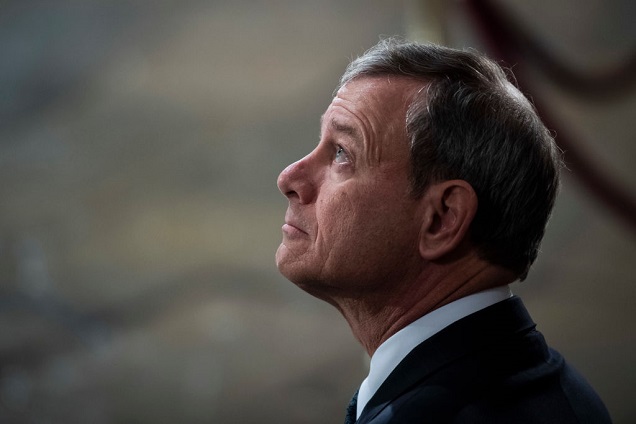
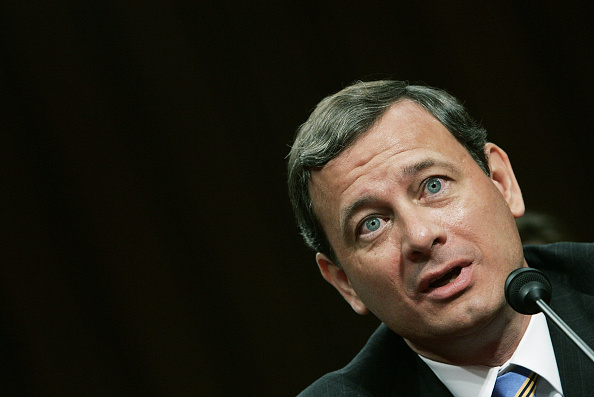
John Roberts

It’s Friday, Friday, gotta talk about grammar on Friday. Welcome back to Grammer Pole of the Weak, a column where we turn questions of English grammar and usage over to our readers for discussion and debate.

Last week, we discovered that 75% of our readers love to use substantive footnotes in their legal writing. Aww, Scalia would be so proud.

And speaking of Scalia, we’ve given him a little too much time in the limelight in this series. So, this week, we’re going to turn to an issue of grammar with some stylistic flair that was brought to our attention by another member of SCOTUS….

double red triangle arrows Continue reading “Grammer Pole of the Weak: The Case of That v. Which”

Many prominent people, including Chief Justice John Roberts and Judge Harry Edwards, have raised their voices about the increasing irrelevance of academic writing to practicing lawyers and judges. Yet, despite railing at the academy, those judges — and law firms, and sophisticated purchasers of legal services — all rely on the academics to identify talented lawyers. Law schools brand the beef, and purchasers buy based on the brand. What do I mean, and why is that process natural and appropriate?

Let’s start with an example for people coming right out of law school: How should judges pick law clerks? One way — perhaps even the “fair” way — would be for judges to assume that each of the 45,000 people graduating from law school is equally likely to make a fine clerk. Judges would solicit applications from all 45,000 and then start the process of sorting the good from the bad.

That cannot work, of course. Judges don’t have the resources (or, necessarily, the ability) to study transcripts, read writing samples, conduct interviews, and do the other spadework needed to assess all of those candidates comprehensively. And judges can’t externalize the cost of the screening process; there’s no person or institution that would play that role for an acceptable price.

What are judges to do? They rely on law schools to brand the beef.

Rant as they may about scholars producing unhelpful scholarship, most judges rely essentially unthinkingly on those same scholars to have separated the potentially gifted lawyers from the crowd. Judges assume that the best students went to the best law schools; that, after arriving, the more talented law students outperformed the less talented ones; and thus that the best performers at the best law schools will make the best clerks. Judges typically pick their clerks from among the top graduates of the elite schools. Judges may think that professors are insane when they’re selecting topics for their scholarship and then devoting months to researching and writing on those subjects, but those same judges rely on the same professors to brand the beef astutely. Whatever criteria law schools are using within the asylum to rank their students, the outside world seems quite happy with it.

Is that fair?

double red triangle arrows Continue reading “Inside Straight: How The Legal System Brands The Beef”

Non-Sequiturs: 07.08.11

Chief Justice Roberts: not a fan of law reviews.

* Chief Justice Roberts tries to explain why law reviews are so damn useless and boring. [Adjunct Law Prof Blog]

* Look, I like Jimmer Ferdette Fredette. I think that he was discriminated against because he’s white and I’ll bet all the money in my pocket that he ends up having a better career than Kimba Walker. But the childhood contract thing is silly. Derek Jeter’s is silly. Unenforceable fake contracts are silly. [Legal Blog Watch]

* Gun owners, why do you need to be able to practice shooting at things at ranges located close to schools? It’s like gun nuts won’t be happy until they’ve turned society back into game of Red Dead Redemption. [WSJ Law Blog]

* Here, let me trying using “gun nut” rhetoric to defend something that doesn’t kill anybody: Michele Bachmann will have to pry my pornography from my cold, lubricated dead hand. [Slate]

* Federal prosecutors should not have kiddie porn on their government computers (unless it’s pursuant to a child pornography investigation). [Not-So Private Parts / Forbes]

* Cataphora Legal + Ernst & Young = WIN. [Above the Law (sponsored content)]

* Do not forget to vote in Above the Law’s Fictional Lawyer Contest this weekend. You can vote from as many different IP addresses as you like. The battle of between McCoy and Hutz is close while it seems people have abandoned Elle Woods. [Above the Law]

It should not be surprising that the two dissents have sharply different views on how to read the statute. That is the sort of thing that can happen when statutory analysis is so untethered from the text.

– Chief Justice John Roberts, benchslapping the dissents by Justices Breyer and Sotomayor in Chamber of Commerce v. Whiting.

(The Court upheld, against a preemption challenge, an Arizona law that provides for suspending or revoking the licenses of businesses that violate state immigration law. Gavel bang: Josh Blackman.)

Southwestern Bell payphone with new AT&T signage

Not human enough to warrant 'personal privacy'

There’s some good news this week for those people whose blood boils at the mention of Citizens United. The Supreme Court proved that it is not always sympathetic to the rights of corporations — and is even willing to have some fun at their expense.

Chief Justice John Roberts penned a tongue-in-cheek opinion lambasting AT&T lawyers’ legal reasoning that has Dahlia Lithwick at Slate asking whether Roberts is the funniest justice ever. (Cue a scowl here from the legions of Scalia lovers in the audience.)

The case at the heart of the hilarity is FCC v. AT&T. The telephone company was involved in a billing practices investigation in 2004, in which it paid a $500,000 fine but admitted no wrongdoing. Some clever rivals at CompTel — a trade association representing some of AT&T’s competitors — wanted to take advantage of FOIA to get documents from the investigation and find out more about AT&T’s inner workings and alleged wrongdoing.

AT&T claimed protection under the Freedom of Information Act’s “personal privacy” exemption. A lower court was sympathetic to AT&T: “Corporations, like human beings, face public embarrassment, harassment and stigma” when they get involved with investigations by authorities. In other words: artificial persons have feelings too!

The Supreme Court did not agree. John Roberts whipped out a can of dictionary definitions to explain why corporations aren’t entitled to “personal privacy.”

Read on at Forbes….

* Marc Randazza wants to feed the members of the Westboro Baptist Church into a wood chipper, but he respects their First Amendment rights; accordingly, “the Westboro Baptist Church is the first entity to receive both the First Amendment Bad Ass award and the Asshat award in a single blog post.” [The Legal Satyricon]

* Everyone’s talking about the Westboro Baptist Church case, but don’t overlook Chief Justice Roberts’s hilarious opinion in FCC v. AT&T, rejecting a corporation’s claim of privacy rights under FOIA (contrary to the alarmist predictions of certain overwrought, Citizens United-obsessed liberals). [Slate]

* Speaking of noteworthy cases, check out the latest precedent of Zoopreme Court: Justice Under Paws. [Zoopreme Court]

* New New Hampshire motto: Leave my junk free or die. [Huffington Post]

* Musical chairs: three real-estate partners leave Kirkland & Ellis in Chicago for Latham & Watkins. Speaking of these firms, will either pay spring bonuses? [Chicago Tribune]

* Meanwhile, on the South Side, UofC Law is encouraging young black high schoolers to go to law school. If B (# of black students) < P (Posner) + L (Liberals), then you've got to do some outreach. [University of Chicago Law School]

* If you enjoyed our recent post about Chief Judge Kozinski’s taste in movies, you can check out all of his mini-reviews over here. [IMDb]

* Some reflections by Jane Genova on politics, law firms, and the power game. [Law and More]

Here come the judges.

President Barack Obama just finished delivering his State of the Union address for 2011. Alas, it wasn’t as exciting as last year, which featured a confrontation between the president and the Supreme Court. This time around, six justices attended — Chief Justice Roberts, joined by Justices Kennedy, Ginsburg, Breyer, Sotomayor, and Kagan — but they were on their best behavior. There was no POTUS v. SCOTUS showdown.

Your Above the Law editors covered the speech via Twitter. See @ATLblog, @DavidLat, and @ElieNYC.

Here’s an open thread for discussion of the address. We’ll get the party started with a few legally-oriented highlights, after the jump.

double red triangle arrows Continue reading “The State of the Union: Open Thread”

Justice Alito is going to the State of the Union this year? Not true, not true!

Tomorrow night, many of us will tune in to President Barack Obama’s State of the Union address — hoping to catch more catfighting than on an episode of Jersey Shore.

Last year’s SOTU did not disappoint drama-seekers. As you may recall, an Article II vs. Article III smackdown took place: President Obama chided the Supreme Court for its Citizens United decision, with six members of the Court sitting a stone’s throw away from him, and Justice Samuel Alito responded by mouthing “not true” at the POTUS.

(Speaking of Citizens United, the decision celebrated its one-year anniversary last week, on January 21. And as Josh Blackman notes, the world has not come to an end, contrary to the dire predictions of distraught liberals. Of course, experts in this area — including some Obama-supporting liberals — told us that Citizens United wasn’t that big a deal.)

Thanks to last year’s juicy Obama v. Alito showdown, numerous commentators have wondered: Will Supreme Court justices attend the State of the Union this year? If so, which ones?

Let’s make some predictions, justice by justice….

double red triangle arrows Continue reading “Will SCOTUS Go to the SOTU This Year?”

Two people from my high school got into the same college I did. We were all in the top 10 of our class, but none of us were in the top 5. One was a white guy who was a brilliant piano player. The other was a white girl who excelled at sports. Then there was me. I had the “does lots of activities” application. You know the type of d-bag kid I’m talking about: debate this, mock trial that, sports, school plays, bands.

Also, I’m black. Do you think that might have had something to do with it? I hope it did, since it seems to me that my race is at least as much of a factor in what I may add to an incoming college class as whether I could play the piano or dominate in field hockey.

Of course, saying race can be a factor in college admissions is controversial. A certain segment of the population gets all bent out of sorts when a “deserving” white student potentially gets “passed over” because a college official gave a person of color “extra points” when making up the entering class of students.

I find these arguments totally irrational. If the top five students from my high school were passed over — three Jews and two Asians (you know, the real victims of affirmative action, if there are any) — then who exactly “took” their spots? Me, or the sports chick? And if an Asian guy “takes” my spot, but I bump down the piano player who didn’t score as well as I did, and the piano player takes the spot of some poor Hispanic kid who has never seen a piano in real life, would everybody say that we all got what we deserved?

Coming up with an effective way to balance all of the relevant factors in college admissions is hard. But when race is involved, people don’t want to deal with “hard,” and they don’t want to hear “complicated.” They want simple rules and a few platitudes they can recite on television. After yesterday’s Fifth Circuit decision upholding affirmative action at the University of Texas, the only question is whether the Supreme Court has the will and intellectual rigor to think through something hard, or whether the majority will want to fall back on truisms and clichés…

double red triangle arrows Continue reading “Fifth Circuit Upholds Affirmative Action, But Is It Begging for SCOTUS Intervention?”

Over many years, however, a persistent problem has developed in the process of filling judicial vacancies. Each political party has found it easy to turn on a dime from decrying to defending the blocking of judicial nominations, depending on their changing political fortunes. This has created acute difficulties for some judicial districts.

— Chief Justice John G. Roberts Jr., in his annual report on the state of the federal judiciary (gavel bang: Tony Mauro / The BLT).

Page 6 of 71...234567