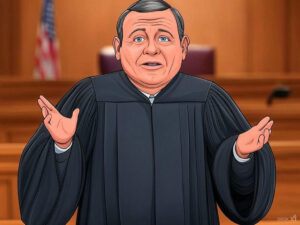
Three years ago, Chief Justice John Roberts looked at Alabama’s congressional maps and decided they were too racist. Roberts wouldn’t use those words, of course, but that was the impact. Allen v. Milligan required Alabama to draw a second district where Black voters would not have their voting rights diluted out of existence by white majorities. At the time, America’s most gullible voices cited the decision as proof that John Roberts remained the consummate “balls and strikes” justice, the architect of Shelby County really was willing to call voting rights cases both ways! We took a different view: John Roberts had decided that minority voting rights were weak enough for his taste and he didn’t need to burn any institutional capital on a fight over one representative when the nationwide map looked promising for the GOP.
Apparently, voting rights aren’t weak enough for Roberts anymore.
Yesterday, in an unsigned, unexplained decision in Allen v. Caster — which, despite the rotating party names, is the same dispute — the Supreme Court vacated a district court injunction that held Alabama’s racist 2023 map at bay. Per the order, another shadow docket special, the case was remanded “for further consideration in light of Louisiana v. Callais.” Roberts (and Kavanaugh, for that matter) had balked at the 2023 maps before, but now have no problem opening the door to impose the racist maps… even though absentee voting has already started.

From ‘Vendor’ To ‘Partner’: How LexisNexis Is Deepening Law Firm Relationships
The company is emphasizing ‘white glove service’ in the AI era. Here’s what the initiative is delivering for clients.
What changed between 2023 and today? Why has the Chief decided Alabama’s maps might magically have shed their racism? Roberts — who spent last week scolding the public via sound bite for having the temerity to suggest that the Supreme Court’s conservative majority are just “political actors” — isn’t going to like the answer. Because the answer is “politics.”
In 2023, Roberts could let a majority-minority district in Alabama slide because Republicans had a healthy path to a congressional majority. But after Donald Trump flogged Texas into mid-cycle redistricting, a bid to shore up the GOP’s dwindling midterms advantage, Democrats did something they’d never really done before, and fought back. After years of railing against gerrymandering on principle, Democrats in at least some states decided that, if that’s how Texas wants to play, then Blue states could accept a necessary evil. California asked voters to endorse an aggressive redistricting wiping out the Texas change and then some. Virginia followed suit — now blocked by its state supreme court — and suddenly Republicans found themselves worried about a squeeze play and running headlong into a wall.
The Reconstruction Amendments and the Voting Rights Act limited how much deep Red states could redistrict. For Republicans, the only path to more seats would require diluting minority voting rights in ways that are at least illegal and likely unconstitutional. For Alabama, the courts have already ruled — and the 2023 version of John Roberts acquiesced — the new maps were both.
That’s how 2026 Roberts decided that all of a sudden these maps might be fine actually!

AI Built for Litigation. Verified by Design.
Grounded in authoritative content and verified at every step, Protégé is the only legal AI tool that delivers work you can trust—without exception.
Justice Sotomayor, joined by Justices Kagan and Jackson, wouldn’t call it out that directly in dissent. Instead, Sotomayor asked what Callais has to do with any of this.
In addition to holding that Alabama’s 2023 Redistricting Plan violates §2, the District Court held, in one of the three cases before this Court, that Alabama violated the Fourteenth Amendment by intentionally diluting the votes of Black voters in Alabama. That constitutional finding of intentional discrimination is independent of, and unaffected by, any of the legal issues discussed in Callais. Vacatur is thus inappropriate and will cause only confusion as Alabamians begin to vote in the elections scheduled for next week.
Alito’s opinion in Callais does not touch on the Fourteenth Amendment rationale at play in the Alabama case. In fact, Alito bent over backward in Callais to announce “we have not overruled Allen,” explaining that the facts in Callais couldn’t support overruling Allen because the Alabama plan didn’t even try to defend the map as “drawn to achieve a political objective.” Mere days later, apparently the majority thinks it’s an open question whether they can spot Alabama a defensible motivation as a treat.
The Alabama district court held an 11-day trial, heard from 51 witnesses, viewed nearly 800 exhibits, and wrote a 268-page opinion — reviewable only for clear error — and determined that Alabama had intentionally discriminated against Black voters, when it spurned the Court’s prior remedial order and drew a map with one majority-minority district instead of two. The district court called the record “replete with sharp departures from (and some outright conflicts with) Alabama’s traditional districting guidelines,” found that the legislature had conjured findings out of “thin air” in “the dead of night,” and concluded that the new rules were “mathematically impossible” to comply with while producing a second district. And, again, the court included an independent constitutional rationale beyond the §2 issue implicated in Callais.
Sotomayor noted, with the dryness of a justice who has clearly run out of patience:
Callais also insisted that this Court’s prior decision in Allen remains good law.… These cases are, of course, Allen. So if Allen is good law anywhere, then it must be good law here.
Not for nothing, but the Alabama case comes as absentee votes have already been cast. The Supreme Court protected the Texas redistricting with a nod to the Purcell principle — the doctrine that says courts shouldn’t change election rules close to an election lest they confuse voters — claiming that a challenge four months before an election would be too soon to make an election law change. In the past, the Court has ruled that upwards of eight months cuts it too close. In the last couple weeks, the Supreme Court is inviting states to redraw maps after votes have already been cast. To quote Justice Jackson: Calvinball.
But John Roberts has seen bad climates for Republicans before without panicked U-Turns. Why is this midterm election driving the Chief to jettison whatever contrived “institutionalism” once guided his actions? In the past, he could count on Democrats to take their lumps while whining about the rules. California’s redistricting effort must have hit the right-wing of the Court like a thunderbolt. Democrats had never tried fighting back before. And a radicalized Democratic Party could spell doom for Roberts and the mission to rewrite constitutional order from the bench. The public supports mandatory judicial retirement ages and judicial term limits by supermajorities. Court expansion, once a “nuclear option,” is creeping into normal political conversation. Democrats willing to throw punches could overturn the whole countermajoritarian apple cart. Robbing Democrats of legislative majorities could be existential for Republicans generally and for Roberts and the Court specifically.
For John Roberts, his thoughts on voting rights remain entirely consistent: three years ago, rights were weak enough to support Republican victories and today they aren’t.
(Opinions on the next page…)
Earlier: John Roberts Decides Voting Rights Already Weak Enough For Him In Latest Supreme Court Ruling
John Roberts Dismayed Public Sees Supreme Court As ‘Political Actors’ Just Because They’re Political Actors
Jonathan Turley Defends Virginia Redistricting Opinion By Refusing To Explain It
John Oliver Spends More Time Explaining The Shadow Docket Than Supreme Court Does On Its Rulings
 Joe Patrice is a senior editor at Above the Law and co-host of Thinking Like A Lawyer. Feel free to email any tips, questions, or comments. Follow him on Twitter or Bluesky if you’re interested in law, politics, and a healthy dose of college sports news. Joe also serves as a Managing Director at RPN Executive Search.