As many of you know, I went straight through from college to law school without taking any time off. And many of you know that I count this as one of my many mistakes. The people I know who took time off between college and law school came back to law school with an appreciation of school and a focus on what skills they needed to succeed in the real world.
People like me who went straight through tended to start out with a “College II” mentality, got book-raped first semester, and muddled through law school kind of wondering why everything was so boring. In my anecdotal experience, these people disproportionately ended up in Biglaw, because people who get on only one train tend to end up at the same destination.
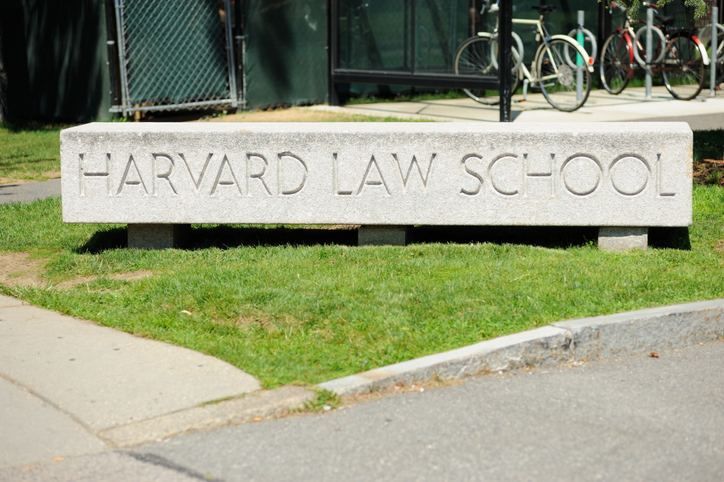
Given that experience, I think this new pilot program from Harvard Law School could be a very good idea. Harvard Law will now admit Harvard undergraduates after their junior year of college, provided they agree to an automatic, two-year, post-graduation deferment. That’s two years after college where you can work, earn money, and experience the real world outside the ivory tower, all the while knowing that you have Harvard Law to fall back on.
At least, that’s the positive view of the program. Our tipsters point out the cynical side….
LSATs are lower than in previous years. There’s been an arms race with LSATs and GPAs [among top law schools], but I think the shrunken pool has forced admissions officers to think about what we really need in our class, and it’s not just the LSAT. I think we are choosing substance over LSATs.
– Sarah Zearfoss, dean of admissions at the University of Michigan Law School, explaining to The Careerist that with fewer applications, Michigan is starting to consider substance (implying that she doesn’t think the LSAT is substantive).
Today, April 15, is Tax Day. But it’s an important day for another reason as well: it happens to be the day that some law schools want to hear back from applicants — and collect their deposit checks, of course.
Let’s close out our series of posts soliciting advice on picking a law school with three fact patterns. All of them involve at least two members of the so-called “T14,” the nation’s 14 leading law schools according to the U.S. News rankings….
In our last story asking you to advise a law school applicant, the 0L in question was choosing between UVA, Northwestern, and Minnesota, which offered him scholarships of different sizes. You voted in favor of Northwestern, which offered him a generous scholarship, and he took your advice.
Today we bring you a doubleheader. Our first candidate wants to know whether she should go to law school at all, given the options she faces. Our second candidate is choosing between two excellent law schools, but with different price points….
Yesterday we asked you to advise a prospective law student choosing between NYU Law School, at full sticker price, and UVA Law School, at half price. You overwhelmingly voted in favor of UVA. (Some of you suggested in the comments that he try to use his UVA scholarship to wrangle some scholarship money out of NYU; he did, but NYU said no.)
Today we bring you another 0L choosing between some excellent law schools. This individual has narrowed his decision down to three places: UVA, Northwestern, and Minnesota. For those of you who slavishly adhere to the U.S. News rankings, the three schools check in at #7, #12, and #19, respectively.
So what makes this choice more challenging? The differing scholarship amounts they’re offering this candidate….
Going to law school is a smart choice for many people. It’s not a smart choice for all people or probably even the majority of people who end up going, and it’s not a decision to be entered into lightly. But if you want to be a practicing lawyer, based on an informed view of what lawyers actually do, and if you’ve concluded that law school is right for you, after a rigorous process of psychological and financial self-examination, then by all means, matriculate.
(We are not uniformly anti-law-school here at Above the Law. I’ve written many times in defense of going to law school, provided you’ve done your research. See, e.g., here, here, here, and all of these law school success stories. And Elie’s on vacation this week, hahaha….)
The question then becomes where you should go to law school. It’s a timely topic, since now is the time of year when prospective law students or “0Ls” must decide where to put down their deposits. So help a brother out and offer some advice on the following situation….
Last week, in Morning Docket, we mentioned that one law school was thinking about lowering tuition. My colleague Staci requested less thinking and more doing.
As it turned out, the law school in question went ahead and reduced tuition, by significant amounts. How much are we talking about? And could this positive trend spread to other schools?
Maybe — especially if law students do their part and speak out….
Ed. note: This is the latest installment in a series of posts from the ATL Career Center’s team of expert contributors. Today, Ann K. Levine gives prospective law school applicants valuable advice on how to write the most effective personal statement.
If you’re sitting down right now, trying to write the most brilliant, persuasive, powerful personal statement ever written, but your fingers are paralyzed on the keys, you’re not alone. “I hate to write about myself,” some tell me. Others say, “My life has been pretty boring/sheltered/standard/privileged.” Still others say, “I went through hard times but I don’t want to write a sob story.” How do you hit the perfect compromise and create a personal statement you can be proud of?
Here are a few ideas to get you started on brainstorming topics:
1. It’s very hard to go back to the drawing board after writing an intro and conclusion, so just start writing your ideas down and sharing your stories and experiences. Start writing like you would a journal or blog post, using a conversational tone. Write how you speak. You can fix the grammar and spelling later. Fine-tune conclusions and themes later. Right now, get your stories on paper and see what themes naturally emerge.
2. Yes, your final personal statement will be between 500 words and four pages depending on each law school’s specifications. Most law schools want two-to-three pages. And yes, this is double-spaced. But don’t think about that. When you first get started you should write at least four pages so you have room to cut.
3. Don’t try to weave together everything you’ve ever done. Find things that are similar, either in subject matter or in exhibiting a trait you’re trying to demonstrate, and only weave them together if it really works.
4. Don’t reiterate things from your resume. Leave job descriptions to the résumé, and if you discuss résumé items in your personal statement, be sure to take a more anecdotal and lessons-learned approach rather than describing your duties and accomplishments.
5. Going in chronological order can be a trap. There is no reason to start with the day you were born, no matter how dramatic the birth might have been. Start with the most interesting thing about you — get the reader’s interest by sharing information about you that will be likable and interesting and as captivating as possible. Don’t try to “warm up” to your story with childhood memories, no matter how cute. You can always reflect back on those memories later in the essay if they were essential in formulating your goals and ideals and if they provide real context for your later achievements.
With LSAT takers down to a 30-year low, and with law school applications dwindling by the day, law schools are hoping that only the best and brightest will choose their institutions. Schools will do anything to protect their coveted yield rate, the percentage of admitted students who actually choose to enroll.
Last week, we shared a story with our readers that had to with with the lengths that law schools will allegedly go to to protect their yield rates. A tipster notified us that UVA Law withdrew his wife’s application after she informed them that she’d be attending another school. That sounds shady, but UVA calls it “standard practice,” and we’re sure other schools have resorted to similar measures given the sad state of the current field of applicants.
We mentioned in Morning Docket: U.S. News recently released a list of the schools that had the highest yield rates in 2012, referring to them as the “most popular law schools.” Chalk it up to schadenfreude on our part, but it figures UVA didn’t make the top 10 on this list — even though a fair share of surprising schools did….
100% of kids who got into this box were in this box!
Earlier today, we talked about the brain drain as law schools have to compete for a dwindling pool of high-scoring applicants. In this market, hitting your targets for your entering class is a tricky business for deans of admission at our nation’s law schools.
It’s an issue of yield: law schools need to make offers to enough applicants to fill their seats, without becoming overwhelmed with matriculating students. If schools that are ranked higher than you start admitting applicants with slightly worse qualifications than usual, you end up with not enough students — and your yield rate (the percentage of students you make offers to that actually accept the offer) goes in the tank. Poor yield rates look bad, and make it harder to predict how many people you need to admit in the first place.
Man, if only there was a way you could know whether or not people would come to your school before you admitted them….
Watch to find out what some of our subscribers received in their May box!
The proper hair styling product might just be the only thing standing between you and your dream job. And the best way to find what works for you is to try the best stuff on the market. Join Birchbox Man for $20 a month and you’ll get customized shipments of the best grooming and lifestyle gear on the market every month—everything from haircare and shaving supplies to style accessories and tech gadgets.
As the leading discovery commerce platform, Birchbox is redefining the retail process by offering consumers a unique and personalized way to discover, learn about, and shop the best grooming and lifestyle products out there. It’s a full 360-degree process: try, learn, buy. Once you sign up and fill out your profile, head over to Birchbox Man’s online magazine to find article and video tutorials on how to get the most out your monthly box products. Pick up full-size versions of anything you like in the Birchbox Shop and earn points for every purchase.
We currently have a number of active openings for associate roles at US and UK firms in HK / China, Singapore and two new in-house openings. As always, please feel free to reach out to us at asia@kinneyrecruiting.com in order to get details of current openings in Asia, as well as to discuss the Asia markets in general and what we expect for openings later this year. Our Evan Jowers and Robert Kinney will be in Beijing the week of March 25 and Evan Jowers will be in Hong Kong the week of April 1, if you would like to meet them in person.
The US associate openings we have in law firms are in the usual areas of M&A, cap markets, FCPA / white collar litigation, finance, and project finance. The most urgent of our top tier (top 15 US or magic circle) law firm openings in Asia (among many other firm openings that we have in Asia) are as follows:
• 2nd to 5th year mandarin fluent M&A associates needed in Beijing and Hong Kong at several firms;
• Korean fluent 2nd to 4th year cap markets associate needed in Hong Kong;
• 2nd to 5th year Japanese fluent M&A associates needed in Tokyo;
• 4th to 6th year mandarin fluent cap markets associate needed in Hong Kong;
• 2nd to 4th year M&A / cap markets mix associate needed in Singapore.
The last time I flapped my wings your way, I tried to make at least enough noise about your mobile phone to make you more than a little bit uncomfortable. I hope I did. If enough of us become anxious enough about the known and unknown unknowns and knowns in our mobile phones, then we can start making wise decisions about how to manage that information and its resultant investigations.
Today, I’d like to put a finer point on the last installment’s topic by asking a question that seemed to catch most attendees off-guard at a conference panel that I moderated last week: is there discoverable personal information in a mobile app? Our panelists’ answer was a uniform “yes” with one stating that, if he had to choose only one type of data that he could discover from a mobile phone, he’d choose app data. Why? Because there’s simply so much of it and because almost all of it is objective – not just user-created like an email – but machine-tracked like GPS, usage duration, log in and log out times, browsed web addresses, browsed actual addresses. Also, most of us seem to have the idea that data doesn’t actually “stick” to our mobile devices the way it “sticks” to our hard drives. Maybe there’s a disconnect based on the fact that our phones are mobile so we assume the data is mobile to?
The traditional job application and interview process can be impersonal, and applicants often struggle to present themselves as more than just the sum of their GPAs, alma maters, and previous work history. ATL has partnered with ViewYou to help job seekers overcome this challenge. ViewYou NOW Profiles offer a unique way for job seekers to make a personal, memorable connection with prospective employers: introduction videos. These videos allow job candidates to display their personalities, interpersonal skills, and professional interests, creating an eDossier to brand themselves to potential employers all over the world. Check it out today!