 Congratulations on successfully traversing the OCI gauntlet! You have, ideally, met dozens upon dozens of attorneys and recruiters, hopefully having remembered at least a few of their names. You have also, hopefully, started to receive invitations for callback interviews, the second part of the two-step interview process to land a summer associate position. In the pre-recession legal economy, the simple fact that you were invited for a callback might have been enough to justify a firm reception, but alas in 2018, it is likely that you are going to have to hold off a bit longer for the bevy of free food and drink to cascade upon you from on high.
But what are callbacks? Students will have sometimes garnered a number of callback opportunities without entirely knowing what this second stage of the interview process entails. A callback is when an employer, quite literally, calls a student back to their office for a more in-depth set of interviews. As discussed last week, the initial OCI interview is a truncated 20-minute affair where employers barely have time to ask a handful of questions before the next candidate enters the room. Conversely, callbacks are a half day, or even a day long, event in which you will meet with many attorneys, often times in one-on-one situations which can stretch for an hour. It is a cliché, but whereas OCI interviews are a sprint, callbacks are more of a marathon. Though callbacks typically end in a fancy meal, rather than collapsing in a heap of exhaustion.


From ‘Vendor’ To ‘Partner’: How LexisNexis Is Deepening Law Firm Relationships
The company is emphasizing ‘white glove service’ in the AI era. Here’s what the initiative is delivering for clients.
The best part of the callback is what it signals, which is that you are a legitimate candidate for that legal employer. Almost universally, the biggest culling of the candidate herd takes place after initial interview. Being invited for a callback means you likely have met any requirements that employer has for students from your particular school, e.g., a GPA cutoff. This conclusion is borne out by the data. Per the National Association for Law Placement, for the 2017 Fall Recruiting Cycle, law firms extended offers for summer employment to 52 percent of all callbacked students.
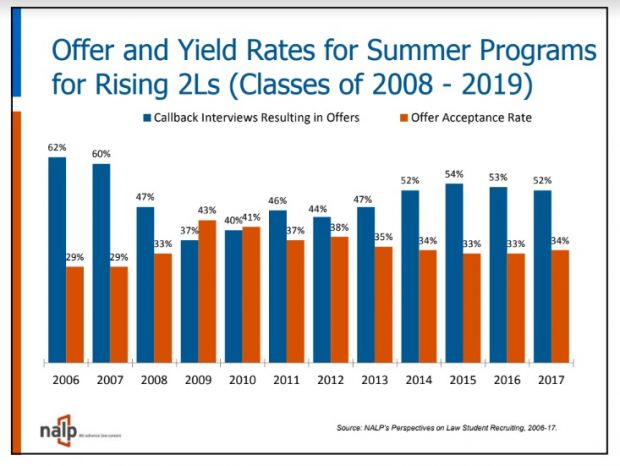
This is not to say that if you go into the callback portion of the recruiting cycle with two interviews, you should be brazenly confident that you will have a job offer by Thanksgiving. I have seen students with a dozen callbacks not get a single offer. Obviously, this is not the norm and likely indicative of a larger problem that student has with interviewing, but it is a possibility — though similarly possible is having a dozen callbacks and getting a dozen offers. If you want to make that 52 percent figure closer to 100 percent, here are some thoughts about how to best conquer the callback interview.
First (and this applies to initial interviews as well), be cognizant of what you are wearing to your callback. As should come as a great surprise to exactly no one with any passing familiarity with the industry, legal employers can skew toward the conservative. This is especially true of Biglaw employers. This does not mean that the halls of this nation’s biggest law firms are filled with attorneys wearing those notorious red Trump hats, but especially for those attorneys in a position of power, they are used to a particular set of sartorial choices for their younger colleagues. For those callback interviewees who identify as male, go with a suit and tie. And this is not the time to scan the runways of Milan or Paris for the newest in men’s fashion. Do not look to Trae Young and invest in a shorts suit.

AI Built for Litigation. Verified by Design.
Grounded in authoritative content and verified at every step, Protégé is the only legal AI tool that delivers work you can trust—without exception.

Dark suit with a white shirt and a subdued tie will ensure that the subsequent conversation about you that will take place once you leave focuses only on your potential as an attorney and not on whether or not you were struck temporarily blind while picking out your clothing for that day.
For those students who identify as women, the choice of what to wear can be a bit more difficult due to the wider array of options. Pantsuits obviously work, but so can a skirt and a blouse with a jacket. While you do not need to don the red and white frocks of GiIead, I will say that I have had more than one conversation with an employer that has focused entirely on whether a female student’s interview attire doubles as club wear. As with male students, this is not the lasting impression a law student should wish to make.
Next, be wary of political discussions. As mentioned above, you will be meeting with a litany of attorneys from a particular employer. Many, if not all, of these interviews are likely to take place in a particular attorney’s office. If you walk in and your eye is immediately drawn to the aforementioned red Trump hat sitting in a prominent position on the bookshelf, your first response should not be, “So, Helsinki . . . what the **** was that?” Try to keep politics completely out of the conversation for the course of the interview. Now, it is entirely possible that the attorney with whom you are meeting decides to interject their own political opinions into the conversation. Your best bet is to either pivot entirely away from the remark, “I think I can better address your previous question regarding my Criminal Law class” or provide an anodyne comment followed by said pivoting. Now I am sure most of the other folks here at Above the Law might disagree with the above, with Elie Mystal, for example, pushing for some light arson in the face of a Trump hat. But they have jobs and you, currently, do not, so your reactions need to be tempered.
Even if politics do not arise, there is a psychological toll that can come from talking to that many people in a day. Especially if you are determined to make each interview a unique experience. The good news is that is not necessary. Employers will give you the names of those attorneys with whom you will be meeting, so go ahead and do your research. In an ideal world, you would have a unique slate of questions for each person that you will meet. But since 2018 seemingly hues much closer to the darkest timeline than to an ideal scenario, you should feel free to reuse some questions. If you are going to meet with a first year associate and then a sixth year, it is perfectly acceptable to ask them both what a typical day is like, since you will likely get widely divergent answers. And while it is always good to have a list of questions ready to ask for any interview, do not worry if your interviewer is taking up a sizeable portion of the conversation. While in an OCI interview that can signal the attorney is trying to run out the 20 minute clock, for a callback interview it is evidence that they are trying to sell you on the firm. One way in which callbacks are similar to OCI interviews is that the attorneys with whom you are meeting are sacrificing a part of their billable day to talk with you; so drop a thank you note in the mail soon after your interview.
The litany of interviews also means your odds of being given an off-the-wall or pop-psychology question increase significantly. Did I once get asked in a callback what sort of tree I would be if I could be any tree? Yes. Did I get an offer from said firm? Yes. Did I take said offer? No. Is that firm still in business? Absolutely not. Some of these questions are the type that can be anticipated and thus practiced, but other questions will seemingly come out of left field. The good news is that, often times, these questions do not have “right” answers. Instead, the employer is trying to gauge your personality from that answer and see how it lines up with their firm. So listen to the question, take a second or two to think of an answer, and then say what comes to mind.
Finally, whereas OCI typically takes place before classes start, callbacks are often overlap with the beginning of classes. While having a large number of interviews can be an enjoyable experience, full of five star hotels and free meals at Michelin starred restaurants — though remember that even though these meals can take place after the formal portion of the callback has been completed, you are still be evaluated by the employer, so probably pass on that second glass of wine — it can be a strain on your coursework, especially if your interviews take you out of town. While some professors can get annoyed if you are constantly missing class, many realize that the ultimate end goal of a law student, shared by the law school, is to be employed at graduation and that callbacks are a vital step in that process. However, be smart when it comes to your schedule. If you have multiple interviews in the same city, group them together. Yes, five separate trips to New York City would be great, but less great is angering your professors, without whose classes you will not be able to graduate. Plus, firms can pool costs if a candidate is visiting multiple firms on the same trip, so no need to also anger your potential future employer by making them pay more than they otherwise would have needed to for your callback. In fact, law firms can get rather competitive with one another for top talent, so if you let them know you are meeting with multiple firms in the same market, you might very well see the charm offensive kicked up a couple of notches.
Making it to the callback phase of the Fall Recruiting Cycle is an achievement in and of itself and something of which you should be proud. It also means you are tantalizingly close to achieving the ultimate goal of summer employment that can very likely lead to full-time, post-graduation employment. Remember that 52 percent of callback interviews lead to offers, so go into the second round with confidence and you may well emerge with multiple offers from which to choose.
Next week, the offer stage.
Nicholas Alexiou is the Director of LL.M. and Alumni Advising as well as the Associate Director of Career Services at Vanderbilt University Law School. He will, hopefully, respond to your emails at [email protected].