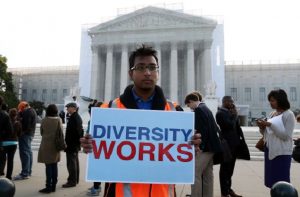
(Photo by Mark Wilson/Getty Images)
We are in the endgame now, for affirmative action in America. And just like in the Avengers, defeating the big bad is just the start of the movie.
Yesterday, U.S. District Judge Allison D. Burroughs ruled that Harvard University’s admission program was a Constitutional application of affirmative action. Her opinion is a beautiful application of prior precedent, as establishing in Grutter v. Bollinger. Plaintiffs, a group called Students For Fair Admissions (SFFA), argued that affirmative action as practiced by Harvard discriminated against Asian-American students. Asian-Americans applying to Harvard have some legitimate concerns (which I have written about). But this trial and case were never really about Asian-American discrimination because the SFFA is a group organized by Ed Blum and other white movement conservatives. Their true goal is to kill affirmative action. Blum doesn’t care about Asian-Americans, he cares about mediocre whites, and so the entire posture of the case was centered around killing affirmative action instead of addressing Harvard’s potential discrimination.

What You Didn’t Learn In Law School
How do you keep up with the competition? Share your perspective in this brief survey to help us benchmark your lifelong training in professional skills. As a thank you, qualified respondents receive a chance to win a $250 gift card.
Technically, Blum failed. If you actually care about why affirmative action is Constitutional, read this opinion. But Blum and the conservatives are playing a long game here. This case was never set up to win at trial, again, the white people pushing this do not actually care about Asian-American concerns. This case was set up to give the Supreme Court an opportunity to end affirmative action on appeal, and that project still very much goes forward.
The problem, for affirmative action, is that the Republican justices on the Supreme Court do not care about Grutter. Republican jurists hate Grutter. Hell, the Republican who wrote Grutter hated Grutter. Sandra Day O’Connor famously said in her majority opinion: “We expect that 25 years from now, the use of racial preferences will no longer be necessary to further the interest [in student body diversity] approved today.” I mean Jesus, she wrote the opinion like a white lady who won’t give a homeless man a dollar but will buy him a sandwich so long as she gets to lecture him about personal responsibility while the dude is trying to eat.
John Roberts is the kind of cat who thinks killing affirmative action ten years earlier than O’Connor predicted makes him smart. Don’t forget, Roberts has already declared victory over racism in the South, as he gutted the Voting Rights Act. This dude will gleefully declare victory over racism in college admissions in his never ending quest to make the world safe for mediocre white men everywhere.
And the Republicans have the votes. With Anthony Kennedy ceding his seat to an alleged attempted rapist who has benefited all his life from white privilege yet thinks he’s “earned” it, the Republicans now likely have five votes to kill affirmative action once and for all.

How To Avoid Hallucinations: A Legal Research AI That Works Like A Junior Lawyer
Can we make legal research AI stop hallucinating? The answer is yes – and it’s how attorneys approach legal research with their associates.
What conservatives don’t like about affirmative action is the notion that diversity is actually a goal worth fighting for. But directly arguing that a school shouldn’t want racial diversity is not a legal argument, it’s a Klannish one. So instead, the entire legal debate about affirmative action is fought over the grounds of what is narrowly tailored, and what isn’t, as opposed to whether diversity is good or bad. Only the truly odious conservatives (and, you know, all of alt-right Twitter) say the quiet part aloud and make the frontal case that diversity itself is a bad thing.
So our legal debate about affirmative action proceeds along three grounds, laid out in Grutter: Does a school have a compelling interest in creating a diverse class? Is their race conscious admissions policy narrowly tailored to achieve that legitimate aim? Are their viable race-neutral alternatives to achieve the same result?
Conservatives want to attack the first premise, but they can’t. As Judge Burroughs said in her opinion: “It is somewhat axiomatic at this point that diversity of all sorts, including racial diversity, is an important aspect of education.” Troll level alpha, conservatives. She knows they disagree, but how racist do they want to sound while disagreeing?
The third prong is also fairly straight-forward. SFFA offered a number of “race-neutral” alternatives, and Judge Burroughs knocked them down, one-by-one. If you think that diversity is an important — and Constitutional — goal, then Burroughs showed how these race neutral approach would not lead to classes nearly as diverse as Harvard wants. She wrote: “In considering the proffered race-neutral alternatives, the Court is mindful of Justice Ginsburg’s astute observation that “only an ostrich could regard the supposedly neutral alternatives as race unconscious.” (I’m telling you guys, it’s really a brilliant opinion, if you hate white supremacy and stuff.)
That leaves the narrowly tailored analysis. That’s where Supreme Court Republicans will strike. Judge Burroughs found that Harvard’s admission program is narrowly tailored, and, critically, she found that the admission process does not unduly burden Asian-Americans. In fact, it actually helps some groups of Asian-Americans, namely women:
[T]he Court is unable to identify any individual applicant whose admissions decision was affected and finds that the disparity in the personal ratings did not burden Asian American applicants significantly more than Harvard’s race-conscious policies burdened white applicants. Further, there is no evidence of any discriminatory animus or conscious prejudice. To the contrary, certain statistics can be interpreted to suggest that Harvard’s admissions process unintentionally favored some subsets of Asian Americans, including the ALDCs and certain other discrete demographic groups like disadvantaged Asian females. The most likely causes of these statistical findings, however, is random variation in the admissions process or omitted variable biases, not selective discrimination that favored some Asian Americans and disfavored others.
In terms of burden, it is likely that eliminating consideration of race would significantly disadvantage at least some Asian American applicants, as evidenced by the testimony of the amici at trial, all of whom viewed their race or ethnicity as a critical aspect of their life experiences and applications to Harvard.
The court noted that the SFFA did not put up even ONE Asian-American applicant who could show that they would have been admitted to Harvard but for affirmative action. And the SFFA erased Asian-Americans who believe their lived experiences are a valuable part of their contribution to the campus, and the disregard the beneficial aspects of affirmative action for women — which the anti affirmative action crowd always does because they want people to not know that affirmative action style admissions policies primarily benefits white women.
To the extent that a certain subset of academically high achieving Asian-Americans have a legitimate beef with Harvard’s admissions policies (and, again, I believe they do), their beef is not with the Constitutionality of affirmative action. Making race the ONLY thing colleges and universities can’t consider, while preserving the admission biases that benefit white students, will not help their cause.
But the conservatives have the votes to kill affirmative action now, and they probably will. We are hurtling towards our final battle on affirmative action, and there’s really only one way to save it: Democrats have to win the White House and the Senate in 2020 and immediately pack the Court before this cases percolates up. If Democrats get the power, will they have the will to snap their fingers and change this outcome? If not, you’re going to see a whole lot of black and brown students being disappeared from colleges and universities across the land.
Elie Mystal is the Executive Editor of Above the Law and a contributor at The Nation. He can be reached @ElieNYC on Twitter, or at [email protected]. He will resist.