(Photo by Al Drago/Getty Images)
One of the right-wing talking points about Judge Ketanji Brown Jackson is that, of her almost eight years on the bench, she’s spent less than one as an appellate judge. Leondra Kruger, meanwhile, has seven years of appellate experience, but all on the state level. Drawing arbitrary lines around which judicial experience “counts” and which doesn’t may seem ridiculous, but consider that the hand-waving around the “lesser Black women” argument rests on the idea that “it’s not racist, we just mean there are other potential nominees with more experience.”
But, seriously, how much judicial experience does it take to make a good Supreme Court justice? Professor Steve Vladeck crunched some numbers and history suggests that it’s not much. In fact, some of the most warmly remembered justices of the last century had no judicial experience at all. From the professor’s Twitter account:

Managing Partners are Navigating the AI Inflection Point.
New executive research from Ari Kaplan explores how law firm leaders are responding to changing client expectations, evolving economics, talent transformation, and AI governance.
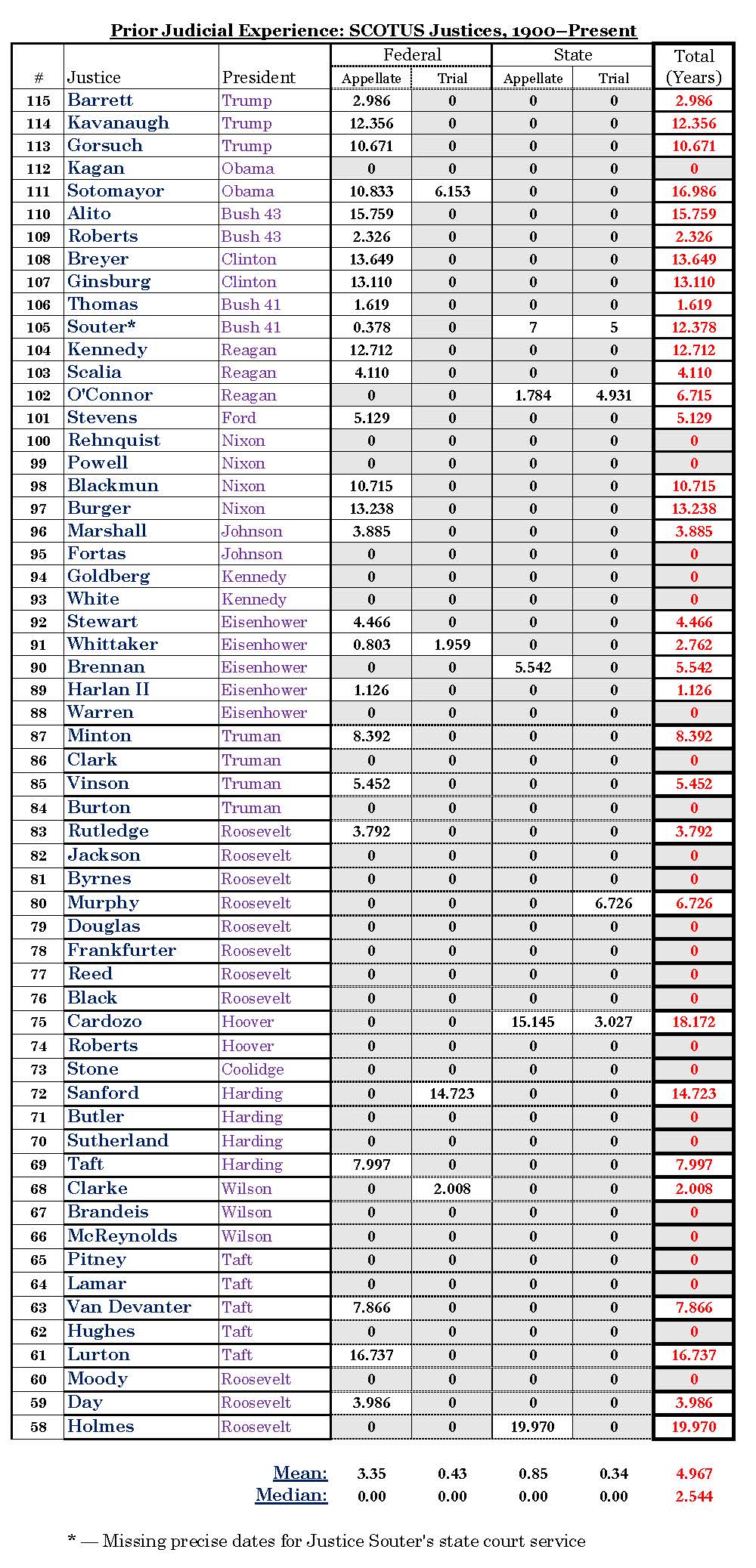
While the run from Rehnquist’s initial appointment in 1972 until Elena Kagan’s elevation from Solicitor General in 2010 (and every nominee since) saw only nominees with judicial experience — even if O’Connor’s had been limited to state court and Souter’s federal experience was limited — before Rehnquist, Supreme Court nominees without judicial experience were quite common. As Vladeck notes, 43.1 percent of nominees had no judicial experience at all and the median prior experience was a mere 2.5 years.
Oliver Wendell Holmes and Benjamin Cardozo boasted nothing but state service. Earl Warren and William O. Douglas had no prior judicial service at all. They turned out all right. That said, Roger Taney also had no judicial experience and worked out… poorly.
But the point is, why all this talk about experience? Because it’s the whole crux of the campaign against the, and I can’t stress this enough, still unnamed nominee.

What You Didn’t Learn In Law School
How do you keep up with the competition? Share your perspective in this brief survey to help us benchmark your lifelong training in professional skills. As a thank you, qualified respondents receive a chance to win a $250 gift card.
Like the beatings that will continue until morale improves, the standards for a judicial nominee will keep shifting until there’s one that excludes all Black women. Both potential nominees listed above have more judicial experience than Amy Coney Barrett… but now it suddenly doesn’t matter. Likewise, after years of conservative nominees exclusively from Harvard and Yale, Justice Barrett’s sub-T14 pedigree is lauded as a virtue the Democrats would do well to model, as soon as the leading Biden nominees graduated from… Harvard and Yale.
Don’t bite on this. The next Supreme Court nominee will have all the requisite qualifications to succeed at the job. For that matter, the next overlooked nominee will also have sufficient qualifications. If anything, maybe try to get someone else on the Court who actually ran a trial and made those calls at some point in their lives — Justice Sotomayor is getting lonely up there.
 Joe Patrice is a senior editor at Above the Law and co-host of Thinking Like A Lawyer. Feel free to email any tips, questions, or comments. Follow him on Twitter if you’re interested in law, politics, and a healthy dose of college sports news. Joe also serves as a Managing Director at RPN Executive Search.