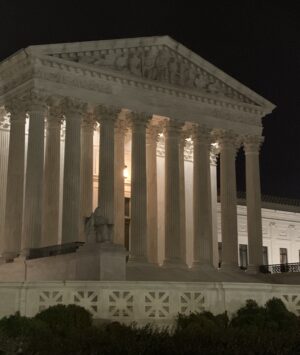
(Photo by Staci Zaretsky)
The majority’s opinion in Trump v. US left me with several questions. Here are just a few of them in no particular order: What in the ever-loving fuck did they just do?! Trump’s legal team didn’t even ask them to go this far — what happened to the Court’s tradition of deciding matters on as limited terms as possible? Is Biden King now? I voted for him: where’s my damn student loan forgiveness, King?!
I wasn’t the only one desperate for answers. Reporters scrambled to get anybody and everybody to give some semblance of meaning to the opinion. Things were so bad, even Ty Cobb got some screen time:

AI Built for Litigation. Verified by Design.
Grounded in authoritative content and verified at every step, Protégé is the only legal AI tool that delivers work you can trust—without exception.
On top of the clear sexism of dismissing Sotomayor’s dismay at the 6-3 decision nixing the threat of criminal consequences for the head of state if they tried to assassinate a political rival as wild hysterics, Cobb here must not have paid attention to oral argument — that’s literally the hypothetical that was posed to Trump’s legal team. It was met with a shrug and a maybe:
Justice Sotomayor: "If the president decides that his rival is a corrupt person and he orders the military…to assassinate him, is that within his official acts for which he can get immunity?"
Trump’s Lawyer: "That could well be an official act."
– Trump v. US, oral arguments pic.twitter.com/6hOzZ3WFPN
— Keith Boykin (@keithboykin) July 1, 2024

Why Experience Still Matters In An AI-Driven Legal Industry
A conversation with Trustpoint.One CEO Christopher Gallagher.
The good news is that Cobb was immediately followed by Laurence Tribe. The bad news is that Cobb isn’t the only fool with a platform spreading misinformation about what this ruling means to a general public desperate for information. There’s a slew of bad takes running free on Twitter, here are just a few of them:
https://twitter.com/debc17593354/status/1807791452803539130
For starters, Supreme Court justices aren’t disposable employees on day 6 of their 90-day trial period. Lifetime appointment is lifetime appointment, and while the Christian 6 may very well have given King Biden the go ahead to assassinate a couple justices to free up some seats if he can tie it back to an official act, he does not have the power to reinterpret the Constitution to serve his political ends: that authority got stolen from the Executive and Legislative branches way back in 1803 with Marbury.
But hey, who needs constitutional knowledge to process what the Supreme Court just did? All you really need is some contract know-how!
While in the Army, as a 12P (Prime Power Production Specialsit) part of my job was being a Contractor’s representative for the core of Engineers. My job was to ensure the contractors would follow the contract. I understand how important wordage is.
I also served on a board to…
— Shane (@RealShane80) July 1, 2024
Oh?! Since the Court used the “right words,” we as the American public are safe so long as the President just does what’s right and steers away from what’s wrong? It all makes so much sense now! …Right up until you remember that the whole Watergate thing — which pretty much everyone agreed was wrong — would be facially a-okay under the Court’s “bold and unhesitating” approach to heading the Executive. It doesn’t take long to hear how concretely Nick Ackerman and Mary McCord’s rationales for why Nixon’s actions weren’t permissible fly in the face of the Court’s new stance on presidential immunity:
Any lawyer worth their salt knows that the wiggle room that the Court left in the Trump decision makes for a world of difference:
https://twitter.com/draculavoice/status/1807816818377023531
And while Biden swore not to use the new authority the Court just vested in him, Trump’s camp has made no such promises:
Scharf: We believe the assembly of those alternate slates of electors was an official act of the presidency. pic.twitter.com/JNczpFCSJZ
— Acyn (@Acyn) July 2, 2024
It isn’t much of a stretch to argue that the vagueness is there by design:
The point of Roberts not telling us what "unofficial" or "official" actually means is that it gives him leeway to make it up later, depending on who wins the next election. https://t.co/6aocS0Zhhv
— Elie Mystal (@ElieNYC) July 1, 2024
For what it’s worth, this may be one of those times when the right response to seeing someone be loud, confident, and wrong in a public setting is to give some grace. We’re living through unprecedented times! Well, maybe not, parallels have been made between this moment and the 1933 Enabling Act:
Reminder—Trump had expressed executing people on many occasions while President, according to his own Attorney General. Now the Supreme Court has green lit any official act with full presidential immunity. Germany did the same in 1933. It turned out great.pic.twitter.com/RCusBGtCoN
— Eric Feigl-Ding (@DrEricDing) July 2, 2024
But what we’re fundamentally dealing with is above the law. And not even in the cliche, dramatized manner that will be shoved down our throats to throttle engagement. Structurally so. Lawyers may not even be the proper experts to consult on understanding the regime we now live in:
I mean, at a core level, listening to us lawyers is of no more use here. We are beyond "law." We are beyond principles we studied or researched.
We can only tell you what they've done. Experts on fascism and authoritarianism can tell you how to stop the Court. https://t.co/NVsXKnEKOz
— Elie Mystal (@ElieNYC) July 1, 2024
To that end, there are probably two practical places for us to look to on guidance. The first would be the lower courts. Judicial review remains in the Judiciary’s hands, further elaboration on what constitutes an “official act” and what isn’t could create some clear guidelines on what presidential accountability looks like. Maybe three Supreme Court justices will have a change of heart and reverse this decision before things get really bad. The other place? I’d recommend Carl Schmitt or Giorgio Agamben’s writings on the state of exception for a deeper understanding of sovereign unaccountability and its consequences.
 Chris Williams became a social media manager and assistant editor for Above the Law in June 2021. Prior to joining the staff, he moonlighted as a minor Memelord™ in the Facebook group Law School Memes for Edgy T14s. He endured Missouri long enough to graduate from Washington University in St. Louis School of Law. He is a former boatbuilder who cannot swim, a published author on critical race theory, philosophy, and humor, and has a love for cycling that occasionally annoys his peers. You can reach him by email at [email protected] and by tweet at @WritesForRent.