
As soon as we all cracked the code and identified Judge Eleanor Ross of the Northern District of Georgia as the unnamed judge in a wild judicial discipline case about sex in chambers and then lying to investigators about it, the countdown to impeachment began. While the sex brought a salacious dimension to the case — and introduced a real risk of judicial extortion — the gravest sin for a federal judge was lying to investigators. Respecting an investigation and telling the truth should be bare minimums for a judge.
That and knowing how to park.
Freshman Rep. Clay Fuller (R-GA) just dropped a single article of impeachment seeking the removal of Judge Ross. To Fuller’s credit, he pushes the other headline-grabbing allegations aside and laser-focuses the impeachment effort on giving false and misleading statements. A judge who lies to the judges investigating her speaks to a contempt for the process she’s trusted to administer.

Managing Partners are Navigating the AI Inflection Point.
New executive research from Ari Kaplan explores how law firm leaders are responding to changing client expectations, evolving economics, talent transformation, and AI governance.
That’s the most damning behavior for a federal judge and should be the entire focus of the effort. But because the House of Representatives are the gang who can’t shoot straight, the impeachment effort already stumbled out of the gate.
Courtney Bublé of Law360 posted the full impeachment resolution on social media, but this is the relevant part:
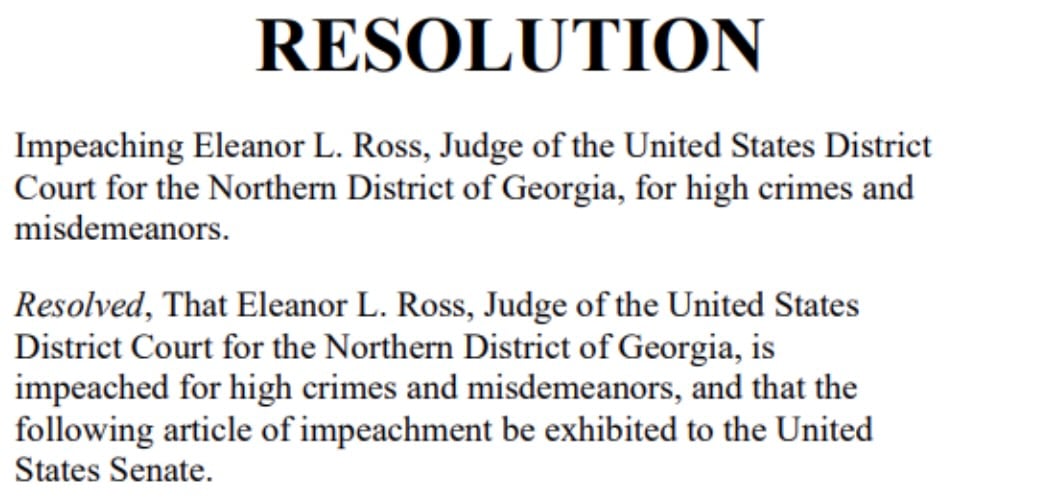
This is not lying to the FBI during a criminal probe — you know, the sort of behavior that Republicans not only excuse but spend taxpayer dollars to compensate people for committing. That’s at least a real crime. Lying to an internal judicial investigation is improper and unethical, but hard to sell as a crime, let along a “high” one. But the good news is HIGH CRIMES AND MISDEMEANORS IS NOT THE STANDARD.

Why Experience Still Matters In An AI-Driven Legal Industry
A conversation with Trustpoint.One CEO Christopher Gallagher.
If you want to impeach a president, you need to find a high crime or misdemeanor. That’s right there in Article II, where the Constitution lays out the rules governing the Executive branch. But judges don’t enjoy that heightened standard. That’s what Article III means when it declares that federal judges “shall hold their Offices during good Behaviour.” That language may be most famous as the (possibly dubious) basis for life tenure, but its real origins are as a standard for impeachment. This dates back to the same Ye Olde English legal tradition that we’re told to privilege whenever it comes to deciding if women have rights, but gets lost when trying to divine what the Framers meant when they said, “hey, let us consciously copy English tradition here.”
Judges don’t need to commit a high crime like, just spitballing here, actively egging on a violent assault on Congress, to be impeached. Congress can remove a judge from office for mere bad behavior, and yet Congress continually tries to square peg/round hole conduct like being a drunk into a high crime.
Even if one wants to believe lying to fellow judges constitutes a high crime, why place a higher threshold on the effort than necessary? The resolution even goes on to state in the next paragraph that Ross was “commissioned to serve during good behavior in office.” Well, this is no longer good behavior.
The tortured mental gymnastics required to spin office sex and lying to your coworkers as a high crime isn’t necessary. National Review is trying to sell Judge Ross lying to a disciplinary inquiry as a violation of 18 U.S.C. §1001. For what it’s worth, the exact same authors of this National Review piece previously offered side-eye to the idea that it could be a high crime or misdemeanor to obstruct an investigation into someone ultimately guilty of 18 U.S.C. §1001. Apparently though, for purposes of this impeachment, “it’s obvious that Ross is guilty of a felony.” There’s just no reason to port Article II’s impeachment clause language here. If it covered the judges it wouldn’t be sitting in Article II. There’s a term — “good behaviour” — with a centuries-old interpretation as a lowered standard for impeachment. Take the path of least resistance, fellas.
Of course, there might be a reason why the House GOP has a vested interest to claiming a high threshold for judicial impeachment. Mere bad behavior would seem to cover activity like, oh I don’t know, collecting half a million in gifts from wealthy donors or taking undisclosed luxury vacations from parties with issues before the Court. If the standard for impeaching a judge dips below the high crime level, it gets a lot harder to claim the conservative stalwarts on the Supreme Court should get to keep their jobs.
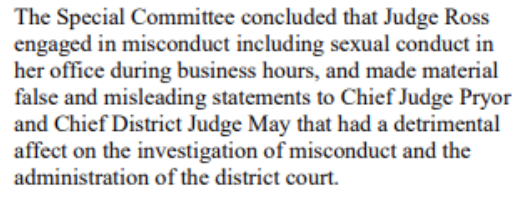
Now… here’s a question: if Judge Ross committed a high crime — and if it’s so “obvious that Ross is guilty of a felony” — what’s the House GOP’s take on Chief Judge Pryor and the Eleventh Circuit and the Judicial Conference Committee on Judicial Conduct and Disability? If this was such a crime, then those judges issuing a private reprimand in a bid to actively conceal Judge Ross’s identity from the public amounts to at least aiding and abetting. Like, if you really believe that’s what Judge Ross did, then the response of all the other judges involved would be at least if not more reprehensible because they functionally conspired to keep an “obvious felon” on the bench. It’s time for articles of impeachment against all of the judges involved in the investigation, isn’t it?
Or, we can just agree this wasn’t a felony, but nonetheless impeachable bad behavior.
Earlier: Federal Judge Had Sex In Chambers Bringing New Meaning To Gavel Bang
Judiciary Tried To Hide ‘Sex In Chambers’ Judge’s Name. It Left A Roadmap To Identify Eleanor Ross Instead.
 Joe Patrice is a senior editor at Above the Law and co-host of Thinking Like A Lawyer. Feel free to email any tips, questions, or comments. Follow him on Twitter or Bluesky if you’re interested in law, politics, and a healthy dose of college sports news.