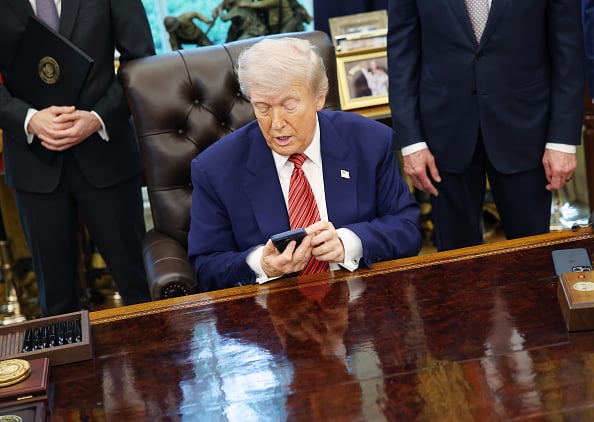
I understand: The Supreme Court has decided Trump v. Slaughter, and independent agencies are no longer as independent as they were last week. President Trump is now empowered to fire at will employees of formerly independent agencies. Trump can remake the government in his own image. Patronage and incompetence! That’s not a pretty picture.
Got it.

Managing Partners are Navigating the AI Inflection Point.
New executive research from Ari Kaplan explores how law firm leaders are responding to changing client expectations, evolving economics, talent transformation, and AI governance.
But stop fixating on the past. Turn your gaze to the future.
It’s indisputable that Congress has the power of the purse. Article I, Section 9, Clause 7 of the Constitution provides that “No Money shall be drawn from the Treasury, but in Consequence of Appropriations made by Law. …’
If Congress controls the money, then Congress still has power to control independent agencies.
I present today only an inchoate thought. I’ll let others — aggressive political insiders — think more seriously about it. But here’s the acorn that others can nurture into a fully grown tree: Congress should pass laws that use the power of the purse to mold independent agencies and thus restrict the president’s actions.

Beyond Recall And Precision: Strategic Oversight Of AI Managed Review
AI can accelerate document review, but metrics alone aren't enough. Learn how Managing Attorney oversight turns AI-driven review into a more adaptive, strategic and defensible process.
Congress could create an independent agency, for example, and write into the law that, “If the President fires more than six people from the agency, all funding for the agency will cease immediately.”
I admit that my proposed law has a few problems. As just one example, my law permits the president to eliminate an agency entirely simply by firing a few employees. But the president already has the power to eliminate agencies that he doesn’t like. Just last year, the president, aided by a soon-to-be trillionaire, chose to feed the U.S. Agency for International Development (USAID) into the woodchipper. What’s the difference between an agency losing funding and an agency losing all of its employees? The agency’s out of business either way.
Nevertheless, if you’re unhappy with my proposed law, maybe we could fine-tune it a little bit. How about: “If the President attempts to fire any person from the agency without good cause, then all funding for the agency will cease immediately.” That protects agency employees from being fired at the president’s whim. It imposes the “good cause” standard for firing that everyone’s now saying is imperative. The remedy might be a little harsh — ending all funding if the president tries to fire a single person without good cause — but you get my drift.
Further fine-tuning could hammer my broadsword into a rapier: “For each person that the President attempts to fire from the agency without good cause, 10% of the agency’s funding will cease immediately.” That’s a little more moderate.
Or Congress could choose to aim the power of the purse at the president, rather than the agency: “If the President attempts to fire any person from the agency without good cause, then the travel budget of the President will cease immediately.” That should get the executive’s attention (and keep him from flying to Mar-a-Lago every weekend on the public’s dime).
I’m sure there would be legal — perhaps constitutional — challenges to laws of this sort.
But Congress shouldn’t lightly give up a power that it’s had for nearly 100 years. If Congress cares about its authority, then Congress should stand up for itself.
If Congress is afraid of the president having too many opportunities for patronage, then basically outlaw them.
If the current Congress is too timid to enact these sorts of laws, then future Congresses, more willing to stand up for the rights of the legislature, could pass them.
But now’s not the time simply to bemoan our fate.
If Congress and the public are unhappy with the result in Slaughter, slaughter it.
Mark Herrmann spent 17 years as a partner at a leading international law firm and later oversaw litigation, compliance and employment matters at a large international company. He is the author of The Curmudgeon’s Guide to Practicing Law and Drug and Device Product Liability Litigation Strategy (affiliate links). You can reach him by email at [email protected].